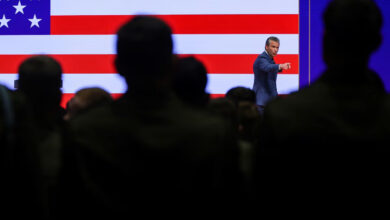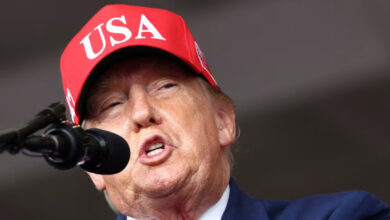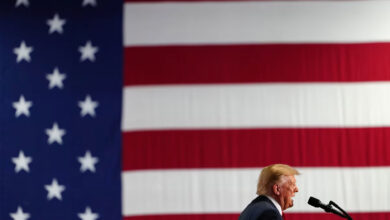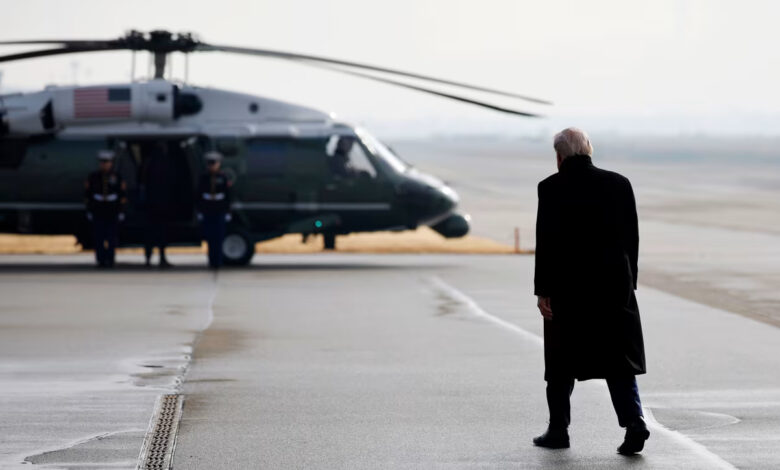
President Donald Trump’s climbdown on Greenland capped one of the most erratic episodes involving a modern president on the world stage.
Within hours Wednesday, Trump flipped from demanding “right, title, and ownership” of the semiautonomous Danish territory to celebrating an “infinite,” “forever” framework deal over its future.
But he won’t say what’s in the breakthrough. It seems to hinge on extra NATO forces to secure the Arctic — something he could have got before his week of mayhem — if only he’d asked.
And there’s no sign he’ll return home from the World Economic Forum in Davos with the deeds to a vast, icy land on which he can plant the Stars and Stripes. NATO Secretary General Mark Rutte said on Fox News that the question of Danish sovereignty over Greenland didn’t even come up during a meeting with the president that will bolster the smooth Dutchman’s reputation as a “Trump whisperer.”
But Sweden’s Deputy Prime Minister Ebba Busch warned the storm may not yet be over.
“Today’s progress might be tomorrow’s headache,” Busch told CNN’s Jim Sciutto on “The Brief.” “It’s still too soon to tell what this deal really entails.”
Farcical scenes unfolded after Trump flung days of insults at allied leaders, raising fears that NATO was about to implode. His initial refusal to rule out sending troops to take Greenland — which is already alliance territory — seemed torn from a bad futuristic thriller.
Trump further confused the issue with several days of rambling and baffling public appearances in Washington and Switzerland. On Wednesday, he even got Greenland and Iceland confused.
He’s always governed by whim and social media outbursts. But in extricating himself from a crisis that he triggered, Trump laid bare the alternative factual reality that surrounds his increasingly unpopular presidency.
And one of the most perplexing episodes so far of Trump’s two terms will deepen concern about where his volatile moods will lead the nation and the world in the next three years.
“My message to President Trump and the Trump administration is: It’s time to come to your senses and calm down,” Busch said.
“I’m not going to change my policy tomorrow in a new tweet.”

Two dueling realities
On conservative media, Trump was again being lionized as the master strategist playing 4-D chess who staked out a maximalist position to pressure feckless Europeans into a “deal.” This line of argument relies on the belief that the president threatened Europe with the implicit breakup of NATO and devastating tariffs, thereby securing stunning concessions.
This is hard to take seriously because there is no sign Europe gave Trump anything, nor that he secured Greenland as an addition to US territory as he demanded. In any case, under existing treaties with Denmark, Washington has long had the capacity and right to send any military assets that it wants to reinforce the world’s largest island.
Outside the right-wing bubble, Trump is being mocked for another “TACO” (“Trump always chickens out”) moment after dropping the threat of tariffs on European nations until they agreed to give him Greenland. Just as with his “Liberation Day” tariffs, the president may have been spooked by the result of his own actions.
The president couldn’t even explain the deal he claimed to have clinched. When he was asked by CNN’s Kaitlan Collins whether the agreement meant the US would own Greenland, there was a prolonged pause before he insisted it was the “ultimate, long term deal” and would be “infinite.”
In an interview on CNBC, the details were equally foggy as Trump boasted about “the concept of a deal” after talking to Rutte. “It’s a little bit complex, but we will explain it down the line,” the president said, but revealed that this was for “forever,” showing a barely believable lack of grasp of detail for a commander-in-chief.
Former US Ambassador to Ukraine William Taylor told CNN’s Erica Hill that Trump was right in one sense when he said the proposed deal would make everybody happy. “It does make people happy because we can get off talking about this non-problem. Now we can get back to what really matters and that is getting peace in Ukraine,” Taylor said.
Wednesday’s head spinning events in Davos, Switzerland, were not the only controversy raising concerns about the 79-year-old president’s mindset and the long-term damage that his behavior may wreak on US national interests.
His plans for a Board of Peace that he said might replace the United Nations also came into focus in Davos. The $1 billion joining fee for member states who want permanent membership recalled the dues at one of his private clubs more than a bona fide international diplomatic institution. Then it emerged that Trump had asked Russian President Vladimir Putin to join, despite his butchering of civilians during his illegal invasion of Ukraine. “Yeah, I have some controversial people on it, but these are people that get the job done,” Trump said.
The small print for the peace board underscores the absurdity of the idea. It implies, for instance, that the president would continue to run the club, directing global diplomacy, even after he’s left the White House. Several US allies have distanced themselves from the plan since it implies the eclipsing of the United Nations. Yet in Trump’s mind, it’s “the greatest board ever assembled.”

New questions raised over America’s destiny under Trump
There are several significant takeaways from the Greenland storm.
The first is that Trump’s conduct of foreign policy is becoming ever more narcissistic and illogical. The odd twists and turns over Greenland may tarnish the image of a steely commander in chief he’s cultivated, in particular after a special forces raid that extracted Venezuelan dictator Nicolás Maduro.
The Greenland crisis was largely driven by a personal presidential obsession. He told the New York Times that owning the vast island was “psychologically important for me.” He then implied in a text message to Norway’s prime minister that he was owed Greenland as a sort of participation trophy since he was not awarded the Nobel Peace Prize.
The Pentagon never revealed tangible plans to move on Greenland. But Trump’s tempestuousness and second-term belligerence mean no one could be sure. Many outsiders doubted that Trump would strike Iran’s nuclear program last year or that he would oust Venezuela’s president — but he took on the risks and built credibility for his threats.
Trump’s bitterness towards allied leaders was also remarkable. In recent days, he’s savaged British Prime Minister Keir Starmer, French President Emmanuel Macron and Switzerland — although he praised its prowess in watchmaking. He delivered a dark warning to Canadian Prime Minister Mark Carney, who a day earlier had warned in a speech that the US had caused a “rupture” in the international system.
“Canada lives because of the United States,” Trump said. “Remember that, Mark, the next time you make your statements.”
It goes without saying that none of this is normal presidential behavior.
Trump also raised fresh doubts about whether he’d honor NATO’s Article 5 mutual defense guarantee if he didn’t get Greenland. “They have a choice. You can say ‘yes’, and we will be very appreciative, or you can say ‘no’, and we will remember,” Trump said in his Davos speech.
Trump has been justified in his past complaints that NATO members were taking advantage of US military support by tanking their own defense budgets. But his antipathy in recent weeks may have further weakened the alliance. In fact, he’s justified the growing understanding among fellow alliance members that the Western alliance is waning because of unstable American leadership.
Still, Trump did ultimately back down.
Following his weekend threat to tariff European states into handing over Greenland, a stock slump hit the previously soaring 401k accounts which he uses as a barometer of his economic performance. Global stocks bounced back when he walked back his tariff threats. When the inevitable next controversy emerges, Europe may again be willing to threaten to mobilize its trading might to calm the American bully — especially in a midterm election year when US voters are already hypersensitive to new economic upsets.
For Europe, one lesson from this saga will be that by standing together and standing up to Trump they appear to have forced him to back down. Before now, only China among foreign nations had halted him in his tracks by using its rare earths trump card to ice his trade war.
Previously, European leaders flattered and genuflected to Trump to avoid his wrath. What a failure. His tariff threat to Britain over Greenland showed that last year’s royal visit might have touched the president’s heart in the moment, but it left no half-life of goodwill.
European solidarity behind Denmark, meanwhile, was an object lesson of Carney’s call in Davos for “middle powers” to stick together, in a speech likely to be remembered as the first credible blueprint for the West’s post-American era.
But this will not be the last confrontation stirred by the White House’s determination to rule by strength and force.
Still, after Trump backed down, the idea of NATO-on-NATO conflict has receded. He can add another data point to the ever-lengthening list of wars he claims to have ended.