Four years of war in Ukraine has brought seismic evolution to the world – to the nature of warfare, the balance of global powers, and to European security.
For Ukraine, the war has been a curse – a curse to survive and adapt long enough to spare Europe’s borders from Russia’s forces and absolve its allies from springing into greater action.
Kyiv is paying the price of the upheaval with constant churn and relentless loss, Ukrainians told me. “Some of us are still positive, but just because there is no other option,” texted a military intelligence officer.
It is the Ukrainians in this fight who wish most urgently the war would really end tomorrow. It is a cruel paradox: Many in the West also wish the war would stop, because of its cost to their defense budgets and heating bills. Yet it is the West’s lack of spending – of material support for Kyiv – that has condemned Ukraine to fight on.
Europe’s is a false economy, spending less now, but risking spending far more if the conflict spreads in the future.
Were Ukraine’s front lines to collapse and Kyiv to fall, Moscow by most Western estimates would soon move to NATO’s borders. Yet that threat does not panic Europe into wholesale action. The first three years of big-dollar American support only went so far and is now over. But the war is not, and more anniversaries likely lie ahead. A full four years in, Russian President Vladimir Putin’s display of ruthlessness and determination seems to have left Europe more convinced that he might just one day stop seeking to occupy foreign lands, rather than less.
Oddly, exhaustion – that of Russian budgets and manpower – is both what the West hopes will end the war and the emotion through which it often sees it. Yet, as each year passes, the war has brought radical change globally.
Diplomatic disorder

This disruption is relentless, and can be hard to catalogue, but let us begin with diplomacy. US President Donald Trump’s dismissal of decades of norms in negotiation – the over-laden formats of red lines and agendas, that for decades have been the mechanisms of how peace begins – marked a new, disruptive approach. It should be judged not by how much it eviscerated the established order, but by results alone.
And at present, those results are scant. A red carpet for Putin, who faces a war crimes indictment, in Alaska. Some tough sanctions on Russian oil. Two patchy, short ceasefires limited to energy infrastructure. Emotional rollercoasters for baffled European allies. And the persistent drumbeat of threats against Kyiv if it does not compromise. But no peace in 24 hours, as Trump once boasted – or in 100 days, or even in a year.
Trump’s Secretary of State Marco Rubio even admitted at this month’s Munich Security Conference that the US does not know if Russia really wants peace.
But no new repercussions for Moscow appear imminent, even as the latest trilateral talks in Geneva ended after two hours with no public progress. The loop of new venues, formats, agendas and personae for peace talks seems infinite.
Drones revolution

The automation of warfare in Ukraine is the evolution that may endure the longest.
Attack drones filled urgent gaps in Ukraine’s infantry defenses and artillery stocks in late 2023. The country began a starkly successful race for ingenuity and hi-tech to survive; the pace of change and implementation unparalleled in a six-week innovation cycle of the front line – the time in which a new idea for killing appears.
The advances are perpetually chilling: Reports emerged earlier this month of Russia using drones with motion sensors that fly into the battlefield, and simply wait for infantry to pass them, before detonating.
The revolution in automated killing is yet to be fully understood outside of frontline bunkers and has left Western militaries scrambling to adapt.
Europe redefined

The war has also redefined what it means to be European.
The NATO alliance, and security on the continent, was founded on the promise the US would, ultimately, again, defend Europe.
However fast the Trump White House seeks to erase that assurance, Europe remains slow to pick up the slack. Centrist leaders in the United Kingdom, France and Germany resist spending a larger percentage of their strained budgets defending against a Russian threat that their far-right populist opponents might think can be easily negotiated away.
Aid to Ukraine is slow and increases in NATO defense budgets to 5% of national income are pledged for nine years from now – when few current leaders will be in power.
Even with Russian drones straying into European airspace, and repeated Russian-linked sabotage on the continent, Western officials cling to a narrative that Russia’s time is running out – that it is edging towards a military manpower or economic collapse.
There is evidence to support that, Western officials correctly insist, as they did in 2024, and last year. But until this probable turmoil suddenly erupts to the surface of Russia’s closed society, a collapse still remains a Western hope, rather than a strategy.
US renounces global leadership

The global balance of power meanwhile has been distorted, with the US stepping back from the obligations of supremacy.
World powers pursue their own agenda in Ukraine. China has held back from providing enough military support to guarantee Russia’s victory. But it buys enough oil and sells enough dual-use drone equipment to keep Russia afloat, as Moscow slowly becomes the junior partner in the relationship. India, for decades the Americans’ Asian ally of choice, has bankrolled Moscow for years, buying cheap oil, and may only be slowing because of a larger trade deal with the US.
Europe has been all but abandoned by Trump to plot its own course, dismissed as nearing “civilisational erasure” recently by Rubio. The US is moving from global supremacy to a new era where its goals are reduced and local, and its allies chosen around myopic prejudices and ideological compatibility. The White House’s National Security Strategy refers to “other great powers separated by vast oceans” – likely China, India and Russia – a gentle shorthand for the demise of American global reach and dominance.
Shock, exhaustion and bravado for Ukrainians

These profound changes are not academic or conceptual to Ukrainians, for whom they spell cold, anxiety, pain, grief, loss or even death. Even after four years of trauma that should numb, shock is still palpable.
Katya, a military intelligence officer who I first met during the 2023 summer counteroffensive that failed, never misses a chance to boldly smile as she is shifted between peaks of chaos on the frontline. CNN is using a pseudonym for privacy reasons. She carries a revolver. A medic close to her killed himself 18 months ago; death shrouds most of her days. Every time my message gets a blue tick, showing it has been received, I feel relief she is alive.
“The war becomes a game but there is no choice but to insert another coin and play another round,” she texted me, troubled by the efficiently lethal Russian use of new drone technology, but also their cruel deployment of donkeys, and foreign mercenaries from Nepal, Nigeria, Syria.
Ukraine’s manpower shortages irk her, as does the criticism of strongarm recruitment efforts.
“Exhaustion is huge now,” she said. “Rarely does our society talk about how tired those must be who fought, with no rest, all these years.” Low-skilled commanders, who are “mostly inexperienced and too self-confident” are a growing problem, causing “unnecessary casualties and conflicts,” she said.
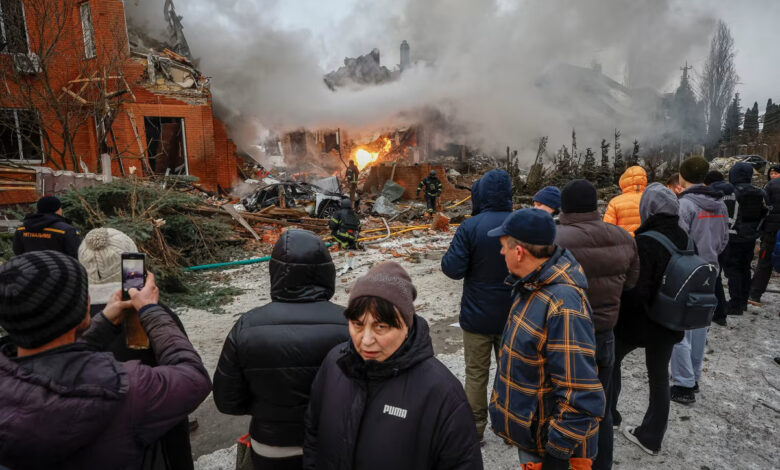
The front lines are moving fast for civilians too. Yulia used to work in a hotel in Kramatorsk – a key military hub on the Donbas frontline – where we often stayed, before it was half-demolished by a missile. She remained in the city, working at a café, even as the streets endlessly echo with sirens. A week ago, she seemed bullish her town would never fall, even with the Russians only seven miles away, saying that “life goes on, the restaurants, barber shops and supermarkets are still open.”
But after a week in Kyiv, she returned to find small attack drones frequently hitting cars and apartment buildings, with huge Russian airstrikes on the outskirts. “I hope that Kramatorsk will not be occupied,” she said, “but given the shelling, it will be tough.” She is moving fast now to the nearby city of Kharkiv, the last of her family to leave. Her boyfriend has just been drafted, to serve thankfully, for now, at a checkpoint. “Everything is changing very quickly,” she said.
One senior Ukrainian official still speaks of his shock that Russia, a so-called “brotherly nation,” entwined societally so deeply with Ukraine, actually invaded. “Perhaps the greatest shock is that (the invasion) happened at all,” he said. He asked not to be identified discussing personal opinions.
The race to evolve drone technology fast enough means Tymur Samosudov finds “it’s impossible to relax even for a minute.” Nothing that works today to hit the Russians will work next month. He ran one of the first drone units I saw in late 2023 and now launches efficient interceptor drones to tackle the Shaheds that plague the southern city of Odesa. His celebration of an imminent new arrival closer to home used two of his combat drones in a gender reveal party that sprayed out colored smoke over the shoreline skies: pink, for a girl.
Samosudov said a lack of infantry was causing slow territorial losses because on the front lines Ukraine was outnumbered by “one to 20. This is very critical and painful.” But Ukraine’s technological advances, he said, meant “the enemy is suffering thousands of casualties every day.”
His bravado is less for show than born of existential necessity. “Ukraine is invincible because we will do everything for our victory, whether anyone helps us or not,” he said.
There is little choice but to believe. The war has torn up a fifth of the country, but even with scant, erratic assistance, Ukrainians must emerge from the dust, to be applauded by the West, and go it close-to-alone again.