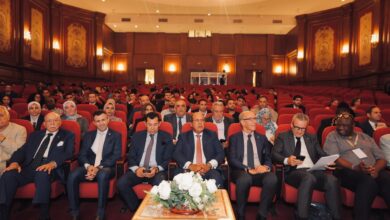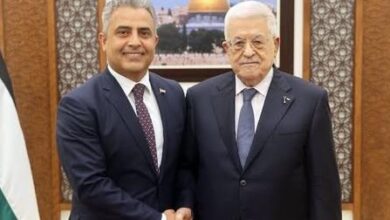
Egyptian Foreign Minister Badr Abdelatty met on Wednesday with his South Sudanese counterpart, Ramadan Mohamed Abdallah Goc (Simaya Kumba), to discuss the Nile Basin Initiative (NBI) – a framework currently at the center of a profound diplomatic rift between Egypt and Ethiopia.
According to the Egyptian Ministry of Foreign Affairs, the ministers held extensive talks on the Nile River issue.
Minister Abdelatty emphasized the necessity of fostering cooperation and mutual benefit among riparian states in accordance with international law.
He specifically highlighted the principles of prior notification, consultation, and the “no-harm” rule, while reiterating Egypt’s rejection of unilateral measures.
Abdelatty affirmed Egypt’s support for the NBI and the ongoing consultative process aimed at restoring “inclusivity.”
He called for continued coordination with South Sudan to enhance consensus, preserve the river’s sustainability, and maximize its resources as a driver for joint development across all basin countries.
Furthermore, he noted Egypt’s full support for efforts to achieve security and stability within South Sudan.
A decade of gridlock
The NBI, launched in the late 1990s, has become a flashpoint for disputes between Cairo and Addis Ababa.
Ethiopia has sought to reshape the regional framework through a new agreement that lacks unanimous consensus, leading Egypt to suspend its participation in 2010 due to disagreements over water allocation and attempts to establish a new status quo.
Earlier this week, Egypt’s Minister of Water Resources and Irrigation, Hani Sewilam, stated that Egypt remains committed to the NBI as the only comprehensive framework capable of uniting all ten Nile Basin nations.
However, he clarified that the consultative process—launched by the Nile Council of Ministers to address the concerns of states that have not joined the Framework Agreement—represents the “only practical path” toward a new era of cooperation that includes all parties.
The Cooperative framework agreement
The NBI eventually produced the Cooperative Framework Agreement (CFA), which remained in limbo for over a decade due to a lack of sufficient ratifications.
It officially entered into force in October 2024 following South Sudan’s accession.
Egypt remains staunchly opposed to the CFA.
Immediately following its implementation, Cairo declared that it “will not concede a single cubic meter of Nile water” and officially stated that it “does not recognize” the agreement.
The Nile Basin Commission currently includes Burundi, the Democratic Republic of the Congo, Egypt, Ethiopia, Kenya, Rwanda, South Sudan, Sudan, Tanzania, and Uganda, with Eritrea maintaining observer status.