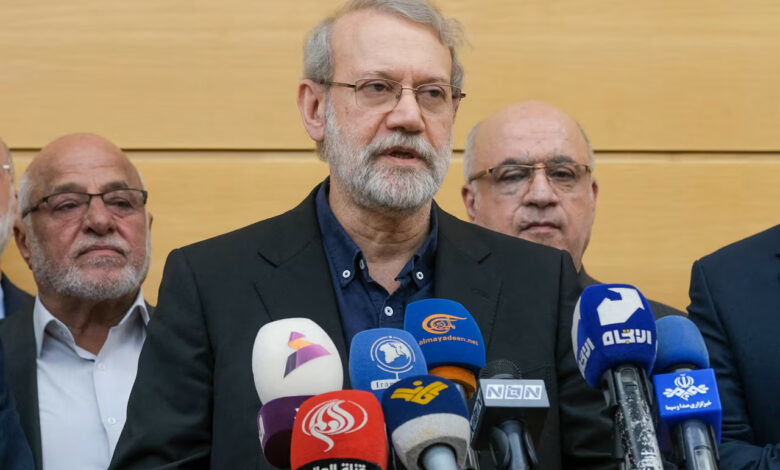
Ali Larijani, the head of Iran’s National Security Council whom Israeli Defense Minister Israel Katz said was “eliminated” Monday night, had emerged as one of the most important figures in Iran in recent months.
First he was seen as significant leader in the suppression of popular protests in January and then as part of the transition that followed the death of Supreme Leader Ali Khamenei.
The 67-year-old had a long association with the Iranian Revolutionary Guards Corps (IRGC) and has become a visible emblem of the regime – even taking part in a public rally last week in Tehran despite being a prime target for Israel.
Larijani has skillfully navigated the politics of the Islamic Republic – serving in a variety of roles. He was a commander in the IRGC during the war with Iraq in the 1980s before transitioning to political roles.
Larijani served as the head of the state broadcaster, Iran’s chief nuclear negotiator and speaker of Iran’s parliament (for 12 years until 2020) – and increasingly had the ear of Khamenei on security issues after his appointment as an adviser in 2004.
After last year’s conflict with Israel, he returned to prominence as head of the National Security Council, regarded by many analysts as the top decision maker of Iran.
Larijani comes from an influential clerical family in the Islamic Republic. One of his brothers, Sadegh, is an Ayatollah and former head of Iran’s judiciary.
He was also an established academic. Trained originally in mathematics and computer science at Sharif University of Technology, he has a doctorate in philosophy from University of Tehran and wrote extensively about the work of German philosopher Immanuel Kant.
Analysts say that while Larijani was seen as a pragmatist rather than an ideological hardliner, he is committed to the survival of the Islamic Republic as Iran’s nezam – or system of government.
Since the beginning of the conflict Larijani has frequently goaded US President Donald Trump and been instrumental in devising Iran’s war strategy, according to analysts.
“Unlike the United States, (Iran) has prepared itself for a long war,” he posted on X soon after the conflict began.