In Israel’s northern-most town, Daniel Dorfman knows his pizza shop will be mostly empty all day, just like it has been for weeks. A few customers dine at two tables in the corner. The rest of the restaurant, much like the town it’s in, is deserted.
Perched on a finger of land that pokes into Lebanon, Metula is usually crowded with tourists this time of year. Built more than 130 years ago, the town was once called “Europe” for the hotels and restaurants that lined its main street, HaRishonim Street, named for the pioneers who founded the community.
The announcement of a new US-brokered ceasefire in Lebanon on Friday – the latest in a string of such proclamations dating back to November 2024 – was met with skepticism and sarcasm in the town.
“What ceasefire?” said Dorfman. “Until yesterday there wasn’t a single day without fire. All day, interceptions overhead, explosions, drones, artillery. I’ve lost count of how many times we’ve been told there’s a ceasefire. It never really is.”
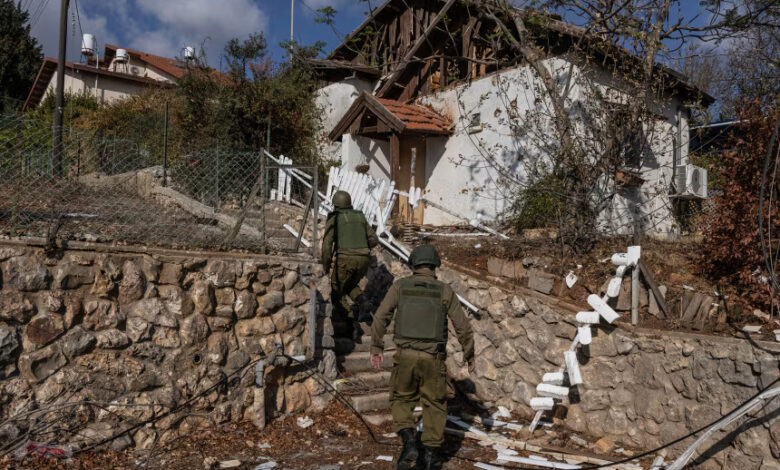
Home to some 2,000 people before the war, Metula has lived with cross-border fire for decades. Until the last few years, the locals had grown accustomed to how close they lived to conflict. That changed in October 2023, when Iran-backed Hezbollah began launching rockets toward northern Israel in solidarity with Hamas. It has been among the hardest-hit communities, with more than 60% of homes damaged. Between a third and a half of the residents have yet to return.

The town’s predicament highlights the limits of any ceasefire between Hezbollah and Israel, and the lingering hardship faced by residents whose lives have been upended by years of conflict.
On Tuesday, Israeli and Lebanese ambassadors are set to meet again in Washington for the fifth meeting to bring about an end to the war. Hezbollah isn’t included in those talks and has denounced them as “a farce.” An Israeli source told CNN they may offer a limited, symbolic pullback, a gesture to Lebanon’s government.
A period of relative quiet followed a the first ceasefire brokered by the Biden administration nearly two years ago, which largely held for 15 months. It collapsed on March 2, when Hezbollah fired rockets at Israel in retaliation for US-Israeli strikes that killed Iran’s supreme leader and opened the Iran war.
Israel responded with a ground incursion into Lebanon and seized what it calls a security buffer zone, pushing its forces roughly 10 kilometers into southern Lebanon, alongside heavy aerial strikes. According to Lebanon’s health ministry, more than 4,000 people have been killed and over a million displaced as a result. The Israeli military says 36 Israeli soldiers and four civilians were killed, as Hezbollah fired thousands of rockets and drones into northern Israel and Israeli troops in southern Lebanon.

Talking to Iran ‘with silk gloves’
Moti Aharon, 58, has lived through decades of escalation. His century-old home was hit twice, and the guesthouses and pool he built are now unusable. “We don’t feel any ceasefires,” he said, expressing little faith in diplomacy. “The Americans don’t understand who they are dealing with. They think they can talk to Iran with silk gloves. It won’t work.”
In November 2024, Prime Minister Benjamin Netanyahu said Hezbollah was pushed “years back” due to Israel’s campaign against it. Yet the latest round of fighting has underscored the group’s resilience, dragging Lebanon into a regional war and drawing the Israeli military back to a familiar southern Lebanon terrain. The military held a similar security strip from 1985 until 2000, before withdrawing after years of steady casualties, a toll that is accumulating once again. Over the weekend, five soldiers were killed from Hezbollah fire within 24 hours.
“For fifty years it’s been the same game. They shoot, we shoot,” Aharon said. “Netanyahu can say we’ve won, that Hezbollah is deterred – it’s nonsense. This requires root-level change.”
Since April 15, the Trump administration has brokered a series of ceasefires between Israel and Lebanon. But even as Washington hailed diplomatic progress, the fighting between Israel and Hezbollah continued.
Meanwhile, Iran made ending the war in Lebanon a central condition in its own talks with Washington, prompting a public rift between US President Donald Trump and Netanyahu, who has resisted ending the wars in both Iran and Lebanon.
US pressure has significantly curbed Israel’s military activity in Lebanon, but Netanyahu insists Israeli troops will remain in the buffer zone “for as long as necessary.” His far-right allies are openly advocating for a more permanent presence and continued operations.
Iran, for its part, is demanding a full Israeli withdrawal as a condition for proceeding with the 14-point Memorandum of Understanding with the US. On Sunday, Iranian and American officials agreed to establish a Lebanon “deconfliction cell” with the Lebanese government and Qatari and Pakistani mediators. Israel is not expected to be represented.
‘Decisions that don’t speak to us’
For residents of Metula, the sense is that their reality is increasingly being shaped elsewhere – by decision makers who do not live with the consequences.
“The prime minister and an entire nation are trampled by decisions that don’t speak to us at all,” Mayor David Azulai, a vocal critic of the government’s handling of the north, said on social media. In another post, he slammed Netanyahu as “not really a leader” but a subordinate of President Donald Trump.

For residents of Metula, Israel’s buffer zone in Lebanon is a necessity meant to push Hezbollah away from the border and prevent infiltration. Over the past three months, the IDF says it has uncovered and destroyed extensive Hezbollah underground infrastructure in southern Lebanon, including tunnel networks, weapons caches and explosives intended for attacks on Israeli communities.
From the bar of his restaurant Dorfman, pointed across the valley to a hill wherea Hezbollah flag once flew. “So, what, we’re supposed to live with that?” he asked. “They’ll be back on the border, waiting to do what Hamas did in the south.” Metula already feels half abandoned, he said. “If I see Hezbollah flags on the fence again, I won’t stay either.”
Niv Shisler, 24, an aspiring rapper who works at Dorfman’s restaurant, moved to the town last November lured by cheap housing when rents collapsed during the war. His neighbor is an anti-missile battery. “(With) every explosion, my heart jumps,” he said. What worries him isn’t more fighting, but a deal that pulls troops back. “People are afraid of a ceasefire where we withdraw from our own border,” he said. “And then one day we’ll have our own October 7 here too.”
In Metula, few are optimistic about prospects for a ceasefire.
“The worst part is, it’s not up to us,” Dorfman says. “It’s all about interests, and Metula isn’t one of them.”