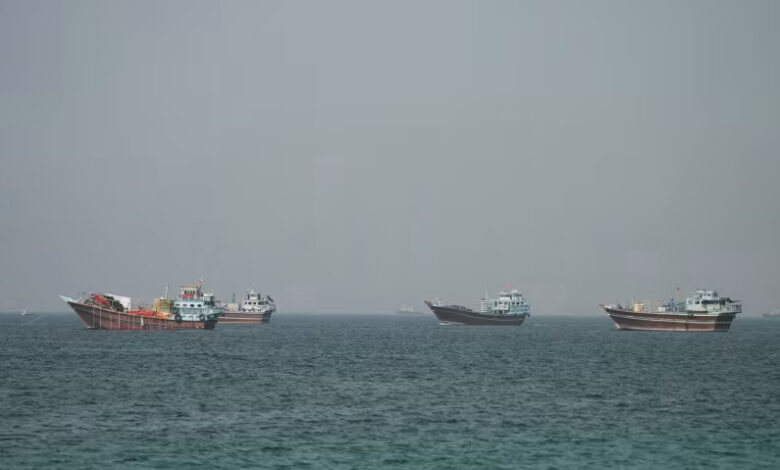
Iran struck a vessel in the Strait of Hormuz on Thursday, forcing a pause on evacuations of stranded seafarers and demonstrating its continued ability to restrict the critical waterway, despite the agreement reached last week with the United States.
A US official told CNN the vessel was attacked by an Iranian drone, but did not provide further details.
While Iran has not claimed responsibility, Thursday’s attack came hours after its powerful revolutionary guards warned that vessels would only be given safe passage via Iranian routes, challenging the Trump administration’s claim that the strait is free and open once more.
The fresh attack, the first reported since the US and Iran agreed last week to work towards a peace deal, prompted an uptick in global oil prices and came as Secretary of State Marco Rubio tried to sell the agreement to skeptical Gulf nations. CNN has reached out to the White House for comment.
The cargo vessel was struck on its starboard side by an unknown projectile, damaging the bridge, according to the United Kingdom Maritime Trade Operations, which monitors marine traffic in the region. No casualties or environmental impact were reported.
Vessels were advised to transit with caution and report suspicious activity,
The attack forced the UN’s International Maritime Organization (IMO) to halt its mission to evacuate hundred of ships and more than 11,000 seafarers who’ve been stranded in Persian Gulf region since the war broke out.
“I have always reiterated that the safety of the seafarers remains paramount,” IMO Secretary-General Arsenio Dominguez said in a statement. “Therefore, to ensure a coordinated approach and navigational safety, the evacuation plan will be paused until further clarity is obtained.”
The evacuation mission only began in recent days, following the signing of the memorandum of understanding between Washington and Tehran.
Dominguez said that the ship that was attacked was not operating under the IMO evacuation framework, adding that the incident highlights the need to ensure evacuation efforts can continue without seafarers being put at risk.
This week, ship movements in the Strait of Hormuz hit their highest point since the war began in late February, with MarineTraffic data showing 70 crossings on Wednesday. Most of those vessels using a route that followed the coast of Oman, the maritime monitoring group said.
Iran sees control of the waterway as a key point of leverage in negotiations. On Thursday, the Islamic Revolutionary Guards Corp warned that safe passage would only be given to ships via routes declared to Iran.
After the attack, the Persian Gulf Strait Authority – an agency Tehran recently established to manage the strait – said safe transit would not be guaranteed. “The consequences of traveling on unauthorized routes will be the responsibility of the owner, operator, and commander of the vessel,” the agency said on X.
The current agreement between Washington and Tehran includes a commitment to reopen the waterway without tolls for 60 days, and has already seen the US lift its blockade of Iranian ports. But the 14-point memorandum also grants Iran a formal role in overseeing commercial traffic through the Strait of Hormuz alongside Oman.
Tehran began to enforce tolls on vessels wishing to transit the strait during the conflict, something the Trump administration has vowed not to allow under a long-term peace deal.
“The reality of it is that no country on Earth has a right to charge for the use of international waterways, and that will never be an acceptable condition of any deal,” Rubio said at a meeting with foreign ministers of Gulf Arab states in Bahrain on Thursday. A joint statement later said the ministers “rejected any tolls, fees, or attempts to assert control over the Strait.”
Tehran, which disputes the waterway being international waters, has previously raised the prospect of charging a kind of service fee, rather than toll, alongside Oman in the future.
But Oman said on Thursday that future arrangements for the strait do not include transit fees for vessels, the state-run news agency reported.
“You can call it a toll, you can call it a fee, whatever you want to call it. It’s a game of semantics,” Rubio said.
The signing of the agreement last week saw global oil prices fall to their lowest level since the start of the Iran war. Thursday’s strike sparked a slight rise, with Brent crude – the international benchmark – closing up 2% at $74 per barrel, before easing back in trading early Friday.
The memorandum is meant to halt fighting, open the Strait of Hormuz and offer economic relief to Iran in exchange for a pledge never to develop nuclear weapons. But it leaves vital details, like the future of Tehran’s nuclear program and its stocks of enriched uranium, to be hashed out over 60 days of high-stakes negotiations.
Those technical talks will be held at the expert level, with working groups on various subjects including nuclear energy and sanctions, beginning June 30, said Rubio on Wednesday.
But the process has been riddled with stumbling blocks – including persistent fighting between Israel and Hezbollah, which threatened to derail US-Iran talks last week. Rubio has tried to separate the Israel-Lebanon talks from the US-Iran negotiations, even as Iran has repeatedly insisted that the issues are entwined. The agreement itself declared an end of fighting on all fronts, including Lebanon.
On Friday morning, Israel launched airstrikes on targets near Nabatieh in southern Lebanon, according to Lebanon’s state-run National News Agency.
The Trump administration has expressed increasing frustration over Israel’s campaign in Lebanon; and Rubio is skipping Israel on his ongoing Middle East visit, which some analysts described as a snub of Israeli Prime Minister Benjamin Netanyahu.
This article has been updated with additional information.
CNN’s James Frater and Sarah Tamimi contributed to this report.