The world feels like it’s spinning out of control.
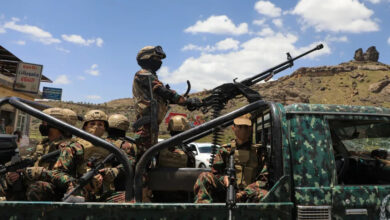
The planet’s two major wars, in Iran and Ukraine, are no longer contained. Experts warn of doomsday scenarios in which AI could wipe out humanity. Soaring energy prices rock industrialized economies blighted by inequality. Floods, fires and blistering heat are turning the climate crisis biblical.
Meanwhile, global institutions that bankrolled relative stability crumble. The United Nations, where world leaders gather this week, looks inept as strongmen spurn its core values: democracy, human rights and international aid.
At any other time over the last 80 years, the US would serve to restore stability. But remarkably, the West’s superpower is now an agent of global volatility.
Step forward, Mr. President.
Donald Trump’s annual address to the UN General Assembly on Tuesday comes with his popularity plunging ahead of critical midterm elections and as he’s stuck in the kind of war he vowed never to fight.
Yet Trump is expected to argue that the US has never been as mighty or esteemed. Officials say he’ll boast of spreading global peace and tackling crises his predecessors ducked.
“Our country is respected again. We’re respected like never before. I go to meetings and everyone stands up. They didn’t stand up for our last president; they didn’t care about him,” Trump said earlier this month.
Much of the world disagrees.

Scorned allies like Canada and in Europe are racing to unify, incredibly, to protect themselves from their former security guarantor – the US. Trust in the increasingly feral US is disappearing.
“America has changed,” Canadian Prime Minister Mark Carney, the self-styled leader of “middle powers” mobilizing for the post-American era, said last month. “We cannot control the storm blowing in from Washington.”
Trump’s second-term rationale is that the US is playing with a stacked deck and other powers have no cards. “I can do anything I want,” he said in March, referring to Cuba but epitomizing his worldview.
Washington’s foreign policy is now an extension of the commander in chief’s personality, marked by the use of threats and leveraging force in pursuit of material gains. At the weekend, for example, he pondered on Fox News whether to “blow the entire nation” of Iran up.
But while Trump envisages the US as supreme, its power looks newly brittle.
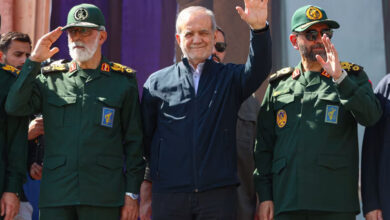
The survival of the Iranian regime, despite everything Trump threw at it, mocks his narrative of dominance. Depleted US missile intercepters and the rusted hull of a long-deployed aircraft carrier symbolize a war Trump said would end in weeks but is exposing limits to American power on the threshold of its eighth month.
Trump completes the transformation
Trump’s belief that he’s a global hit ignores the evidence of multiple opinion surveys that show he’s disdained around the world. It’s the international equivalent of his boast that the US is basking in a domestic golden age even as voters hand him rock-bottom approval ratings.
But what is the true state of American power? Are Trump policies that destroyed a near century-old bipartisan consensus worsening a moment of deep global peril? And is he a cause of the splintering, or merely a product of an inevitable moment when the 20th-century world order dissolved amid a new era’s tests?

In his first address to the UNGA, in 2017, Trump unveiled a foreign policy that would shake the West to its foundations. “As president of the United States, I will always put America first, just like you, as the leaders of your countries, will always, and should always, put your countries first,” he said.
In his second term, he’s completed the transformation.
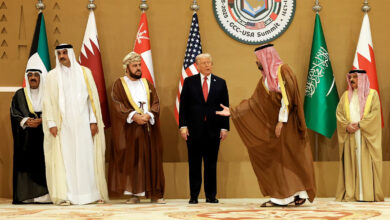
He attacks allies and befriends tyrants like China’s leader Xi Jinping – whom he welcomes to Washington this week – and Russian President Vladimir Putin.
Trump 2.0 revived imperialism, especially in the Western Hemisphere. Venezuela’s oil is set to fill US reserves in a 100-year concession following Trump’s toppling of dictator Nicolás Maduro and embrace of democracy-denying regime figurehead Delcy Rodríguez, whom he is also expected to meet with this week.
The flush of success in Venezuela bred hubris that convinced Trump he could similarly destroy an anti-US regime in Iran. Now he’s yet another American president mired in a Middle East war he can’t win or leave.
Tehran has provided the same kind of lesson in how modern drone-led warfare can humble a great power that Kyiv has administered to Moscow, despite both Ukraine and Iran sustaining devastating damage.
Trump also learned last year about another new reality of 21st-century geopolitics. His China trade war ended when Beijing throttled exports of rare earth minerals that power US tech and an economy over-reliant on AI.
A traditional president would corral global coalitions to meet common threats. Yet Trump’s tariff wars and sovereignty threats caused what Carney calls a “rupture” in the alliance systems Washington had used as a force multiplier.
Transatlantic and trans-Pacific bonds have been further strained by the duress that Trump has caused for his fellow leaders with a war that has oil, gasoline and diesel prices soaring. In Europe, the mistrust is deepened by the administration’s support for right-wing populists assailing establishment leaders.

‘You can never trust that dog again’
The fracturing of American alliances might have been unthinkable before Trump.
But angering allies is not a blip; it’s a win for a MAGA movement the chafed at allies building expensive welfare states under America’s defensive shield.
There’s also an undeniable strategic victory for the US as Europeans start to get serious on funding their own defense.
The president was also right to worry about the growing geopolitical challenge as polar ice melts. But his aggressive attitude also shows how he undermines America’s power. He could easily have achieved the new defense deal he’ll sign with Greenland this week, for instance, without threatening to invade a sovereign territory of Denmark, a NATO member.
Such behavior may be squandering US power for years to come.
Greenlandic politician Tillie Martinussen revived an evocative analogy in explaining a loss of faith in Washington. “Even if it’s your best and brightest and strongest sled dog, and it turns around and bites you, you can never trust that dog again,” she told Britain’s Channel 4 News.
But Trump is not alone in eroding America’s competitive edge.
His political ascent was a direct result of draining foreign wars in Afghanistan and Iraq early in the century that cost trillions of dollars and thousands of young lives; showed the limits of US air power; and punctured the US aura of post-Cold War invincibility.
But it’s also clear that Trump has ended the world he inherited.
“I’ve talked to leaders … who just looked at me and said, ‘Look, the first time you guys did this … it was a blip,’” possible 2028 Democratic presidential candidate Pete Buttigieg said at The Atlantic Festival this month. “’Now it’s a pattern and our country has to prepare’ … we’re entering into a world where the old patterns and institutions are not coming back,” he said, paraphrasing those conversations.

Trump is not responsible for the stunning evolution of AI and its potential to change the world. US policies that unwittingly empower China were chosen by previous presidents. Putin’s long-festering hatred of the West can be traced back to Cold War defeat. The climate was changing long before Trump won the White House, even if he still denies it. And the West never really thought about what was next once memories of 1940s unity faded with the greatest generation.
But his volatile temperament is now a mirror of the political era in which he rules. It could make a fierce confluence of global challenges more extreme. And it is fueling long-building questions about the sustainability of American power.