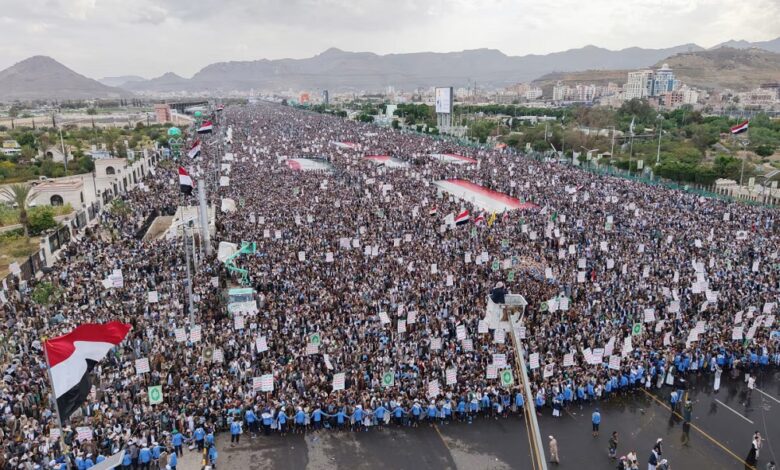
In the last month, Iran-backed Huthi militants in Yemen have joined the Middle East conflict in dramatic fashion — capturing a swath of the Red Sea coastline, launching missiles and drones at Saudi energy infrastructure and even targeting the Saudi capital, Riyadh, over the weekend.
Now their campaign appears to be entering a new phase, with a major offensive aimed at cutting off government forces in a central part of Yemen.
Their ultimate goal, according to some analysts, is control of the entire country.
The latest Huthi advance comes as Saudi Arabia deploys fighter jets and missiles in an effort to stem the militant group’s progress south toward the port city of Aden, where Yemen’s internationally recognized government is based.
Saudi appeals for US airstrikes to reverse Huthi gains have fallen on deaf ears, according to a regional diplomatic source.
Britain, however, has answered the Saudi request for assistance. Prime Minister Andy Burnham said on Monday he has agreed to provide “defensive air-to-air refueling” for Saudi jets for a limited period, according to Reuters news agency.
In a joint statement on Monday, foreign ministers from the G7 nations called on Iran to end its arming and support of the Huthis – and for the militant group to “cease all military actions, all threats and attacks against civilian shipping.”
The Huthis have already seized a long stretch of the Yemeni coastline bordering the Red Sea — one of the world’s most important waterways — and they control the Bab al-Mandeb chokepoint at its southern end.
Now, they are trying to seize the mountainous region of Taiz, which includes important routes for government forces.
“Cutting these routes would threaten a key transport and supply connection between government-held areas,” according to Yemen analyst Mohammed al-Basha.


The Huthis have run into stiff resistance from local tribes, Basha told CNN.
The battlefield situation remains fluid, according to Basha, and the risk remains that the Huthis will be able to surround the city of Taiz. But it appears that defenses have not experienced a collapse comparable to what was seen on the west coast front, when a large area — including the port of Mocha — fell within hours.
Basha added that, as of Monday, the government still holds a critical road junction connecting Taiz and Aden in an area hosting hundreds of thousands of internally displaced people.
There is also heavy fighting farther east, according to several Yemen analysts, in the province of Marib. Marib is an oil-rich region long in the Huthis’ sights.
Yemeni government forces have used artillery and rocket systems — supported by Saudi airstrikes of growing intensity — to repel Huthi forces in the region, according to analysts. A senior commander claimed that his troops have now gone on the offensive.
Yemen’s internationally recognized government said Monday that its forces targeted Huthi fighters and supply lines in the strategic Bab al-Mandeb area overlooking the Red Sea and in Bayda province in central Yemen. A military spokesperson, Col. Majed al-Nazili, said government forces struck Huthi positions, personnel and supply routes, and the Information Ministry released footage it said showed attacks on Huthi sites and equipment. The claims could not be independently verified.
Huthi military spokesperson Yahya Saree claimed Monday that Saudi Arabia has carried out 157 aircraft and missile strikes across four Yemeni provinces, bringing to 917 the total number of strikes since the latest escalation began. He vowed the attacks would be met with a response.
Saudi authorities had no immediate comment, and CNN could not independently verify the Huthi claims.
“The Huthis likely seek to capture the area in order to try to extract and export oil through the Red Sea, which could fund Huthi political and military activities,” the Institute for the Study of War, a Washington think tank, reported Friday.
The cities of Taiz and Marib are key bastions, “and if the Huthis capture both, it is game over,” Basha told CNN. “But their defenders are putting up a strong fight.”
The Huthis control a large chunk of western Yemen, where more than 70 percent of the population lives, including the capital, Sanaa. Government forces hold a slice of southern Yemen and the sparsely populated eastern part of the country.
It’s unclear whether the Huthis intend to put pressure on Aden itself. Much will depend on the ability of government forces to improve coordination after the disastrous western shore retreat.
“The Huthis do not need to defeat Saudi Arabia militarily and near certainly cannot,” said Ibrahim Jalal of the Middle East Institute in Washington.

“They, however, need to influence how much financing, intelligence, logistics, air defense and potentially airpower Riyadh is prepared to commit to the Yemeni armed forces capable of reversing their gains on the ground.”
To that end, Jalal told CNN, the Huthis are avoiding getting bogged down in urban fighting and trying to encircle government forces.
CNN has contacted Huthi officials for comment.
The New York Times reported Monday that, after a call from Saudi Crown Prince Mohammed bin Salman last week, US President Donald Trump agreed to launch airstrikes against the Huthis. But Trump changed his mind on Sunday, according to the Times.
Last week, Trump said the Huthis “let us know they don’t want to fight with us,” adding that they were allowing “most ships” to pass through the Bab al-Mandeb Strait but were “unhappy” with one country — obviously Saudi Arabia.
The Huthis said two months ago that they would attack Saudi shipping.
“Trump’s best option is to stay out of the Yemen quagmire as remote warfare won’t change the equilibrium on the ground while widening supply chain disruption,” according to Andreas Krieg, CEO of London-based political risk firm MENA Analytica. “It would also derail the Iran and Hormuz diplomatic track,” Krieg wrote Monday on X.
However, the “inconsistency in the US position vis-à-vis Tehran’s proxies means that the Yemeni government and Saudi Arabia have had to handle the Huthis largely on their own,” Fatima Abo Alasrar, a Yemeni analyst, wrote in a piece for the Stimson Center, a US research institute.
So far, Saudi Arabia does not appear to have invoked its recently agreed trilateral defense pact with Pakistan and Turkey. And Turkish officials have been careful not to offer too much.
“We see there are very serious attacks on Saudi Arabia’s territorial integrity, sovereignty,” Turkish Foreign Minister Hasan Fidan said Saturday, referring to Huthi drone and missile attacks on Saudi Arabia.
“We are in serious solidarity on this point. … They may have some military needs, especially on some technical issues. We would have no issues in meeting these,” Fidan told Turkish channel NTV.
Saudi isolation
“Saudi Arabia is discovering how alone it is in a moment of need,” analyst Natiq Malikzada said Monday. “For years, it built its security around the hope that Washington would defend it.”
“For the US, as for any other country in times like this, Saudi security matters less when American interests are not directly at risk,” Malikzada wrote on X.
Jalal said the Saudis can count on some support from regional allies and Pakistan, and potentially from Egypt.
But for now they bear the lion’s share of the burden.

Iran is banking on the Huthis as its “last resilient proxy to improve its bargaining position and leverage, while the Huthis now seek to consolidate gains and expand territorially, as well as intensify attacks into Saudi Arabia, to redraw the rules of the game,” Jalal wrote in the online publication Al Majalla.
The Huthis “will continue to punish Saudis till they get their multibillion-dollar reparations fund,” Basha told CNN on Monday. They have long insisted on Saudi compensation for the long blockade against Yemeni territory they hold.
But Huthi ambitions may go further. Their ultimate goal is control of all of Yemen, Jalal said.
Javan Online, an Iranian publication affiliated with the Islamic Revolutionary Guard Corps (IRGC), recently suggested the Huthis were close to unifying Yemen under a “single center of power.”
In so doing, they would become a regional force capable of making their opponents negotiate over Red Sea security and the future of the Arabian Peninsula itself, the Javan commentary said.
That is Saudi Arabia’s nightmare.
CNN’s Nadeen Ebrahim and Mohammed Tawfeeq contributed reporting.