Egyptian President Abdel Fattah al-Sisi said that his greatest dream is for Egypt to have 10,000 doctors with the same stature and caliber as world-renowned surgeon Magdi Yacoub.
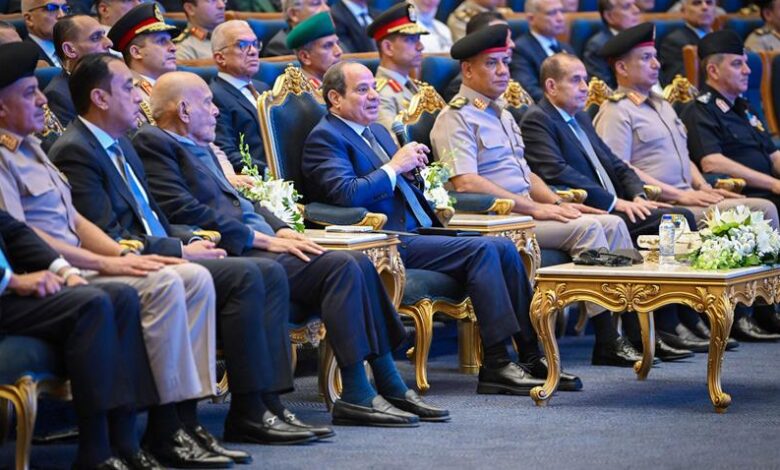
Sisi’s remarks came during the opening session of the Third Medical Conference of the Armed Forces College of Medicine, which was held at al-Safwa International Conference Center at the Strategic Command headquarters in the New Capital.
He stated that preparing new generations of scientists and specialists requires drawing upon successful Egyptian role models and studying the factors that contributed to their excellence.
The President elaborated on his grand dream of developing the education and health sectors, stressing they are the primary drivers of progress in any nation.
“If we want Egypt to regain its position, priority must be given to health and education,” he stressed.
President Sisi pointed out that the state exerted tremendous efforts in 2013 and 2014 in both sectors; however, the challenges were so immense that those efforts were not sufficiently felt.
He explained that the scale of spending from 2014 to 2026 has been substantial.
Sisi asserted that the state prioritizes not merely the number of facilities and graduates, but also merit and quality, adding that this focus drove the state to establish twinning agreements with world-class universities and hospitals to leverage their expertise and rapidly elevate Egyptian capabilities and skills.
The president stressed that signing the cooperation protocol between the Armed Forces College of Medicine and the Royal College of Surgeons in Ireland represents one of the steps taken by the state, not just the Armed Forces, to guarantee merit.
Sisi reaffirmed the state’s focus on human development across all fields and sectors.
Armed Forces College of Medicine
Regarding the Armed Forces College of Medicine, Sisi noted that a large number of civilians applied to join this year.
Therefore, a plan was developed to expand upon this initiative by establishing six new faculties at Kayan University in the fields of Medicine, Dentistry, Physical Therapy, Pharmacy, Engineering, and Computer Science & Artificial Intelligence.
He said these disciplines represent the most advanced fields, adding that the state is actively seeking to forge twinning agreements between these faculties and their prestigious foreign counterparts.
The president noted that Kayan University will have a capacity of approximately 25,000 students.
The president emphasized that for the state to deliver high-quality healthcare as envisioned, it would require a budget at least double or triple the current healthcare allocation.
Sisi noted that providing healthcare to citizens, or to anyone seeking refuge in Egypt, is a matter that carries not only economic dimensions, but also moral, humanitarian, and religious ones.
Tahya Misr Fund
Sisi ordered the “Tahya Misr Fund” to cover the tuition costs for outstanding gifted students to attend Kayan University, provided they maintain their academic excellence.
President Sisi stated that Kayan University will be inaugurated in February 2027. Sisi called upon parents and students to take full advantage of the carefully tailored programs offered by these faculties.
The president noted his pleasure regarding the upcoming inauguration of Kayan University, as well as another new university along Ain Sokhna Road in March 2027, whose name has yet to be determined.
Both the president and the Minister of Higher Education and Scientific Research noted that work is underway to develop eight universities into world-leading institutions across all aspects, including facilities, academic standards, and digitalization, confirming that the state will make significant strides if major progress is achieved in the health and education sectors.
President Sisi concluded by underscoring the importance of continuous communication between officials and citizens to highlight state efforts across all sectors, reassuring the public that Egypt is on the right track toward achieving its target goals.
The President emphasized that the progress of nations spans decades, requiring a clear action plan, diligent follow-up, robust political will, stability, and continuity.