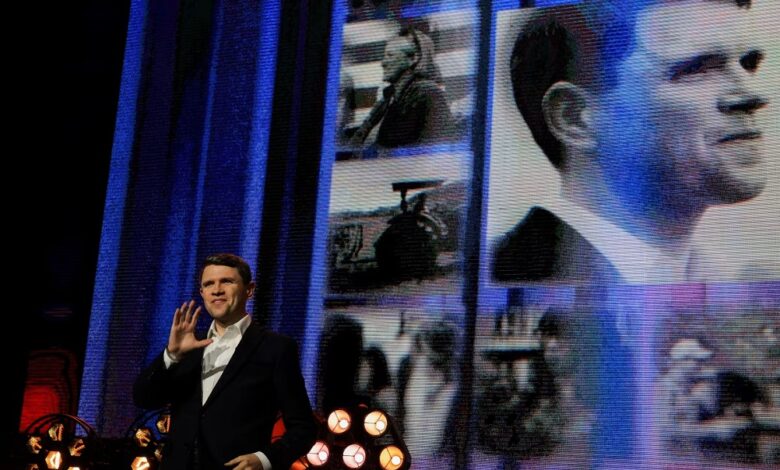
But the vibes among the hundreds of party operatives, strategists and would-be 2028 presidential candidates who gathered to ask what’s next after nearly a decade of living in President Donald Trump’s shadow?
Party on, Wayne! Party on, Garth!
Democrats arguably haven’t had such a wide-open presidential field since the “Wayne’s World” era, when a preternaturally talented Southern state governor named Bill Clinton came almost out of nowhere to win the White House in 1992.
Now, Democrats have exploded out of a Trump-imposed political wilderness to their most sweeping midterm win since Watergate. And they were ready to take a beat before they begin what’s sure to be a frenzied season of presidential campaign announcements, hiring, fundraising and knife-fighting among a dozen or more White House hopefuls.
Even the would-be candidates could barely hide their elation during donor dinners, at hotel rooftop receptions, and over drinks at the bar at the Ritz-Carlton in downtown Denver, where many mingled late into the night.

But on the main stage, on the first day, those gathered here were warned: Voters still aren’t all that into them.
“These voters that we lost and that we have turned away are still out there and they have not become Democrats yet,” influential Democratic data guru David Shor said as the two-day gathering kicked off. “They will be here in two years, and if we have not persuaded them by then, we might not be happy with how things turn out.”
There was no agreement about how to do that. The prescriptions coming from the stage previewed the struggle that’s beginning to emerge: Did Tuesday’s wins signal an uncompromising fighter from the party’s left wing can dominate the nominating contest and go on to win a national election?
Or is the message that to win everywhere, the party should choose someone who can appeal to the voters who rejected the woke culture-war politics of the Covid era?
“The American people cannot wait two years for change. So we must work with President Trump,” said Texas Sen.-elect James Talarico.
“The only way we’re going to fix that is by fixing it together. We can’t do it with the same warfare that brought us here,” said Rob Sand, the incoming Democratic governor of Iowa.

Contrast those two millennial red-state newcomers with Democratic Rep. Ro Khanna, who hails from deep-blue California, co-chaired Bernie Sanders’ presidential campaign in 2020, and is widely expected to run for president in 2028 as an unapologetic progressive.
“This is not the 1990s. We cannot cobble together a fleeting big tent through perpetual triangulating, straddling, and calculating,” Khanna said onstage. The reference to “triangulating” was an unmistakable jab at a buzzword of the Clinton era.
The gathering offered a few reminders of the anger emanating from the party’s base. Maryland Sen. Chris Van Hollen spoke after announcing he would challenge Chuck Schumer to be the next Senate majority leader.
Likely incoming House Speaker Hakeem Jeffries was heckled by the audience, with one person yelling Jeffries was “a f**king liar!” before being escorted from the hall.
And protesters gathered outside the security perimeter, holding signs that read, “Abolish billionaires,” “No Schumer coronation,” and “No more do-nothing Democrats.” A Denver SWAT vehicle was parked between them and the rideshare dropoff line.


But inside that perimeter and off the stage, all the divisions evaporated into an atmosphere of celebration bordering on elation. There were food trucks parked outside the brewery serving local craft beers on draft. There were musical acts performing in the outdoor plaza in between speeches. Both days were about 65 degrees and sunny, with the weather clear enough to see the mountains.
And it was very cozy and comfortable after hours at at the Ritz bar. The drinks started flowing Thursday night, with Arizona Sen. Ruben Gallego, who’s considering a presidential run, holding court. Pete Buttigieg was also spotted there Thursday night, as was Pennsylvania Gov. Josh Shapiro.
And Friday evening, the nationwide FAA ground stop stranded everyone in Denver at least for a few hours. Michigan Sen. Elissa Slotkin sat with Govs. Abigail Spanberger of Virginia and Mikie Sherill of New Jersey until the stop was lifted. Georgia Sen. Raphael Warnock huddled off the record with reporters. Buttigieg was back too, spotted snapping a selfie or two. Illinois Gov. JB Pritzker couldn’t attend the conference, but his team was at the Ritz bar too. So were operatives with ties to Arizona Sen. Mark Kelly and a handful of others.

This was where the conference’s real business unfolded. A top priority was recruiting staff and making connections for presidential campaigns that are set to start kicking off as soon as January, if not earlier, according to conversations with over a dozen strategists and operatives with ties to presidential hopefuls.
Much of the chatter and speculation focused on possible candidates who weren’t in the room, Kamala Harris and Alexandria Ocasio-Cortez chief among them. Their decisions to run or not to run for president in 2028 will fundamentally shape the rest of the field.
Wins across the South underscore the power of Black voters, already perhaps the most important single constituency in any Democratic primary, and Harris starts with an enormous advantage there, especially among Black women.
And then there’s the progressive wing, energized by victories from working-class candidates and people like Abdul El-Sayed in Michigan.
“People are thinking there’s more room for someone on the left, and wondering if it means AOC is going to run,” said one top operative with close ties to a likely 2028 Democratic presidential candidate.
There was also widespread speculation about Pennsylvania Gov. Josh Shapiro, whose been widely considered a top-tier likely 2028 contender. At the heart of his appeal had been the argument he can win big in one of the most important swing states on the map. Now, he’s got a lot of competition from newer faces in the party.

“I’m proud to be the governor of what I think is the swingiest state in America, but we got a lot of company now,” Shapiro told me in an interview. “Look at Texas, look at South Carolina, Iowa, and a whole lot more. But I think that presents an opportunity for Democrats not to be thinking about how to get to 270 on an electoral map, but get to 370 back how Obama won and Clinton won.”
Other potential contenders, including California Gov. Gavin Newsom and Georgia Sen. Jon Ossoff, also didn’t appear here. Newsom, who had occupied something of frontrunner status in the invisible primary as he jabbed at Trump over the past year, seemed to have faded somewhat from the main conversation, at least in these halls.
(Newsom hasn’t faded, apparently, for Trump, who spent part of his weekend attacking Newsom for commuting the death sentences of all California inmates on death row and changing them to life without parole.)
As the hundreds of Democrats who gathered here struggled to find a way out of Denver, the airport chaos almost presaged what could be a massive post-Trump hangover for a party that’s elated but set for a bruising internal struggle over what’s next.
“If you ask the American people, there is no question about who we oppose,” said Massachusetts Rep. Jake Auchincloss. “But also no sense of what we believe. That is the question we have to answer right now.”
CNN’s Abby Baggini and Jimmy Carr contributed to this report.