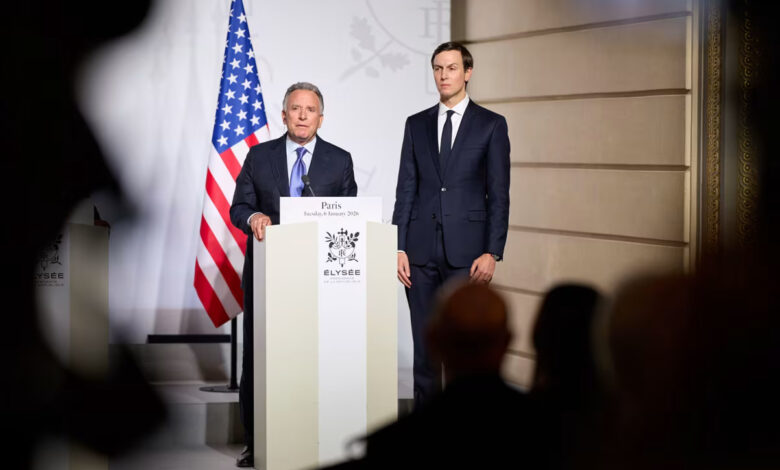
Witkoff and Kushner.
It sounds like an elite law firm, a 1970s cop show or even a duo of visionary architects, since they hope to turn battlefields into futuristic cityscapes.
But Steve Witkoff and Jared Kushner are running President Donald Trump’s freelance peacekeeping franchise, on which global stability, countless lives and their boss’s best hope of that elusive Nobel Peace Prize depend.
The pair were in the thick of it Tuesday, on an extraordinary double-barreled day of diplomacy in Geneva, huddling with Russian, Ukrainian and Iranian officials. They’re expected back in Washington this week for a meeting of the Board of Peace — Trump’s personal big-dollar private global diplomacy network.
The two super-rich, well-connected American dealmakers are charged with ending one vicious war and preventing one that might be about to erupt. Success in either case would be a huge achievement, but both goals seem intractable.
Trump’s hopes for a deal with Iran, as he masses a vast armada within shooting distance, only crawled forward Tuesday. The Iranians touted an understanding on “guiding principles.” But Vice President JD Vance told Fox News that while things “went well” in some ways, Tehran won’t acknowledge some of Trump’s red lines.

The first of two days of talks between Ukraine and Russia also highlighted a big potential roadblock: the question of whether Moscow really wants to end the fighting or is only playing at diplomacy to buy time for battlefield wins.
Still, talks are taking place. Given global skepticism about the prospects for agreements and of the Witkoff and Kushner double act, this is an achievement in itself and a mark of Trump’s desire to work for peace.
Three global disputes with deepening implications

Witkoff and Kushner’s latest efforts come at a perilous moment for the world and a politically tenuous one for Trump’s presidency.
► Their biggest win so far — the ceasefire in Gaza — is fragile amid renewed fighting. The transition to the disarmament of Hamas still seems like a pipe dream. A possible renewal of full-scale war would worsen the misery of Palestinian civilians and again threaten Israeli security.
► At the same time, the Ukraine war is grinding through another winter, amid battlefield carnage and Russian attacks on defenseless civilians. The longer the war goes on, the greater the risk that it spills over into a NATO-Russia conflict. Maybe no one can end the war. But Trump probably has a better chance than anyone.
► The president, meanwhile, is getting inexorably dragged closer to a war with Iran that he may have to fight to save face and protect his own credibility. But polls show Americans don’t want it.
Each separate negotiation risks running into the same brick wall — the parties’ refusal to compromise on issues they see as existential to national survival or honor. For President Vladimir Putin, this means fighting on at least until he seizes the reminder of the eastern Ukrainian Donbas region on which he’s already spent tens of thousands of Russian lives. The government in Kyiv cannot cede the region — as the Trump administration apparently wants — because of its own massive casualties and because it forms fortifications vital to the defense of the capital.

Iran has its own potential deal-breakers. While it’s ready to discuss concessions on a nuclear program already shattered by US attacks last year, Tehran is refusing to bargain away its ballistic missile program and regional proxy networks, which it views as crucial to the survival of the Islamic revolutionary regime.
Trump sometimes appears willing to take any deal to celebrate clinching it. But he’d lose face if he inks an agreement that offers Tehran sanctions relief and looks like the Obama-era nuclear pact he destroyed. He said on Friday that regime change “would be the best thing that could happen.” But if he tries to force it, he may unleash regional, political and economic consequences he can neither predict nor control.
“If the parties want a limited and achievable agreement, they’re going to have a deal,” Ali Vaez, director of the Iran Project at the International Crisis Group, told CNN’s Becky Anderson on Monday. “If they want to go for overreach, they’re going to have a war.”
How the double act might work
Witkoff and Kushner might be unorthodox. But they have the indispensable credential every successful peace negotiator needs — empowerment by the president. Special envoy Witkoff, a wealthy real estate developer, has been a Trump friend for decades. Kushner has no official government role. But he’s the husband of Trump’s daughter Ivanka, and therefore family. Neither appears to have any political ambition outside polishing Trump’s legacy.
Each man personifies Trump’s unique brand of foreign policy. They’re business tycoons who disdain formal diplomatic and governmental structures and seem to see every global conflict as a potential real estate deal. Each also has huge commercial interests in the Middle East and elsewhere, a concern for critics who believe Trump makes no distinction between his own interests and the nation’s.
“We can’t spend our time focused on perception as much as we have to focus on the facts,” Kushner told CBS’ “60 Minutes” in a joint interview with his partner in October. “We’re here to do good. These are impossible tasks.”
But their double act also stirs concern among US allies and former US officials. Part of it is down to inexperience. Witkoff, for example, seems to emerge from meetings with Russian President Vladimir Putin singing the Kremlin strongman’s tune. “I don’t regard Putin as a bad guy,” he said last year, of a man who launched an illegal, unprovoked invasion and has massacred thousands of Ukrainians.
Concern grew over a transcript of a phone call reviewed and transcribed by Bloomberg last year that showed Witkoff coaching a top Russian official on how to talk to Trump. And a 28-point peace plan he drew up last year could have been written by Moscow. It took weeks of diplomatic sanding down, including by Secretary of State Marco Rubio, before it could serve as the basis for talks.
Still, despite huge skepticism that their quasi-official partnership could master the diplomatic game while bypassing traditional US foreign policy norms, Witkoff and Kushner are responsible for one of the most significant foreign policy successes of Trump’s second term: the Gaza ceasefire deal.
Their quiet diplomacy and networks in the region — both in Israel and the Gulf states that will be asked to finance rebuilding — secured an official end to the fighting based on 20-point peace plan. This included the return of living and deceased Israeli hostages from Gaza in return for significant releases of Palestinian prisoners and large quantities of humanitarian aid entering the devastated strip.

But the first stage of the deal — as difficult as it was — is the easy part. The second stage involves the disarming of Hamas, the entry of an international stabilization force to bolster a transitional technocratic government and the initiation of a reconstruction plan to be monitored by the Board of Peace. Trump said Sunday that members had pledged $5 billion toward rebuilding and thousands of troops to the stabilization force. “The Board of Peace will prove to be the most consequential International Body in History,” he said on social media.
But Phase 2 of the plan seems, for now, like a nonstarter. There’s little chance nations will put their troops into a war zone, and at least 11 people died in Israeli airstrikes over the weekend, Reuters reported. And both Israel and Hamas regularly accuse the other of sabotaging the ceasefire agreement.
“Boards of Peace don’t mediate conflicts. Mediators mediate conflicts. The president knows this,” former US Middle East peace negotiator Aaron David Miller told CNN’s Richard Quest last week. “He mediated, unlike all of his predecessors (and) brought (an) extraordinarily a degree of pressure on Benjamin Netanyahu to do phase one, and he has got his son-in-law and one of his best friends, Steven Witkoff, mediating or trying to mediate deconfliction with Iran and Russia-Ukraine.”
But Miller argued that arms decommissioning was still a long shot. “The notion that Hamas is going to give up its guns before the Israelis withdraw, or frankly, before Hamas gets an opportunity to take over the Palestinian National Movement, which is what they want, is slim to none. And I am sorry to say, for the sake of the 2 million Palestinians in Gaza and Israeli civilians, slim already left town.”
This reality points to a major liability of the Witkoff-Kushner approach. Conflicts in the Middle East and Ukraine can superficially seem like land disputes, but they are far more complex than a knotty business problem. For those involved, the land is more than a future construction site. It’s alive with symbolism and encapsulates history, identity and survival.
Trump is piling on pressure as he eyes his legacy

Trump’s impatience also means Witkoff and Kushner are under the kind of pressure that can lead to superficiality. Successful US peace efforts usually followed painstaking and intricate diplomacy. The Camp David Accords in the Carter presidency were the culmination of an entire term of preparatory work. The Dayton Accords that ended the war in the former Yugoslavia followed months of daring wartime diplomacy and relentless US duress on the parties led by Richard Holbrooke, the most talented American diplomat of his generation.
The US also played a key role in the British government’s Northern Ireland efforts — which took years to deliver the decommissioning of the IRA’s weapons and eventual peace.
Still, history also shows that using unofficial envoys outside the government’s official structures can work.
President Franklin Roosevelt maintained layers of personal emissaries in World War II to outwit other power centers in the government and to ensure he was the sole American with a full overview of the conflict. President Richard Nixon and his national security adviser Henry Kissinger set up a parallel foreign policy operation to cut out the State Department — much as Trump has done — and they opened a historic channel to communist China.
But Trump’s evisceration of the department has deprived his administration of institutional memory and expertise that might have built on any breakthroughs by Kushner and Witkoff.
Ultimately, breakthroughs may require more than drive-by summits in Geneva. And America’s amateur peacemakers may have Trump’s ear, but they have yet to prove they belong in the geopolitical big leagues alongside a Machiavellian Putin, a manipulative political survivor like Israeli Prime Minister Benjamin Netanyahu and the theocratic fascism of Hamas.