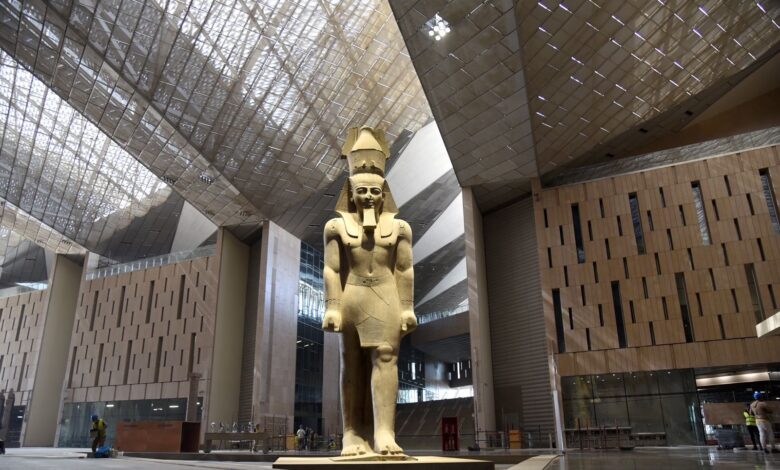
The Ministry of Tourism and Antiquities responded on Friday to a video circulating online showing rainwater falling on the statue of King Ramses II located in the Grand Hall of the Grand Egyptian Museum (GEM).
The supervisor of the museum project, Atef Moftah, confirmed that the claims of danger posed by the rain were unfounded.
He assured that the statue of Ramses II will not be impacted by the water, and that the museum and all its spaces are in excellent condition.
‘Not a threat’
Moftah stated that rainfall is natural, expected, and factored into the museum’s design and construction.
It poses no threat to the museum or its artifacts, and there is absolutely no cause for concern regarding the statue or the museum, he assured.
He explained that the rain falling on the Grand Hall area is due to the architectural and engineering design of the open-air hall, and there is no flaw in the design or the museum’s construction.
The placement of the statue of King Ramses in the Grand Hall is specified in the museum’s original design, he noted.
It is positioned as if under a canopy in the atrium area, which lies between the museum’s exhibition building and the commercial building.
He continued that the Grand Hall is shaded, with a roof covered by perforated aluminum panels that gently refract sunlight and allow for air circulation within the atrium, relying on natural ventilation and lighting, thus conserving energy and also reduces the intensity of the summer heat.
Systematically designed
Moftah noted that rainwater collection was taken into consideration, with channels designed to collect it in a water reservoir for reuse in irrigation.
He emphasized that the museum’s design and construction were carried out scientifically, systematically, and meticulously, ensuring a unique and comfortable visitor experience in both winter and summer.
“The statue of Ramses, like other massive granite statues designed for outdoor display, is intact and unaffected by rainwater.”
He also noted that the museum building, which houses the various exhibition halls, is fully covered, preventing any rainwater from entering or seeping in.
He confirmed that the museum has a drainage system in place.