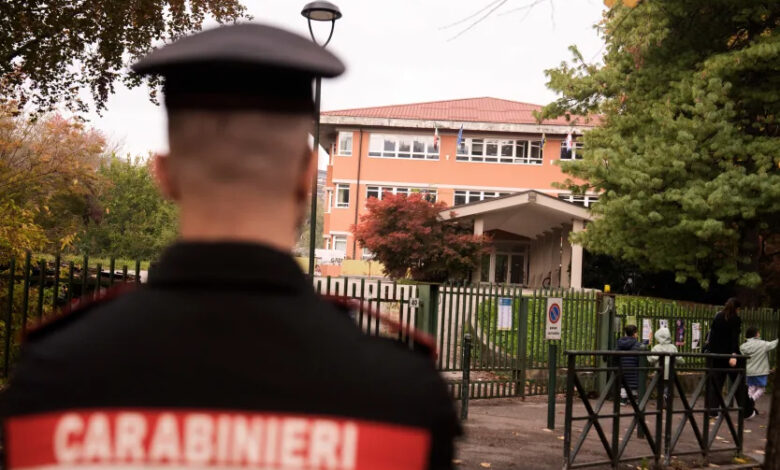
Hundreds of schools across Italy were evacuated on Wednesday after bomb threats were sent to about 6,300 institutions, becoming the latest in a series of incidents targeting infrastructure across Europe.
Schools in Scotland, Northern Ireland and the Republic of Ireland also received emails Wednesday, although police warned these were likely hoaxes and education facilities were not evacuated.
Italian police told CNN that hundreds of schools in the country were evacuated. Officials later said that the incident was a suspected hoax.
Italian Prime Minister Giorgia Meloni later said in a video statement that all threats were deemed fake, with no concrete evidence of an attack, but didn’t rule out such threats resurfacing.
“It’s possible that messages such as these will arrive again. That is not the sign that something is not working, but rather the proof that those who send them have nothing left,” Meloni said, while urging against speculative finger-pointing as to who was behind the messages.
Authorities were investigating the source of the email, the police spokesperson said, declining to confirm the email address the communication came from.
About 6,300 schools across Italy received the e-mail threat, a spokesperson for the Italian public education ministry told CNN Wednesday. “It’s unclear how many have been evacuated, that is a decision taken locally under the advice of local authorities,” the spokesperson added.

In central Rome, dozens of kindergarten and primary school children enjoyed a day off as the Quirinio Visconti primary school was evacuated. Their parents were notified to pick them up, a teacher told CNN.
The Italian prime minister said the government was “doing everything necessary to ensure the safety of citizens.”
Schools in UK and Ireland also receive emails
In Northern Ireland, more than 300 schools received a threatening email, police said Wednesday, adding that the message originated outside the United Kingdom and was being treated as a hoax.
“Our enquiries are ongoing, however, at this stage we consider risk to the public as low,” Assistant Chief Constable Anthony McNally said in a statement.
The Education Authority said the message sent to “a large number of schools” in Northern Ireland resembled a hoax sent to schools last month and that it was unaware of any evidence of a “credible” threat.
Police in the Republic of Ireland said a generic communication was sent to “a number of educational establishments” Wednesday. Police assessed the threat as “not credible” and said they were not advising any evacuations.
Dublin teacher Sharon Magee told CNN her school received a bomb threat at 10:55 a.m. local time (5:55 a.m. ET), but it was not evacuated.
“We were just told to keep alert in case we noticed anything on the premises and then the day just went ahead as normal,” she said, adding that everyone at the school got through the day safely.
Meanwhile, Police Scotland said “threatening messages” were sent to schools. The force said the messages were being treated as hoaxes and advised schools that the emails alone did not warrant evacuation.
Wave of disruption across Europe
Wednesday’s incident is the latest in a series targeting infrastructure and organizations across Europe.
“Everyone can be a target and that makes it harder to defend ourselves 100%,” Italian Defense Minister Guido Crosetto told CNN the day before hundreds of schools were evacuated Wednesday, describing efforts by Italian authorities to combat attacks.
“The goal of this hybrid warfare is to destroy this sovereignty and generate panic,” Crosetto said.
Last week, a string of hoax bomb threats disrupted dozens of flights and targeted media organizations across the continent.
And in the last few weeks, cyberattacks have hit supermarket refrigeration systems in France, Sweden, Belgium and Ireland.
The European Union said last week it was too early to tell whether the bomb threat incidents were linked, while security analysts and government ministers have suggested the wave could be part of a wider hybrid campaign or series of malicious hoaxes.
This story has been updated with developments.
CNN’s Niamh Kennedy and Farida Elsebai contributed reporting.