When Kenyan tech entrepreneur Paul Akwabi visited a juvenile prison on the outskirts of Mombasa, he didn’t see young criminals — he saw himself.
Having grown up in some of Nairobi’s poorest neighborhoods like Kibera, among the world’s largest slums, childhood memories of delivering drugs, guns and other illegal items for older boys flooded back.
“I thought, ‘This could have been me,’” Akwabi recalled to CNN.
Instead, as a young teenager, Akwabi taught himself basic electronics through books and by repairing radios. After finishing secondary school, he worked as a street vendor to support himself and studied Computer Science at the Technical University of Mombasa.
“Technology became more than an interest, it became my pathway to possibility,” Akwabi said.
Born from that recognition, and a belief in second chances, was his decision to bring his organization TechKidz Africa, the Mombasa-based technology academy he founded to empower young Kenyan innovators, into Shimo La Tewa Borstal Institution and Boys Education Centre.
With programs spanning robotics, software engineering, computer literacy, coding, animation, and online safety, Akwabi’s academy for 4- to 19-year-olds typically works with schools.
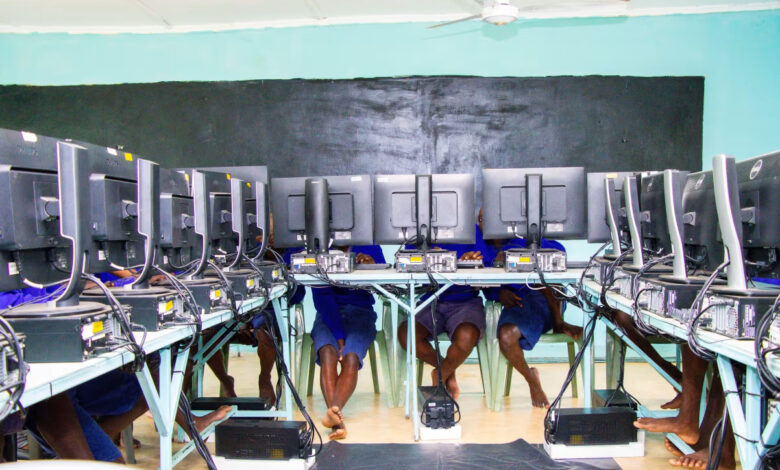
In 2024, TechKidz collaborated with Close the Gap Kenya — a nonprofit that refurbishes and donates IT equipment — to install a computer lab in the prison and develop a three-month digital literacy course that teaches young offenders Information and Communications Technology (ICT) skills specifically focused on employability and online safety.
Digital divide in Kenya
Of the first 25 original participants in the course, 21 had no prior exposure to this technology.
TechKidz uses the term “learners” to refer to inmates in the course. CNN sent them questions through the TechKidz staff, who forwarded their replies. CNN is not using their names.
One 19-year-old learner from Nyeri County wrote in response to a CNN question that, “at first, it was difficult to operate the computer,” having never interacted with one before. An 18-year-old from Meru County wrote, “I was able to use a computer for the first time and enjoyed typing activities,” adding that he hopes to use his new graphic design skills to promote his plumbing business upon release.

While Kenya’s tech innovation sector continues to grow, a disparity remains in access to technology, affordability and ICT skills. A government survey in 2024 showed that while just over 50% of Kenyans use mobile phones, only 11.6% of the population uses computers.
The Center for International Governance Innovation noted urban areas see much higher digital literacy and internet access compared to rural and marginalized communities.
Jostinah Wawasi Mwang’ombe, senior superintendent of Shimo La Tewa Institution, told CNN that Kenya’s youth prisons have an overrepresentation of inmates from lower income rural communities, with varying levels of education and literacy. Often the most computer access they’ve had — if any — is watching movies in cybercafés.
“We had to start from way, way lower — just understanding even what computers are and their purpose before we started teaching them how to use them,” Akwabi said.
Curriculum that rehabilitates
In Kenya’s adult prisons, overcrowding is “untenabable,” according to the country’s chief justice, but in recent years the judiciary has carried out “decongestion” efforts, and shifted its approach to focus on “rehabilitation and reintegration” of inmates.
Shimo La Tewa Borstal Institution incarcerates, rehabilitates and reintegrates boys aged 15 to 18 at the time of committing serious criminal offenses. It requires the boys to enroll in either formal education, vocational training, or agricultural programming during their standard three-year sentences, though they have a chance to spend the last two years on probation in their community.
Mwang’ombe says the institute now ensures all boys get basic “digital hygiene” training to ensure they can use tech in a secure way with positive habits in the future. The three-month course is delivered to 25 boys selected based on completing their vocational training exam and is designed to build on their respective skills.

The TechKidz curriculum moves from digital ethics and data protection, hardware repairs, and email etiquette, to Microsoft Excel and Word skills before covering coding, web design and finally, robotics, video production, and graphic design.
“Most of (the learners) have hands-on skills like carpentry, barber, salonist, agriculture, masonry … (but) when they come out, they don’t know how to (market) themselves,” Akwabi said.
One learner said he planned to create posters to advertise his skills as a barber, while another said he hoped to become an ICT teacher upon release to help other young people access tech training.
“I am confident of making more sales in my tailoring business through the website I am building,” wrote a 20-year-old learner from Kilifi County, who loved the creativity of web development.
In September 2025, TechKidz and Close the Gap Kenya helped the learners create a “digital booth” in the yard by repurposing a garden shed and installing tech equipment, so the inmates can use a computer to call their families or for counseling sessions.
Opening doors within confinement
According to a TechKidz report shared with CNN, prison staff saw a rise in motivation across all programs in the prison, not just the computer lab, because inmates hoped to qualify for the TechKidz course.

Beyond motivation, Mwang’ombe said the program has been key in raising self-esteem, a valuable resource in rehabilitation.
“The happiness alone that they are now accessing something that they thought was for the elite, built their self-esteem,” Mwang’ombe said. “They are more confident in going back home because they feel they haven’t missed what happened outside.”
Three boys who were semi-literate upon arrival were unable to continue their formal education, so they trained in agricultural practices, she added. Through the course, they designed a 3D model of a greenhouse with automatic robotic irrigation systems.
“It embodied the curiosity that adolescents have plus the skills that they lacked, and they were even able to develop and explain it,” said Mwang’ombe. The boys presented the model during the project’s graduation celebration, planning to find funding to make it a reality upon release.
Now, TechKidz Africa and Close the Gap plan to expand their program with help from Kenya Prison Services to 14 more prisons across the country, including more juvenile institutions and women’s institutions.
They will hold training days with prison officers to develop more digital literacy educators, who will take TechKidz curriculums and donated computers into each prison.
“Digital literacy is a flat battleground that doesn’t choose where you’re coming from,” said Akwabi.
He is confident that these skills can open doors, just as they once did for him, and offer young offenders new oppurtunities regardless of how they grew up.
“I am committed to ensuring that children from backgrounds like mine, full of crime and hardship, can dream bigger, innovate earlier, and build a future that once seemed impossible,” said Akwabi.