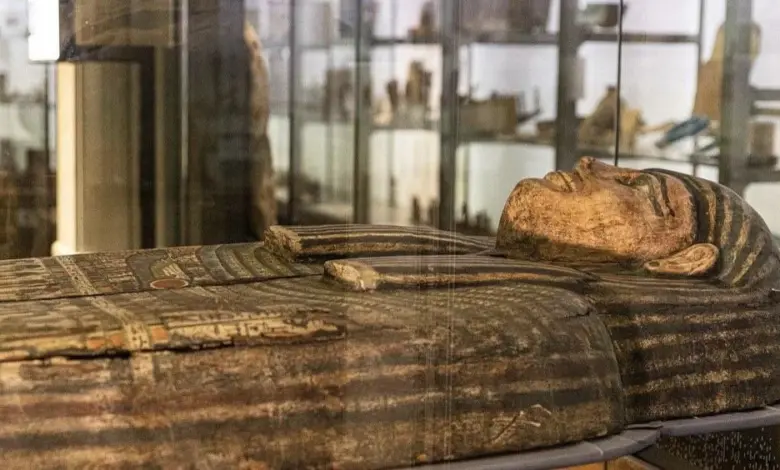
After more than two centuries under the public gaze, the Manchester Museum in the United Kingdom announced on Monday that it has removed the ancient Egyptian mummy Asru from the Egypt and Sudan Gallery.
She has been returned to her sealed outer coffin in a move the institution describes as a step toward aligning with her presumed funerary beliefs and spiritual wishes.
Why Manchester Museum took Asru off display
The Manchester Museum clarified in an official statement that its decision was not prompted by a written testament or an explicit message left by Asru herself.
Instead, it was informed by modern Egyptological understanding of ancient burial traditions.
For high-status Egyptians of Asru’s era, the expectation was that their mummified remains would rest indefinitely within protective coffins, fully wrapped and shielded from the eyes of the living.
Re-evaluating these cultural expectations led curators to reconsider the ethics of keeping her body exposed.
Museum officials emphasized that withdrawing Asru from public view reflects a broader shift in how global cultural institutions handle human remains, demonstrating greater accountability and deference to the heritage and sensibilities of source communities.
Who was the ancient Egyptian woman?
Asru lived in southern Egypt approximately 2,700 years ago and was buried in ancient Thebes, near modern-day Luxor.
Hieroglyphic inscriptions on her coffins preserve her identity alongside the names of her parents, including her father, Ba-Kush, who served as a scribe in ancient Egypt.
Her mummified body and ornate coffins arrived in Manchester during the early 19th century after being acquired by merchants William and Robert Garnett, who donated her to the Manchester Natural History Society in 1825.
In April of that year, her linen bandages were unrolled during a public unwrapping event in Manchester—a common practice of the era.
Her body remained on near-continuous display in the city for almost two centuries until museum leadership resolved to return her to her sealed outer sarcophagus.
A person before a museum exhibit
The decision to withdraw Asru coincides with a comprehensive ethical review by the Manchester Museum regarding the stewardship of human remains in its collections.
Throughout 2025, the museum initiated a public dialogue concerning Asru’s future, seeking feedback from visitors while consulting Egyptian researchers and diaspora representatives before reaching a final decision.
Egyptian scholar Marwa al-Hossary of the University of York noted that viewing Asru as a human being who lived and died—rather than a artifact behind display glass—raises critical ethical questions about whether institutions have the right to keep ancestral bodies perpetually exposed.
Is Asru leaving the Manchester Museum?
Removing Asru from public galleries does not mark the final chapter in her journey. She currently rests in her sealed outer coffin within the museum’s climate-controlled storage facilities.
Museum authorities confirmed that her current location is not necessarily permanent as they continue evaluating long-term care frameworks for human remains in their custody.
Future plans may involve creating a dedicated, private space within the museum for her rest, or considering wider discussions regarding repatriation to her country of origin.
For now, after nearly two centuries under museum lights, Asru rests quietly inside her closed sarcophagus, away from the public eye.