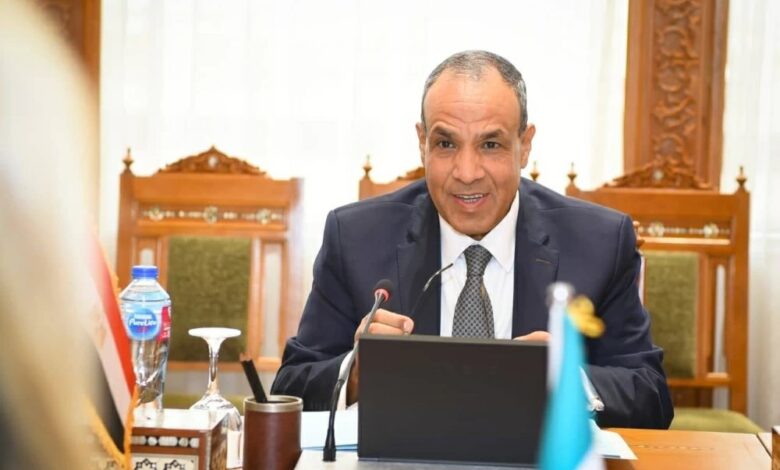
Egyptian Foreign Minister Badr Abdelatty said on Sunday that regional developments since October 7, 2023, have proven that any attempts to impose hegemony or redraw the map of the Middle East unilaterally will not succeed.
The Egyptian minister stressed that any future regional arrangements must be based on consensus among the countries of the region, which includes influential regional powers, RT reported on Sunday.
He emphasized that no country, regardless of its strength, can impose its will or dominance on others through coercion or military force.
Responding to a question about whether the idea of a “Greater Israel” or a redrawing of the region has become unfeasible, Abdelatty affirmed that any project based on imposing one’s will unilaterally will not succeed, and that the collective will of the region’s countries is the foundation for any future arrangements.
Regional Quartet
He stated that the “Regional Quartet” – which includes Egypt, Saudi Arabia, Turkey, and Pakistan – should be more accurately seen as a “platform for consultation and coordination” among four influential regional states, and not a military or political alliance.
This platform aims to enhance cooperation among the four countries in various fields, he explained, in addition to coordinating positions on regional issues such as the US-Israeli war on Iran, the course of negotiations, and post-war arrangements in the region.
The Foreign Minister revealed that the regional quartet has held four meetings so far, emphasizing the continuation of the consultation and coordination mechanism among the participating countries.
Abdelatty noted that Egypt is also coordinating closely with Saudi Arabia, the UAE, and the Gulf Cooperation Council (GCC) countries to develop a shared Arab and regional vision for the future of the region.
He assured that the door remains open for other regional parties to join, provided they adhere to the agreed-upon parameters.
Palestinian issue
Regarding Palestine, Abdelatty stressed that any arrangements concerning the control of weapons must be made within a Palestinian-Palestinian framework, and not through their handover to Israel.
Egypt is acting out of its national responsibility to preserve the Palestinian cause and prevent the continuation or expansion of the occupation, he added.
The minister warned that the plan to displace Palestinians remains in place, noting that making life inside Gaza Strip impossible could force residents to leave under the guise of “voluntary departure,” given the continued deterioration of the humanitarian, health, and environmental conditions, and the lack of any early recovery or rubble removal projects to date.