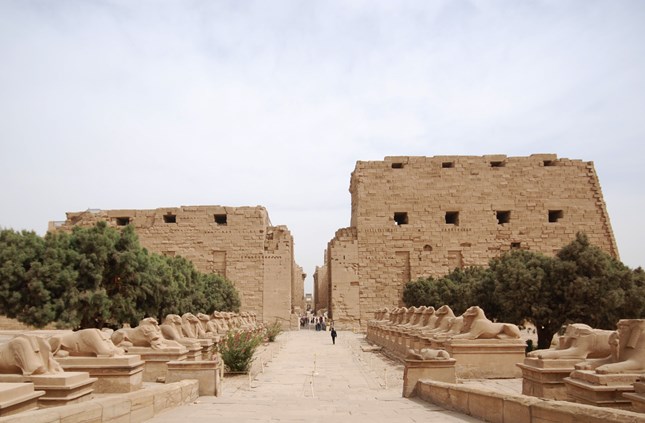
A specialized Egyptian scientific committee has recommended re-evaluating the sections used to complete the statue of King Ramses II, located in front of the Second Pylon at the Karnak Temple Complex in Luxor, RT reported on Sunday.
The committee also recommended studying the feasibility of dismantling the restored section atop the statue’s base, so long as it is confirmed that doing so will not impact the original part of the statue.
This recommendation follows from the committee’s comprehensive study of the statue, which revealed discrepancies in the type and color of certain blocks used in the restoration compared to the statue’s original sections.
Furthermore, the committee recommended conducting laboratory analyses on samples taken from the statue’s base—a section still in its original position—and comparing them with samples from the blocks used in the restoration.
This aims to verify whether the blocks belong to the same statue; should the results fail to match, those pieces would be excluded as having no confirmed connection to the statue.
Re-evaluation needed
The study also revealed discrepancies in the anatomical proportions of the restored section; its dimensions exceeded the statue’s presumed natural proportions.
Consequently, the committee recommended a scientific study to assess the feasibility of detaching this section, while ensuring the preservation of the original part and avoiding any damage to it.
At the same time, the committee instructed specialists at the archaeological site to search for missing fragments of the statue—including the upper part of the crown and a portion of the leg—and to examine any such pieces found to verify that they belong to the statue.
If the missing original parts are not found, an archaeological study will be conducted to determine their probable form and proportions, followed by an assessment of the archaeological feasibility of completing the statue, in accordance with international laws and charters governing restoration work.
The study concluded that completing the statue is not feasible; therefore, the discovered archaeological fragments will be preserved and stored rather than used in a speculative reconstruction of the statue.