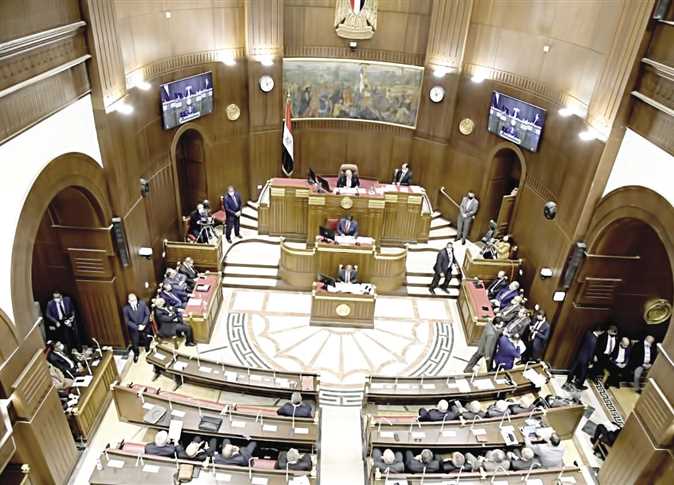
The Senate in Egypt gave its final approval on Sunday to a government-proposed bill amending certain provisions of the Electricity Law.
The amendment included Article 71 of the Electricity Law, aiming to toughen penalties for the illegal tapping of electricity, as part of the state’s efforts to protect public funds and reduce losses in the electricity sector.
The amended article stipulates a prison sentence of no less than one year and a fine of no less than LE50,000 and no more than one million, or one of these two penalties, for anyone who illegally taps into the electricity grid.
The minimum and maximum penalties are doubled in cases of recidivism.
During a plenary session of the Senate, the Vice Chairman of the Constitutional and Legislative Affairs Committee, Ahmed Helmy al-Sherif, presented the committee’s report on the draft law, clarifying that reconciliation in cases of electricity theft would only be possible after payment for the unauthorized consumption.
The Speaker of the Senate, Counselor Essam Eddin Farid, stated that electricity is the lifeblood of the nation’s economy and a cornerstone of its infrastructure stability.
Therefore, protecting the resources of this sector from any depletion has become an absolute necessity, requiring its fortification with robust legislative safeguards.
Rejections voiced
The head of the Tagammu Party, MP Sayed Abdel-Aal, announced his rejection of the draft law, asking: “What are the bases for electricity pricing? How much of its revenue is consumed by salaries and bonuses, and how much is allocated to the service and its continuity?”
Minister of Parliamentary Affairs, Counselor Mahmoud Fawzy, said that the government continues to subsidize electricity because it cannot afford a private sector monopoly on the service.
He assured that the government’s objective is not to generate commercial profits, but rather to serve the interests of its citizens.
Also announcing his rejection of the draft law was the head of the parliamentary body of the Egyptian Social Democratic Party, MP Mohamed Taha Aliwa.
He warned that it could open the door to imposing exorbitant fines, potentially starting at LE50,000 for ordinary citizens in villages or hamlets.
The current wording could place burdens on the most vulnerable groups that are disproportionate to their economic capability, he added.