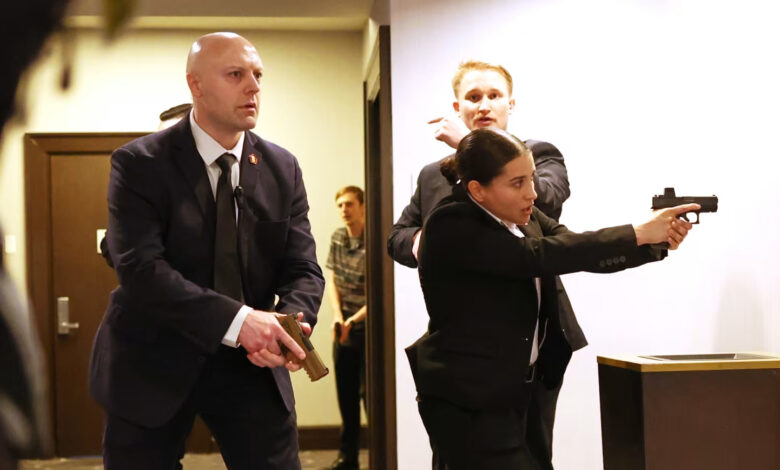
President Donald Trump, the acting attorney general and other top administration officials all publicly say the Secret Service responded as intended when a gunman tried to force his way into the White House Correspondents’ Association Dinner.
But behind the scenes, the incident at the Washington Hilton on Saturday night — in which the gunman sprinted through a security checkpoint before he fell and was subdued by law enforcement — has renewed questions about the long-simmering challenges facing the Secret Service, including staffing shortages, strain on agents and burnout.
Current and former Secret Service officials tell CNN personnel issues have plagued the agency for years, despite promises to address the problems.
“We have limited resources, and we use them as best we can,” one high-ranking former official told CNN. “The reality is we are stretched thin, and the agency is constantly playing catch up.”
Law enforcement experts and lawmakers raised concerns to CNN about vulnerabilities that the incident exposed. They included the security challenges of the hotel itself, as well as whether there should have been a larger security perimeter or additional agents on site for an event where the president, vice president and most of the Cabinet were all gathered.
“Having attended a lot of events — and certainly having attended events with the president and Cabinet — (security was) woefully insufficient when you’re talking about that many people getting into a room of that size,” Rep. Mike Lawler, a New York Republican, told CNN’s Manu Raju on Sunday.
“And the Secret Service did their job when they encountered him, and they were able to stop him and detain him. But it shouldn’t even have come to that,” Lawler added. “He shouldn’t have been anywhere in that vicinity to begin with.”
After the 2024 attempted assassination of Trump in Butler, Pennsylvania — and subsequent probes that exposed significant Secret Service failures — there was momentum to hire and train more agents, said Jonathan Wackrow, a former Secret Service agent and CNN analyst who has helped preparations for the annual dinner.

But instead, the Trump administration focused on training new agents for Immigration and Customs Enforcement for its deportation push, creating a logjam at the Federal Law Enforcement Training Center, Wackrow said.
“The moment to do it was at the very beginning of this administration, when you had the momentum out of Butler, out of the bipartisan recommendations,” Wackrow said. “You had some budgetary support to push through a hiring campaign and get those people through the pipeline. But then the focus was on ICE.”
Since Saturday’s shooting, top Trump law enforcement officials, including acting Attorney General Todd Blanche and Secret Service Director Sean Curran, have dismissed concerns about possible security lapses.
“It was a massive security success story,” Blanche told CNN’s Dana Bash on Sunday. “This man, from what we know from video surveillance and from witnesses who were there, barely got past the perimeter. He was immediately subdued.”
Curran, who began briefing Congress on Monday about the episode, told reporters on Capitol Hill he was “very confident” in the agency. “My agents did a great job,” he said.
Asked why the security perimeter wasn’t farther out, he said, “There’s a reason, but I’m not going to get into that. It’s classified. I don’t want to get in to why we do that, but there’s a reason.”
Pushing the security perimeter farther out would have required more staffing, one source familiar with Secret Service operations said, presenting an additional challenge for an agency that was already stretched thin.
While senior law enforcement officials say that the system worked as intended, there are questions about why there was no one to confront the shooter before he reached the security checkpoint.
Another source familiar with Secret Service procedures expressed concerns about the possibility that no one was assigned at the floor entry point to the ballroom area.
“No protectees were harmed, so count that in the win column,” the source said. “Are there things you can do better? Absolutely.”
‘My family wants me to quit’
Saturday’s assassination attempt is the latest episode drawing scrutiny of the Secret Service, an agency tasked with protecting the president and vice president, their families, former presidents, presidential candidates, as well as others dignitaries, including White House officials and foreign leaders on US soil.
For several years, sources have expressed intense frustration over having to do more with fewer resources. And sources say the departure of numerous agents and officers who have either retired or sought law enforcement work at other agencies has placed a significant strain on the Secret Service’s protective operations.
“We were crucified after Butler,” said another source involved in protective operations, referring to the 2024 attempted assassination of Trump in Pennsylvania, “yet saw no real significant increase in personnel to help do the job.”

Sources also say that current Secret Service agents bristle at the sheer number of Trump family members and staff the already stretched agency is charged with protecting. In addition, the agency is responsible for covering the “erratic” and ever-changing travel schedules of top protectees including the president and vice president, the sources said.
Trump also requires a large footprint because of the increased number of threats, as well as his attendance at events that draw large crowds, such as UFC fights.
“I love the job, but my family wants me to quit,” said one source, who acknowledged that the demands of covering Trump and Vice President JD Vance have caused problems at home.
Delays and caps on overtime pay
The Secret Service is seeking to hire 4,000 new employees by 2028 to ease the burden on agents. But that effort, which was confirmed by a source to CNN and first reported by the Washington Post in January, remains “aspirational” in reaching those numbers and getting that many new agents trained.
CNN reported in 2024 that the Secret Service had approximately 8,100 employees, including 3,800 special agents and 1,500 uniformed division officers.

A Secret Service spokesman said there were “no staffing shortages” to the agency’s Presidential Protective Division.
“The security plan and layered protective model for the White House Correspondents Dinner was effective in interdicting the threat posed by the gunman,” the spokesman said.
Curran said in congressional testimony earlier this month that the agency’s goal was to increase staffing by nearly 2,000 law enforcement personnel by the end of fiscal year 2027. The president’s budget request included increased funding for more than 850 positions, he said.
Curran said that the agency’s operational demands have risen sharply in the last two years, including 37% more protective visits in fiscal year 2025 compared to 2023, and more than double the number of magnetometer screenings.
In addition, agents on some of the security details operated by the Secret Service have been told they may be required to work more than 20 hours of overtime per week, according to law enforcement sources.
While agents generally get paid extra for overtime, sources said, US government pay caps can often result in some overtime pay not arriving in their bank accounts until the following year. Due to the current shutdown involving the Department of Homeland Security, many agents have still not received overtime pay accrued in 2025.
Sworn law enforcement officers for the Secret Service and other DHS agencies are still receiving their regular paychecks during the shutdown — which has dragged on for more than two months now — through the “Big Beautiful Bill,” according to a senior administration official. All other agency employees are currently being paid through the president’s executive order, the Secret Service spokesman said.
One former senior official said that some agents are on pace to reach a higher cap that cuts off additional overtime pay halfway through the year — and they will still have to keep working overtime for the rest of the year because there are National Special Security Events (NSSE) upcoming that will not allow agents to take leave, including the World Cup and celebrations for America’s 250th birthday.
Securing a sprawling hotel
On Saturday, the suspected gunman, Cole Tomas Allen, was stopped before reaching a flight of stairs leading to the ballroom where Trump, Vance, Cabinet members, lawmakers and top reporters and editors were all packed into the Washington Hilton’s cavernous ballroom.
Allen, who was charged with attempting to assassinate the president, was a guest at the Washington Hilton, which meant he was already at the hotel before the dinner began.
Sources noted that because the ballroom is part of a large hotel, it’s virtually impossible to completely secure hotel rooms without infringing on the rights of guests.
It’s unlikely the service would have legal standing to search guest rooms, the sources added, and even if they did, ensuring rooms remain secure once they’ve been searched would be challenging.

A law enforcement source said the FBI is going through hotel video from the last couple of days, as well as surrounding streets, looking for both internal and external video of the suspect, including to see if he walked the route he took to the security checkpoint before the dinner.
In the charging documents, investigators said that agents heard a loud gunshot as Allen ran through the checkpoint. A Secret Service officer was struck in his protective vest, authorities said.
The officer who had been shot fired multiple times at Allen, according to the court filings, and the suspect “fell to the ground and suffered minor injuries” but was not shot.
US Attorney for the District of Columbia Jeanine Pirro said that Allen was not injured aside from “some kind of scrape on his knee.” It’s still not clear whether the officer was struck by shots fired by Allen.
Inside the ballroom, Secret Service agents protecting the president and vice president swiftly took to the stage. According to video of the incident, Vance was removed first, followed by the president.
While there have been questions since about how the president was evacuated, CNN reported Sunday that the sequence appears to follow the Secret Service procedures, which includes measures that may not be visible.