A parent recently told me she’s struggling to get her otherwise well-behaved and academically successful daughter to attend class. Her daughter is regularly late or absent, she complained, and her mom fears her daughter might not graduate high school and have her college admission rescinded.
What’s going on? Her mom, who encourages making mindful choices about technology at home, thinks using technology at school is leaving her daughter stressed and exhausted. Human beings have evolved to interact with one another, use our bodies and be outdoors — not stare at screens all day, she pointed out.
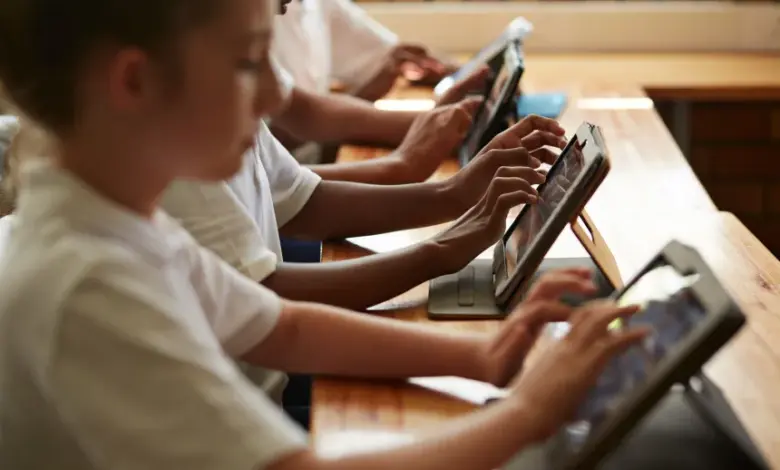
She’s just one of the many parents telling me they’re concerned about what screens in schools are doing to their kids. The vast majority of US public schools — 88 percent — now issue devices to every student, according to a 2025 National Center for Education Statistics survey. My own town’s public schools use a lot of technology, and I’m worried about my daughters, too.
That’s why I wasn’t surprised by the results of an otherwise baffling new study, which found students putting away their phones didn’t seem to meaningfully improve learning outcomes.
I suspect that’s because schools are giving students other forms of technology to replace their personal devices, despite a wide body of evidence showing that educational technology generally makes it harder for students to learn.
Kids perform worse on computers
Students who use computers more perform worse academically, neuroscientist Jared Cooney Horvath documented in his book, “The Digital Delusion: How Classroom Technology Harms Our Kids’ Learning — And How To Help Them Thrive Again.” These results show up in numerous reliable international standardized tests, Horvath explained in congressional testimony.
Recently, public school officials in my town held a session in which they encouraged parents to get their kids off screens at home. It’s good advice, and I share it when I speak to parents across the country to offer tips and tricks about how to responsibly manage their kids’ screen time. But the problem is that those same (probably well-meaning) school officials are letting our kids use technology at school.
One parent told me her daughter’s middle school social studies teacher hasn’t taught a single lesson the entire school year. Her daughter just does exercises on a digital device.
“There could have been such good discussions on women’s rights, religion and power dynamics and yet now my daughter doesn’t care at all,” the mom said. “It is just about how she can get through the hours of online forms.”
This is outrageous — and devastating.
The data is clear that students almost always learn best without technology, so I believe K-12 schools will eventually come around to reducing or eliminating screens. Los Angeles passed a resolution in April limiting screen time in schools. The problem is that by the time other districts follow suit, it may be too late for the generation of kids who are using screens in school right now — including mine.
Screens don’t belong in schools
Of course, I’m happy for my daughters to learn how to use a computer and how to protect themselves online in their technology class. But they should be learning to read, write and do math on paper, not computers.
Study after study shows that students’ comprehension is better when they read printed material, rather than content on screens. Similarly, they comprehend more when they write notes by hand rather than typing them.
In addition to reducing how much students learn, screens are bad for their physical health. Using screens more significantly increases the risk that students will become nearsighted. Also, using screens is a sedentary activity, but the human body needs to move. That’s why lessons that engage the senses and involve physical activity are especially important.
I especially worry that the features used in digital technology — think videos and games designed to keep kids glued to the screen with features such as rewards and fast-moving content — will make it harder for students to develop the focus and commitment to do what learning often requires: reading, research, thinking and studying. These things are often slow and time-consuming, and they don’t offer constant stimulation.
Screens also, of course, can’t teach students to have appropriate interactions with other human beings — skills that will be essential for their future careers and long-term well-being.
Parents also should worry that, on school devices, kids could connect with predators, access harmful content, be catfished or face other online dangers, said Lindsay Lieberman, a Washington, DC-based attorney who represents victims of online abuse.
“Kids are always going to out-tech us. We are never going to be able to make technology in such a way that kids will not be able to figure out how to get around whatever safety barriers we put in place,” Lieberman said.
Lieberman shared numerous games one 8-year-old boy was able to access on his school-issued device, including one that asks users to make life decisions such as whether to wear a condom.
What parents can do now
Parents have the right to know what sites are receiving their kids’ data and to opt out under the Children’s Online Privacy Protection Act, Lieberman said. “We have a right under federal law to say we don’t want our kids on these platforms,” she said.
However, in Washington, DC, where her children attend school, she said there wasn’t a clear opt-out process or alternative curriculum available.
Now, she’s part of a group of parents and teachers asking DC public schools to reevaluate their screen use. I’m also part of a group of parents in my community who have come together to advocate for limiting screens in our schools. If you want to do the same, Lieberman recommended the resources available from Distraction Free Schools and Schools Beyond Screens.
In addition to having these conversations with your child’s school, it’s a good idea to limit your child’s screen time at home and especially to encourage your child to do their homework and studying without digital devices.
Lieberman got involved in the cause after her child learned about the fictional band featured in the movie “KPop Demon Hunters” by watching music videos in public kindergarten. That’s exactly where my daughter learned Rosé and Bruno Mars’ hit song “APT.”
As I joked at the time to my husband, where else would we have expected our 5-year-old to pick up a song about a Korean drinking game? It’s clearly time to rethink the technology in our kids’ schools.
Get inspired by a weekly roundup on living well, made simple. Sign up for CNN’s Life, But Better newsletter for information and tools designed to improve your well-being.