Endorsed by eight foreign ministers, the latest statement has delivered the clearest possible message: Egypt is not alone in its complete rejection of Israel’s announcement.
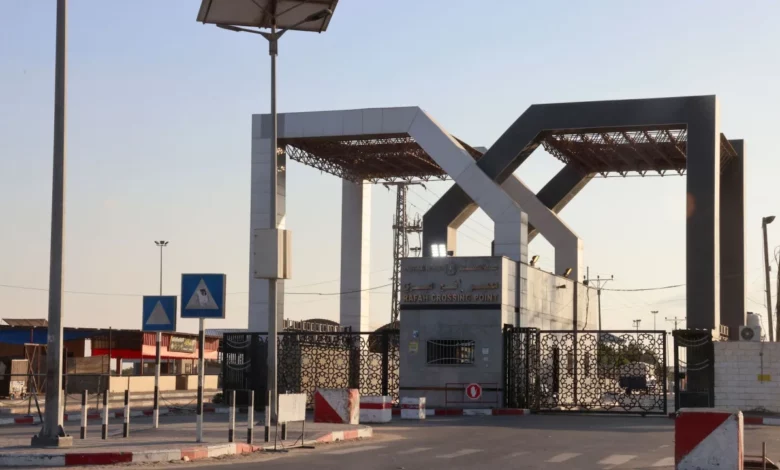
The government in Tel Aviv had announced that it would open the Rafah crossing in the coming days, stating that this would be exclusively for the exit of Palestinians from Gaza into Egypt, and that the move to open the crossing was coordinated with the Egyptian government.
Egypt swiftly and utterly denied Israel’s claims of cooperation.
The most important thing that Israel’s manipulation reveals is that displacement is obsessively dominating the Israeli government, akin to a sickness than anything else.
They never stop talking about it, except to look for a trick that allows them to return to the subject again.
The topic of displacement has been raised repeatedly, and each time it has faced absolute rejection from the Palestinians themselves, even before it faced similar rejection across the region and globally.
Every time Israel has attempted to move displacement from the theoretical realm to practical reality, the attempt has failed.
Despite this, the matter clings to the Israelis as if it were a demon.
The eight nations whose foreign ministers signed the statement are Egypt, Saudi Arabia, the UAE, Jordan, Qatar, Turkey, Indonesia, and Pakistan.
This signifies that the rejection is not solely Egyptian, nor is it merely Arab; rather, it is a combined Egyptian, Arab, and Islamic rejection.
This is not the only meaning carried by the statement.
From its lines, it will become clear that the Trump plan to stop the war in Gaza stipulates the opening of the Rafah crossing in both directions, not just one as the Israeli government desires.
If that is the case the world, which is monitoring Israel’s folly, must be awaiting another statement from Washington to place the crossing issue exactly where it stands in the US President’s plan to halt the war.
The world awaits such a statement alongside the one from the eight ministers, hoping that Israel realizes that the displacement, which failed to occur throughout two years of war, will not succeed now that the war has stopped.
However, a crucial caveat must be made: the war hasn’t truly ended. Palestinian blood is still being profusely shed despite the signing of the ceasefire agreement on October 13.
Israel does not want to understand that the rejection of displacement in Egypt is not limited to official government refusal but extends to full popular rejection, with all that the word “popular” implies.
Author’s biography
Soliman Gouda is a prominent figure in Egyptian journalism, known for his leadership roles and insightful commentary.
He previously served as the Editor-in-Chief of Al-Wafd newspaper and currently writes columns for Al-Masry Al-Youm.
Beyond his journalistic output, Gouda is highly regarded in the professional community, evidenced by his role as a Member of the Arbitration Panel for the Bahrain Journalism Award. A recognized writer, he wrote seven books and is the recipient of five journalism awards, including the Ahmed Amin award.