It wasn’t your typical concert experience.
I watched Billie Eilish from a perspective that felt like I wasn’t in the audience or behind the scenes, but somewhere in between: hovering near the stage alongside the singer as she grasped a fan’s hand in the front row.
This is what it’s like to watch a clip from Eilish’s 3D tour special shot in Arizona and Manchester, England, with Meta’s new VR Glasses. CNN tried the glasses at Meta’s offices in New York last week ahead of their launch in the spring. Meta is banking on experiences like Eilish’s show to make its new eyewear a hit.
Those glasses, along with camera-free Ray-Ban Meta Audio glasses launching Tuesday, are part of the social media giant’s decade-long ambition to develop what it believes will be the next version of the personal computer.
Meta’s previous efforts in this space and its big bet on the metaverse have largely flopped, but the company is convinced things will be different this time. It’s betting that integration with AI agents, stylish designs and more advanced display technology will convince consumers the glasses are the future, despite widespread privacy concerns that have prompted bans and global pushback.
Using Meta’s new glasses
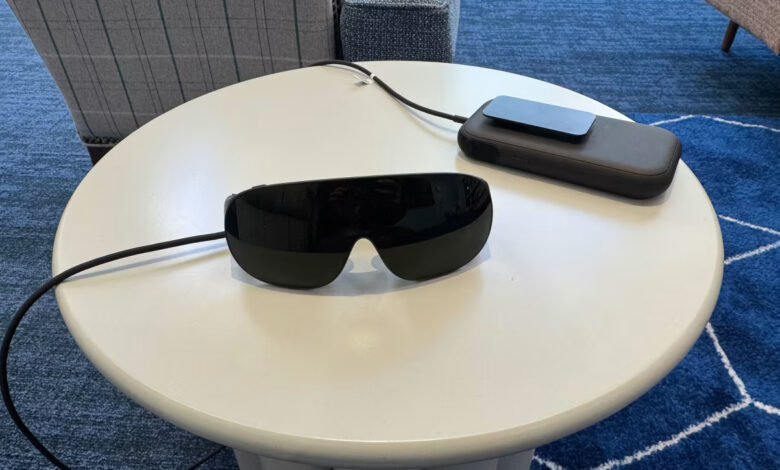
Meta is pitching next year’s new VR glasses as a computer, game console and movie theater in one. The glasses, which are priced at about $1,300, aren’t anything like the Quest VR headsets Meta has been selling for years, which weigh about 18 ounces and look like a visor or helmet rather than glasses.

Instead, the new version resembles a giant pair of sunglasses and weigh about 3.5 ounces. That’s because the computing components are stored in a separate module attached to the glasses with a wire.
Users interact with apps by using their eyesight as a mouse and tapping their thumb to their index finger to click. These gestures were easy to learn, although scrolling took a little practice. That involved making a fist and moving my thumb along my index finger as if it were a trackpad.
The VR glasses seem to function as a substitute for personal computers and televisions. A user can watch a movie or work across multiple displays like they normally would with their laptop or flat screen.
The goal, said Ryan Cairns, Meta’s vice president of VR, is not to replace existing computers but to expand how and where consumers can use them.
“I can put VR glasses on in the plane and basically have like three monitors’ worth of work in front of me,” he said.

Meta’s Ray-Ban AI glasses, on the other hand, are meant to be worn all day like normal glasses but can handle some of a smartphone’s tasks like getting directions, listening to music and answering questions.
Its newest Ray-Ban glasses don’t have a camera, excluding a controversial feature that raised widespread privacy concerns. The glasses have speakers and microphones, but Meta says the mic is limited to phone calls and talking to its AI assistant. It’s like having AirPods built into your glasses.
The idea isn’t new. Amazon has been selling Alexa-enabled smart glasses with microphones and speakers since 2019, and a wave of startups have also launched audio glasses without cameras. Meta decided two years ago that it wanted to launch audio-only AI glasses in 2026 because people frequently use their glasses for talking on the phone or listening to podcasts, said Alex Himel, Meta’s vice president of wearables.
Meta also still sells other glasses with cameras and launched an upgraded version of those spectacles last month called the Ray-Ban Meta Gen 3. The new glasses have a lighter design, a shortcut button and longer battery life, according to the company.
Meta’s quest to own the future of computing
Meta missed out on the mobile boom, ceding control of the tech devices that serve as the portal to its services to companies like Apple, Google and Samsung, thus interfering with Meta’s core advertising business. Meta CEO Mark Zuckerberg said in 2022 that an iPhone optional setting that blocks apps from tracking users across the internet would cost the social media behemoth $10 billion in earnings that year.
Meta has spent more than a decade trying to reduce its dependence on hardware makers by releasing everything from a Facebook-branded phone to a smart home hub and VR headsets.
“There was always a very strong desire: ‘How do we have people on our own platform so we have a little bit more control?’” said Ash Saulsbury, CEO of AI company Awear, who worked in Meta’s wearables division from 2017 to 2019.
Smart glasses are gaining popularity, with shipments expected to grow 263% in the first half of 2026 and more than 7 million AI glasses sold by Ray-Ban parent EssilorLuxottica last year. But those glasses have sparked privacy concerns, and Meta’s previous hardware efforts failed to excite consumers. The company’s Reality Labs division, which includes its smart glasses and VR headsets, continues to lose money while VR headset sales have been declining industry-wide.
“The glasses are still a little bit of a solution chasing a problem,” said Daniel Newman, CEO of technology market research and advisory firm Futurum.

For Meta, there’s more at stake than just a market share of the tech products needed to operate apps.
Meta’s new hardware could give consumers more direct access to its Muse AI agent, which is key in determining how it compares with rivals like OpenAI and Google in the AI race. With glasses like the Meta Ray-Bans, users simply speak to the assistant and show it what’s in their surroundings rather than opening an app and typing a question or taking a photo.
For the VR glasses, Muse will be able to work across multiple projects and tasks managed across various virtual windows and apps, said Cairns. The glasses will ship with Muse, including support for the new Muse Wonder model announced on Monday and any other updates between now and then, he added.
Still, Meta is taking a chance that consumers are willing to add another device to their lives, especially as AI agents become more prominent in gadgets people already own. The optimistic view hinges on how much AI mirrors the smartphone boom, according to Jitesh Ubrani, who covers consumer tech for market research firm The International Data Corporation.
He compared Meta’s AI and glasses gamble to the rise of Uber or Lyft, as hailing a car ride through an app only became common with the growth of smartphones.
“Consumers essentially are just seeing AI today as a simple chatbot,” he said. “They don’t realize how powerful and capable it can be. And both AI and these glasses kind of go hand in hand right now.”