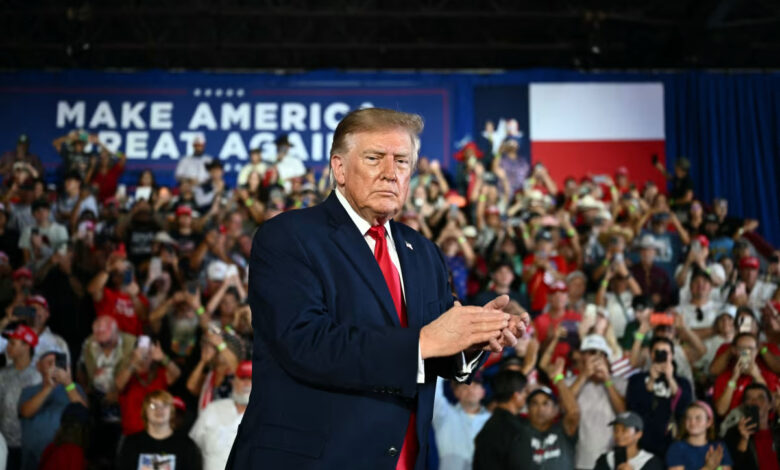
When President Donald Trump signals he might not accept the result of an election, he’s worth taking seriously.
By now, in his fifth national election as Republican Party leader, Trump has an established MO. He spends months whipping up doubts about the voting system and the integrity of election officials while suggesting Democrats may cheat.
Then, he weaponizes the vortex of mistrust he created and implies before votes are counted that the election may not be fair.
A week from Election Day, it feels more like Groundhog Day.
Trump was asked Tuesday if he will accept the midterm election results, which could mean a tough night for the GOP, “whatever happens.”
This would hardly be a question for another other modern president. But Trump’s reply came with a caveat made all the more ominous by his past conduct: “I will, if they are honest elections, yeah.”
There’s a lot to be worried about here, beyond the equivocation of his answer. That’s because Trump effectively presents himself as the sole referee of the probity of an election. When he lost the presidential election in 2020, he falsely claimed fraud, despite multiple Republican officials, courts and even his own Justice Department proving there were no such irregularities.

Trump’s latest hedging over an election came in a threatening context. He’s spent much of this year trying to skew the midterms in the GOP’s favor by pushing a midterm gerrymandering effort in Texas and other states and by unsuccessfully demanding Congress pass a voter registration and ID law that critics say would disenfranchise millions of citizens.
And he recently ordered the Justice Department to sue to block certification of Alaska’s US Senate election if Republican Sen. Dan Sullivan loses, even though the Constitution grants a president no power to administer elections.
Trump insists that a separate candidate named Daniel J. Sullivan could confuse voters and that his candidacy is a Democratic conspiracy. Alaska’s Supreme Court has ruled the second Sullivan can legally run in the election.
In another preemptive strike, the DOJ on Friday ordered California to identify suspected noncitizens on voter rolls and set aside their mail-in ballots — warning that officials who knowingly count noncitizens’ ballots could face criminal liability.
A federal appeals court blocked that DOJ gambit.
In Alaska, Democratic challenger Mary Peltola has asked a judge to strike down the DOJ move before Election Day. But the administration’s maneuvering raises the possibility of a post-election showdown. And in contrast with 2020, when then-Attorney General Bill Barr rebuffed Trump’s accusations of expansive electoral fraud, the department seems less likely to contradict him this time.

Why Trump’s remarks are so worrying
The scars of one of the darkest days in modern American history — January 6, 2021 — mean that Trump’s latest election maneuvering is particularly loaded.
Months before MAGA supporters smashed their way into the US Capitol, some beating up police officers, Trump had been poisoning their confidence in the 2020 election with remarkably similar language to that he used on Tuesday.
“I hope it’s going to be a fair election. If it’s a fair election … I am 100% on board,” Trump said in his first presidential debate against Joe Biden in September 2020. “But if I see tens of thousands of ballots being manipulated, I can’t go along with that.”
Four years later, when Trump was asked by Dana Bash at a CNN presidential debate whether he would accept the result of the election regardless of who won, he replied: “If it’s a fair and legal and good election — absolutely.”
Trump did not dispute the results in 2024. The reason is obvious: He won. Four years earlier he’d lost.
Trump’s serial election denialism in the absence of any widespread US election fraud raises the question of why he, alone among presidents, can’t accept the democratic reality that sometimes you lose elections.
One answer is that Trump has given plentiful evidence that he cares more about power than the principle that voters get to pick their leaders.
Another is that Trump has built a personal brand as one of life’s ultimate winners. This brittle veneer is incompatible with any perception of being a loser — one reason he still can’t admit he lost to Biden in 2020.
But what might he try to do if the election goes badly for Republicans this time?

The DOJ’s intervention in Alaska implies a post-election legal campaign if Peltola tallies one of the four net gains that Democrats need for a Senate majority. Similar moves elsewhere cannot be ruled out.
Republican elected officials and attorneys general in key states can expect to come under withering pressure from Trump, if his failed bid to force GOP officeholders in Georgia to “find” votes in the 2020 election is any guide. There’s now no Barr equivalent to debunk potential claims of fraud. Current Attorney General Todd Blanche said on NBC’s “Meet the Press” in August that he could not pledge the department would always act independently of Trump.
On Sunday, Blanche said on CNN’s “State of the Union” the administration was doing nothing “improper” in Alaska and simply wanted to ensure the rightful person wins, saying, “President Trump is not trying to take over a state election in any way, shape, or form.”
But he vehemently rejected the idea that the president’s attempt to overturn the 2020 election justified any concerns about his remarks smearing the 2026 midterms: “It’s not a conversation about January 6.”
In 2020, America’s legal and constitutional guardrails held firm. But Trump is now less encumbered by aides ready to temper his most antidemocratic instincts.
Still, Democrats and state officials of both parties who oversee elections have had months to prepare for potential threats from White House officials and local MAGA operatives.
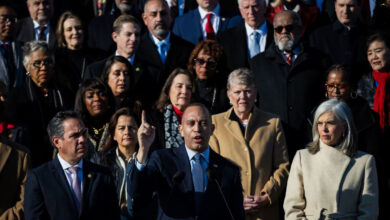
If Democrats win big, Trump may have less latitude to interfere. If the result is closer, it is possible that prolonged legal battles could deadlock the fate of the Senate for weeks. Hakeem Jeffries, the likely House speaker if Democrats win a majority, last week told CNN’s Manu Raju he assumed Republicans would “try to come up with any diabolical scheme to prevent November 3rd from being a free and fair election.”

And it’s not unprecedented for the seating of a new senator to be challenged, according to lawyer and elections expert Ben Ginsberg. “It is done really rarely. It rips apart the fabric of the institution of the Senate when it happens,” Ginsberg said on CNN’s special election coverage on Sunday.
Trump could have powerful incentives to challenge unfavorable election results, since Democrats are already planning a relentless campaign of investigations into the White House, the Cabinet and the Trump family’s financial dealings.
But would a lame-duck president with an approval rating in the 30s who’d just lost a major national election have the political juice to pull it off?
And Trump’s self-absorbed campaign posture has indicated little concern for vulnerable Republicans. He may simply care less when his name isn’t on the ballot.
The president seemed Tuesday to be at least contemplating a period of bitter cohabitation with a Democratic Congress. “Look, I have a strong veto. I hope that won’t be the case, but if it is, that has happened before with many presidents,” he said.
But Trump often follows through on his threats. And his latest electoral caveating shows he still thinks an election he loses must be unfair.
So it’s a good idea to take him at his word.