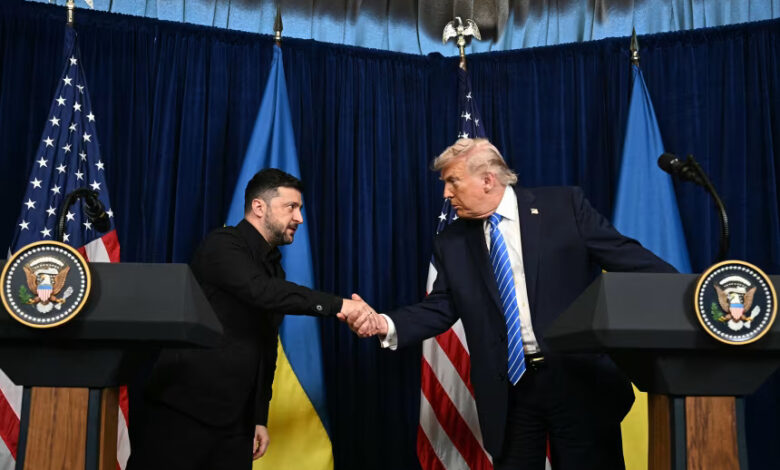
It seemed, at least superficially, to have been one of the better face-to-face meetings between Presidents Donald Trump and Volodymyr Zelensky, their sixth in a year that has seen this relationship fray to breaking point and require regular and painstaking repairs.
The mood, as they emerged from the dining room at Mar-a-Lago was conciliatory. Zelensky wore a suit – the same austere black compromise statement he had worn at the White House in October. Trump called the meeting “terrific” and asked if Zelensky and his general who “looks like central casting” had enjoyed the food. Awkward, yes, but a far cry from the open humiliation of the Ukrainian leader that played out in the Oval Office in February.
And yet, beneath the veil of politeness, there was rhetoric from the US president that suggests his default position in negotiations is still to pressure Kyiv, while appeasing Moscow.
On the toughest question of all – territory – Trump at one point suggested it might anyway be “taken” in the coming months, asking, “are you better off making a deal now?” It was a line eerily similar to that of Kremlin aide Yuri Ushakov, summarizing a call between President Vladimir Putin and Trump earlier on Sunday: “Given the situation on the front lines, it would make sense for the Ukrainian regime to adopt this decision regarding Donbas without delay.”
That echo wasn’t lost on the Kremlin. Putin’s spokesman Dmitry Peskov noted on a call with journalists that Trump “apparently reminded them (the Ukrainian side) that Ukraine is losing land and will continue to lose it.” While Russian forces continue to inch forward in the eastern Donbas region, Putin has demanded that Ukraine cede land that Russia has yet to seize.
The Kremlin would already have been confident in its power to sway the US president. In the lead-up to the Alaska summit between Trump and Putin in August, European leaders worked hard to bring Trump round to the idea that a ceasefire was needed before peace negotiations, something Moscow has always dismissed. In the end, it was Putin who won that argument, and, more than four months later, Trump still appears to support his view.

“He (Putin) feels that, look, you know, they’re fighting to stop and then if they have to start again, which is a possibility, he doesn’t want to be in that position. I understand that position,” Trump said Sunday.
The apparent removal of a ceasefire from the table has now created a new impasse. While Ukraine is sounding increasingly open to discussion of territorial concessions, Zelensky has made it clear that giving up, or changing the status of, Ukrainian land would likely require a referendum, something he says cannot happen without a ceasefire lasting at least 60 days.
No ceasefire then means no referendum, and no referendum could mean no territorial concessions from Ukraine, and ultimately no deal. So, we’re back on the diplomatic merry-go-round, buying more and more time for Russia to attack.
“Russia wants to continue to put pressure on us. And what does this continuation look like? War, missiles, artillery,” Zelensky said in comments to journalists Monday morning. As he spoke, most Ukrainian regions started a new week with regular blackouts, and more than 9,000 households in the Kyiv region woke up with no power at all.
Hardly surprising then, that the Ukrainian president shifted uncomfortably from one foot to the other as he listened to Trump describe Putin as “very good” on the issue of the Zaporizhzhia nuclear power plant, which Russia seized by force in March 2022 and has occupied ever since.
“President Putin is actually working with Ukraine on getting it open. That’s a big step when he’s not bombing that plant,” said the US president.
The Zaporizhzhia plant is currently undergoing repairs to nearby power lines to prevent a nuclear accident, according to the International Atomic Energy Agency. The facility has been cut off from its external power supply 12 times since Russia’s occupation, and earlier this month the UN’s nuclear watchdog warned that Moscow’s constant attacks on Ukrainian energy infrastructure are also a threat to its security. “Persistent instability in Ukraine’s electrical grid continues to undermine nuclear safety,” said Director General Rafael Grossi.
On one critical issue for Ukraine there has been a small step forward: security guarantees. Up until now, Kyiv only had verbal assurances the US would participate in post-war security guarantees, after Trump shifted his position in August. Now these assurances are in writing, albeit with a 15-year expiry date – which Zelensky wants extended – and still in need of congressional approval. The guarantees would not mean US troops on the ground, but at least there would be support for Europe if they decided to send theirs. “We’re going to help Europe 100%, like they’d help us,” said Trump.

And yet until Russia and Ukraine can come together for direct talks, which Zelensky hopes could happen in January after another circuit of discussions with allies, all of this is hypothetical. That prospect seemed even more remote Monday after Russian Foreign Minister Sergey Lavrov accused Kyiv of attacking one of Putin’s residences, promising Moscow would “review” its negotiating position as a result. Zelensky rejected the claim as “another lie” from Russia.
Peskov, the Kremlin spokesperson, reiterated Monday that Russia wants “the withdrawal of the regime’s armed forces from Donbas beyond its administrative borders.” That, of course, includes territory Russia hasn’t been able to occupy in nearly four years of war. And in return Moscow continues to receive praise and diplomatic overtures from the White House, with Trump speaking to Putin both before and after his meeting with Zelensky.
The diplomatic merry-go-round revs up again now going into 2026, with adviser-level meetings followed by a gathering of the “Coalition of the Willing” in Paris in early January, and then a potential Washington summit with Trump, Zelensky said Monday. Meanwhile the Trump administration has proposed that discussions continue in several working groups, an idea endorsed by Moscow.
And yet in this now largely predictable cycle, you can’t rule out a sudden shift. In October, a frustrated Trump slapped sanctions on Russia’s oil giants, a move that has caused Russian oil prices to plummet to their lowest level since the February 2022 invasion.
“Maybe the tug of war for Trump is not lost for Ukraine yet. The leaders are meeting, conversations ongoing,” wrote Orysia Lutsevych, head of the Ukraine Forum at London-based think tank Chatham House in a post on X. Former Russian diplomat Boris Bondarev struck a less optimistic tone. “If you want to delay anything for (an) indefinitely long time – create a few working groups,” he wrote.
CNN’s Kevin Liptak, Victoria Butenko, Darya Tarasova, Issy Ronald, Svitlana Vlasova, Mitchell McCluskey and Aditi Sangal contributed to this report.