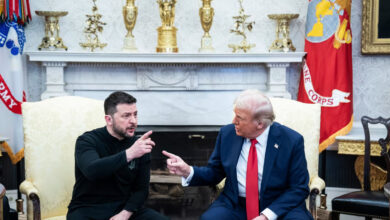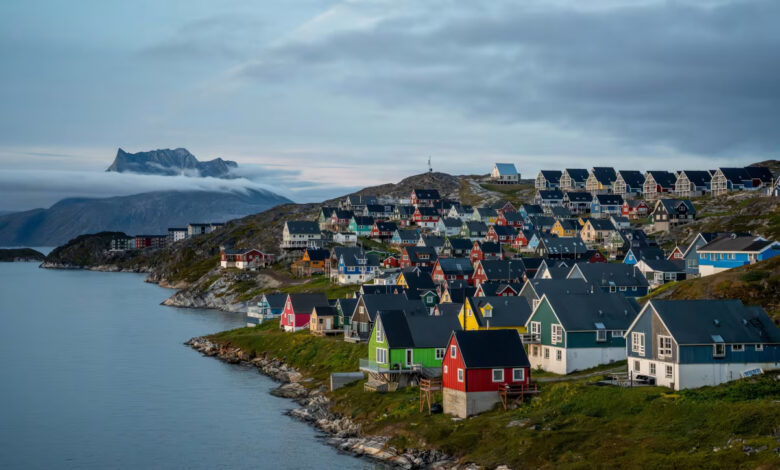
Amid increasing concerns that Greenland, a vast Arctic territory ruled by Denmark, is still being coveted by the Trump administration, the Danish prime minister has delivered a stark warning to the White House.
In nationally televised remarks, Mette Frederiksen reminded Danes that she had already “made it very clear where the Kingdom of Denmark stands, and that Greenland has repeatedly said that it does not want to be part of the United States.”
But she also warned of the consequences of US military action to seize Greenland – something US President Donald Trump has pointedly refused to rule out.
“First of all, I think you have to take the US president seriously when he says he wants Greenland,” Frederiksen said, reflecting heightened anxiety about Trump’s intentions in the aftermath of his extraordinary military action in Venezuela.

“But I also want to make it clear that if the US chooses to attack another NATO country militarily, everything stops, including NATO and thus the security that has been provided since the end of World War II,” she added.
It is a serious and widely shared concern among NATO allies that the Greenland issue has the potential not only to anger and humiliate a longtime US partner, but also to fracture the Western military alliance as pressure from Washington escalates.
Trump repeated on Sunday that the US needs Greenland “from the standpoint of national security.”
“We need Greenland … It’s so strategic right now. Greenland is covered with Russian and Chinese ships all over the place,” Trump told reporters aboard Air Force One. “We need Greenland from the standpoint of national security, and Denmark is not going to be able to do it.”
Late Monday, White House deputy chief of staff for policy Stephen Miller reiterated those claims that “Greenland should be part of the United States,” but he rejected that military force would be necessary to acquire it.
“Nobody’s gonna fight the United States militarily over the future of Greenland,” Miller said on CNN’s “The Lead with Jake Tapper.”
When pressed whether military intervention is off the table, Miller instead questioned Denmark’s claim over the Arctic territory.
His remarks came after Miller’s wife, and Trump ally, Katie Miller posted on X an image of the map of Greenland overlaid with the American flag, writing, “SOON.”
It’s the latest reminder of a repeatedly stated Trump-administration ambition that has set Washington’s traditional European allies – most of all, Denmark – on edge.
CNN visited Greenland in October, as the Danish military staged an unprecedented show of military force officially meant to deter what are said to be growing Russian and Chinese military threats.
Moscow may be bogged down fighting in Ukraine at the moment, but once that brutal conflict is finally over, Danish military officials tell CNN they fully expect Russia to divert resources and use its warfighting experience to pose a much greater threat in the Arctic region.
China, too, has been stepping up its Arctic claims, taking part in patrols and exercises with Russian vessels, as well as funding Arctic infrastructure projects and developing a “polar silk road” plan for Arctic shipping. It’s even declared itself a “near-Arctic state,” even though its most northerly major city, Harbin, is roughly as far north as Venice in Italy.
But in face-to-face meetings, senior Danish military commanders say that neither Russia nor China currently present any significant military threat to Greenland.
“I don’t think we have a threat to Greenland right now,” Major General Søren Andersen, the chief of Denmark’s Joint Arctic Command, told CNN.
What’s more, Danish military officials insist the world’s largest island – the size of six Germanys or two of the biggest US states, Alaska and California, combined – is relatively straightforward to defend. Harsh weather, mountainous terrain and a lack of infrastructure make the entire east coast of the territory “virtually unconquerable,” according to one Danish military official.

Privately, Danish military officials told CNN the maneuvers on land, air and sea were really designed to show Trump how seriously it took Greenland’s security, after his repeated threats to take it over, in the hope of convincing him to change his mind.
But that strategy, it seems, does not appear to have worked. And with a Trump administration seemingly emboldened by what it regards as a stunning success in Venezuela, the future of Greenland and the cohesion of the Western military alliance are once again being plunged into uncertainty.