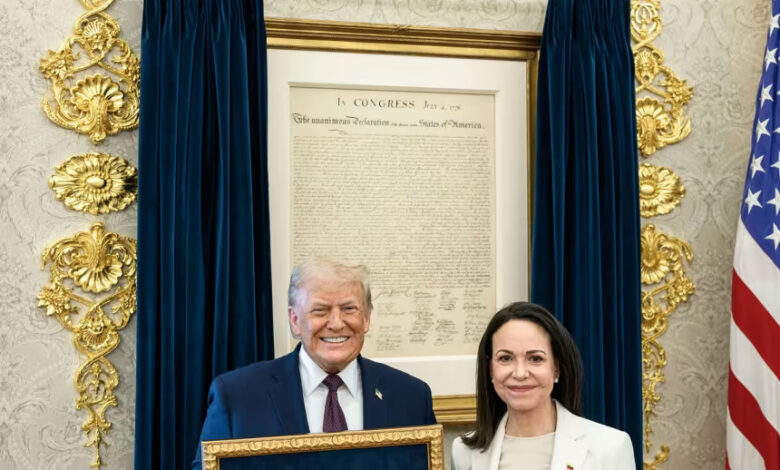
Venezuelan opposition leader María Corina Machado’s presentation Thursday of her Nobel Peace Prize medal to President Donald Trump was instant fodder for ridicule among Trump’s opponents.
ABC late-night host Jimmy Kimmel even displayed a series of awards he had won – or joked he had won, in the case of a 2015 Soul Train Awards “White Person of the Year” prize. He offered them to Trump in exchange for the president pulling ICE out of Minneapolis.
The situation is certainly funny, in a way. Trump’s unquenchable thirst for recognition led him to accept a newly made-up “FIFA Peace Prize” that was obviously created to curry favor with him after he failed to win his coveted Nobel. (The ceremony last month was really something else.) And now Trump has accepted someone else’s Nobel medal, even as the Nobel committee has made it abundantly clear that the award itself is not transferrable.
But in another way, it’s not really a laughing matter – as Kimmel’s bit showed.
While this kind of ring-kissing has become the norm with Trump, it’s especially galling in this instance.
You could certainly be forgiven for thinking Machado felt pressured into handing over the medal. And regardless, the whole thing raises the prospect that some very serious foreign policy decisions with massive implications are being influenced, at least in part, through personal flattery.
The saga began last year, when Trump began engaging in an extremely unsubtle effort to lobby for a Nobel prize.
When the award in October instead went to Machado for her efforts to counter Nicolás Maduro, she seemed to sense an opportunity.
She quickly dedicated her award to the US president who so coveted it – all while suggestively playing up his role remaking Venezuela’s government.
“We are on the threshold of victory and today, more than ever, we count on President Trump, the people of the United States, the peoples of Latin America, and the democratic nations of the world as our principal allies to achieve Freedom and democracy,” she posted on X.
In a later interview with CNN’s Christiane Amanpour, Machado again spoke of why she dedicated the award to Trump, but this time with a more explicit request – that he help end Maduro’s “war” on Venezuela.
“We need the help of the president of the United States to stop this war, because it is about human lives,” she said.
Machado didn’t directly respond when pressed on whether she was asking for an American military intervention, but she didn’t dispute that either.
Less than three months later, that’s what she got. On January 3, the Trump administration launched a brief mission to oust Maduro.
Yet later that day in a news conference, Trump surprised many – and disappointed Venezuelan pro-democracy activists – by declining to back Machado as Maduro’s replacement.
Trump said it would be “very tough for her to be the leader” and added twice that she didn’t “have the respect within the country.”
Two days later, Machado appeared with one of Trump’s favorite TV hosts, Fox News’ Sean Hannity, who floated another potential gesture. He said he had heard “somewhere” that she might actually give Trump her Nobel medal.

Machado indicated that would soon happen — and now it has.
One way to read all of this is that Trump’s lobbying campaign has paid off. But it paid off with a woman who just won a major award – one for which she quite literally risked her life – feeling compelled to turn it over less than three months later to try to keep Trump in her corner.
(Trump on Thursday did not signal a shift in his posture on Machado leading Venezuela, and the White House said his earlier assessment had not changed.)
The other way to read this situation is that regardless of the pressure, Machado used the medal as a bargaining chip.
You could hardly blame her for using it for leverage, given the stakes involved for her and her country.
But this dynamic also underscores the real risks of Trump’s emphasis on flattery. And it raises the prospect that decisions as serious as ousting a foreign leader and shaping that country’s future could be made, at least in part, based upon personal laurels.
It’s for precisely this kind of reason that the founders put in the Constitution an “Emoluments Clause” that prevents federal officials from accepting gifts from foreign states without the consent of Congress. (You might remember lots of talk about “emoluments” in Trump’s first term.)
“Foreign powers will intermeddle in our affairs, and spare no expense to influence them,” Elbridge Gerry said.
A gift of a medal from Machado likely wouldn’t violate the emoluments clause, given she is not a head of state. (A 2009 Justice Department legal opinion on then-President Barack Obama accepting the Nobel prize he won suggests as much. It said the prize was acceptable because the gift wasn’t from a “King, Prince, or foreign State.” Obama did donate the $1.4 million cash prize to charity.)
But Machado seems to have reasoned that presenting her medal to Trump could have some kind of influence on him.
Did her dedication of the award and flattery play any role in Trump’s decision to oust Maduro? Or will her handing over of the medal influence Trump’s future decisions as he exercises what he’s labeled “control” of her country? The US president could play a major role in deciding whether Machado ever comes to power, as CNN’s Stefano Pozzebon wrote this week.
We’ll probably never know. But Trump has shown he’s nothing if not transactional. And this episode, perhaps better than any before it, highlights the potential problems with Trump’s insistence on adulation and awards.
To the extent any of it influences his actions, it means decisions are being made at least in part based on Trump’s interest, rather than based on the country’s interest. Personal interests undoubtedly often come into play in such decisions – especially personal political interest – but this would be even more direct than that.
That’s the prospect Trump raises by accepting – if not effectively requesting – this gift from a foreign figure with an agenda. Even one that’s probably quite sympathetic to lots of Americans.