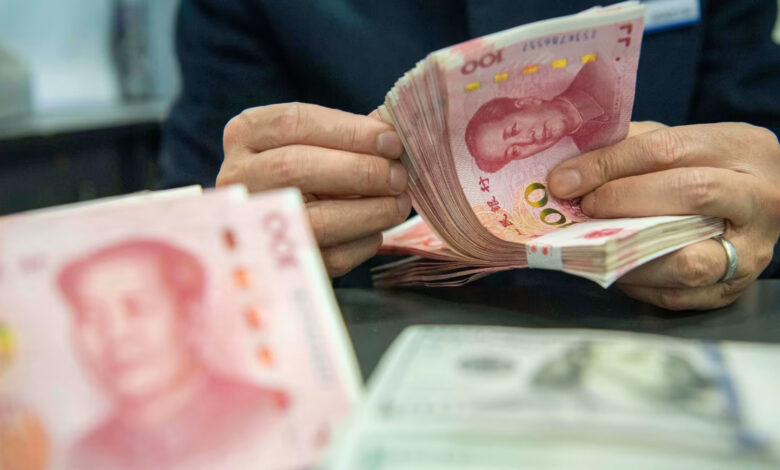
China is seizing an opportunity to challenge American dominance in global finance and exert greater international influence at the expense of the all-powerful US dollar.
Geopolitical uncertainty – driven in large part by President Donald Trump’s often chaotic economic policy – has gripped markets in recent weeks, with the dollar falling to four-year lows. Meanwhile, investors are flocking to safe-haven assets, driving gold prices to record highs of more than $5,500 an ounce. That’s given China an opening to promote its own currency as a viable alternative.
Over the weekend, the flagship ideology journal of China’s Communist Party published remarks from President Xi Jinping that outlined plans to turn the renminbi into a global reserve currency. That’s the role the US dollar currently plays – the go-to currency for the vast majority of foreign transactions, making it one of the world’s safest investments.
No one expects that to change anytime soon. But the steep decline in the dollar’s value since Trump took office again last year has at least opened the door to potential challengers.
According to the journal Qiushi, Xi told government officials that China should aspire to establish “a strong currency widely used in international trade and foreign exchange,” with a “powerful central bank” and the ability to attract investment and influence global pricing.
The Chinese leader’s comments were made privately in 2024. The party publicized them as China is positioning itself as a more reliable economic and political partner than the US – and starting to see results. Here’s what we know.
Why do China’s plans matter now?
China has spent over a decade trying to integrate the renminbi into international markets and ensure its stability as a global currency. But China has recently begun reaping the benefits of growing concerns over US economic policy and a trend known as “de-dollarization.”
Trump’s decision to impose several rounds of tariffs on major trade partners has undermined confidence in economic growth in the US and the value of its currency. A change in leadership at the Federal Reserve – for which Trump has nominated Kevin Warsh after repeatedly clashing with current chair Jerome Powell – has added to the uncertainty around US monetary policy and interest rates.

Investors have been reducing exposure to the dollar since as early as last year, and European Central Bank President Christine Lagarde has called for the euro to take on a larger role in global finance. The threat of duties and sanctions imposed by the US has also prompted some nations to look to hedge their reliance on the dollar.
“To get people to use renminbi, you’ve kind of got to carve out a niche, and it’s been really difficult,” said Dinny McMahon, head of markets research at the research firm Trivium China. “Now the way that the Party thinks about it is, ‘Oh, we’re in a really unique moment in time, because people are becoming disillusioned with the dollar.’”
Why control a global reserve currency?
The dollar has been central to the global economy for more than 80 years, following World War II and the Bretton Woods Agreement that set the dollar as the gold-backed standard and pegged 44 other currencies to it. Strong demand for dollars gives the US more influence in borrowing money overseas at low rates and imposing sanctions on other nations.
The International Monetary Fund recognizes seven other major reserve currencies, including euros, renminbi, Japanese yen, Canadian dollars, Australian dollars, pounds sterling and Swiss francs. China has sought to strengthen its own currency’s standing as a way to insulate itself from US financial hegemony and pressures, as well as increasing its own political and economic influence in global trade and finance.
What has China done to bolster the renminbi?
China has taken measures to make the renminbi more attractive to foreign investors, such as increasing access to Chinese securities like stocks, bonds and commodities, and streamlining cross-border payments.
Strengthening trade ties with developing economies have also bolstered the case for increased use of renminbi in foreign transactions. The use of the renminbi in trade settlements surged to record highs after Western nations imposed sanctions on Russia over the invasion of Ukraine, as China remained one of Russia’s top trading partners.

Last summer, China’s central bank governor Pan Gongsheng said the renminbi was the world’s largest trade finance currency and third-largest payment currency, in comments calling for the development of a “multi-polar” currency system rather than dollar dominance.
The idea that the dollar might be challenged has certainly rattled Trump. Brazil, Russia, India, China and South Africa – the bloc known as BRICS – have mooted the idea of creating a new reserve currency, something Trump has said he would respond to with 100% tariffs if it ever went ahead.
Could the renminbi really replace the dollar?
A global financial system that relies primarily on the renminbi is still a long way from reality. According to data from the IMF, the US dollar accounted for about 57% of foreign exchange reserves last year, the euro about 20% and the renminbi about 2%. China has not explicitly stated plans to supplant the dollar, but rather expand the role of its own currency in comparison.
But while China has portrayed the renminbi as a convenient and safe currency for global trade, experts said that tight controls on moving money in and out of the country will deter investors and financial institutions from relying too heavily on renminbi reserves. China may also prefer to maintain a lower renminbi value compared with other currencies, in order to support its export-reliant economy.
“I can’t imagine a world in which the degree to which the renminbi is embraced as a reserve asset gets anywhere near the levels of the dollar or the euro, and I don’t think Beijing does either,” McMahon said. “But given the shifting tides in the global financial system and geopolitics, Beijing certainly thinks there’s an opportunity here to gain ground.”