It is virtually impossible to quantify the sheer number of mummies exported to Europe from the Middle Ages through the mid-nineteenth century.
Estimates reaching into the millions confirm, however, that the trade in mummies flourished across Europe for several reasons, owing to their abundance and low cost.
Furthermore, there was a consistent demand for their use in various industries and applications, particularly medicine.
This is indeed profoundly distressing: we are talking about the remains of our ancestors being exploited as mere commodities for sale, purchase, and export.
This occurred during a time when Egyptians were largely estranged from their own history, often believing they shared no lineage with those who had mummified their dead thousands of years prior.
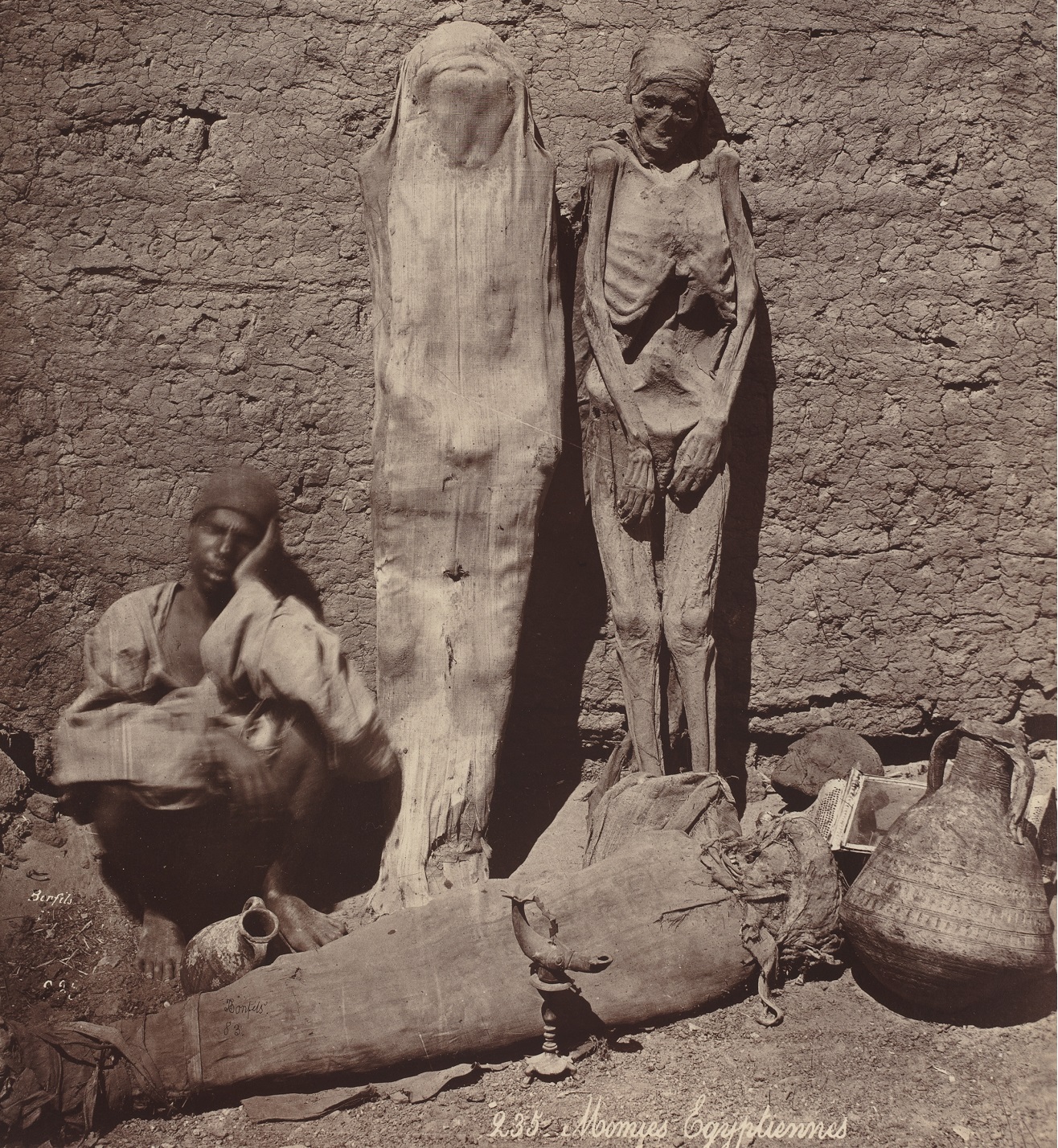
Archived black-and-white photographs depict mummy vendors in streets and marketplaces. One famous image portrays a young boy seated on the ground, displaying mummies for sale; he has propped them upright against a mud-brick wall, their sanctity violated and their shrouds stripped away.
This vividly documents the tragedy that befell millions of Egyptian mummies.
The mummy trade would typically begin with the unrolling of bandages and the stripping of embalmed bodies by scavengers and merchants. This was driven by a search for amulets and jewelry buried within the linens or worn directly by the deceased—such as necklaces, bracelets, and rings crafted from gold, as well as precious and semi-precious stones.
As for the linen wrappings, they were sold or exported to Europe as ‘rags’ used in the production of a specific type of brown paper. This trade was not limited to mummy linens; cotton and linen remnants from the textile industry were also sold for the same industrial purpose.
Furthermore, the mummies themselves were traded for diverse applications: they were either processed to extract oils for use in cosmetic creams and skin moisturizers, or ground into powder.
This ‘mummy powder’ was sought after for various medicinal treatments, particularly for dermatological conditions, reproductive ailments, and infertility.
By the mid-nineteenth century, a severe shortage of papermaking raw materials emerged in the US threatening to bring paper mills to a standstill. This crisis intensified after Italy halted the export of cotton and linen rags, which were essential to the industry at the time.
Reportedly, an entrepreneur named Isaiah Derrick suggested importing mummy wrappings from Egypt as a viable alternative for these rags.
According to his calculations, relying on mummy linens could sustain the industry for over a decade, especially since a pound of these wrappings was sold for a mere two cents.
Consequently, the trade of mummy linens flourished between Egypt and America, either through direct channels or via English intermediaries—until the unthinkable occurred. In a renowned brown paper mill in Maine that specialized in food packaging, the owner was shocked to discover that all workers handling the imported Egyptian linens had contracted cholera.
The outbreak in the city was immediately linked to the mummy wrappings, leading to an urgent decree banning the importation of mummies and their linens from Egypt, as well as prohibiting their use in the production of food wrapping paper.
Remarkably, while popular lore and eyewitness accounts suggest that this incident occurred during the American Civil War (1861–1865), historical documentation indicates that the massive cholera surge in the United States actually took place between 1852 and 1861.
This discrepancy raises the question of whether this was merely a chronological error, or is the validity of the story itself open to debate?
While the existence of the mummy wrapping trade and its use in paper manufacturing is an established historical fact, what remains scientifically contentious is whether these ancient linens could have harbored active cholera pathogens for thousands of years. It is more plausible that the wrappings were contaminated by infected individuals at Egyptian or American ports shortly before reaching the mills.
At the time, it was widely believed that cholera was airborne; the medical community had not yet discovered its direct link to personal hygiene and the lack of advanced sanitation systems—which were absent in both Egypt and the US during that era.
The true significance of this narrative lies in how the perceived link between Egyptian mummies and the American cholera outbreak ingrained a sense of dread—even horror—within the American psyche.
This fascination with the ‘macabre’ was later resurrected following Howard Carter’s 1922 discovery of Tutankhamun’s tomb in the Valley of the Kings.
Hollywood seized upon this, cementing the image of the mummy as a vessel for ancient curses; yet, this portrayal created an unexpected paradox. Rather than alienating the public, it fueled a global obsession with Egyptology, inspiring many who thrived on the allure of the unknown.
Beyond the cinematic tropes, however, lies the sobering reality of what has been permanently erased from Egyptian history.
Centuries of systematic looting, which reached its peak during the Middle Ages, have left irreparable gaps in our heritage. While the scale of such plunder has certainly diminished in modern times, the loss remains.
We can only attempt to reconstruct these missing chapters of our civilization through fragmented evidence and archaeological inference; actually recovering what was lost is, tragically, impossible.