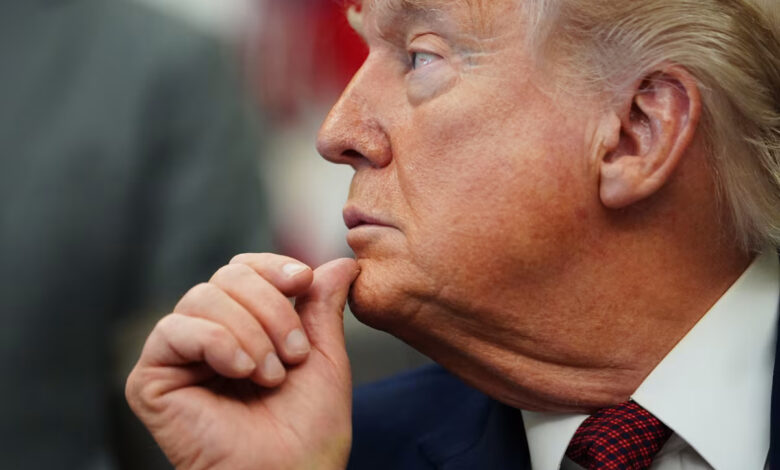
Donald Trump has spent days negotiating peace in Iran — with himself.
The president has rolled out every trick in his entrepreneur’s manual “The Art of the Deal” in trying to create leverage, spin endgame scenarios and force Iran to capitulate.
But his round-the-clock avalanche of online outbursts and quotes to reporters who have him on speed dial seem to ignore one of his big rules.
“The worst thing you can possibly do in a deal is seem desperate to make it,” Trump wrote in the 1987 book that lionized wheeler-dealing and himself.
The commander in chief risks walking into that very trap ahead of possible talks in Pakistan between top US and Iranian negotiators in the coming days.
He can’t stop talking about the possibility of a deal. But since he’s not at the table with Iran’s leaders, he might be worsening the prospects.
Late last week, he announced on Truth Social that it was already done, claiming Iran had agreed to every US demand on handing over nuclear stocks, opening the Strait of Hormuz and halting support for terror groups.
When Tehran pushed back, his threats to send “lots of bombs” unless it agreed to US terms made him look even more fixated on a deal.
Often, as in the case of the strait, Trump’s statements undermine his credibility because they are demonstrably not true. The constant stream of contradictory information also bolsters impressions that he’s got no strategy and is winging it — a constant critique from foreign policy experts during the war.
And he’s hardly offering a poker face to Iran’s negotiators — or the real powers behind them back in Tehran, who, unlike Trump, are in the shadows and silent.
While it’s hard to remember what normal used to feel like, presidents don’t usually conduct themselves in such a manner before critical talks. Ronald Reagan never warmed up for summits with Soviet leader Mikhail Gorbachev by blitzing 1980s TV networks hailing agreements before they even met.
So why is Trump behaving this way? And does his need to constantly be driving the narrative risk scuppering the talks?

The power of social media
Trump observed during his first term that a single tweet gave him extraordinary power to bypass the media and talk to the world. “I used to watch it,” he said. “It’d be like a rocket ship when I put out a beauty.”
It follows, then, that the president sees the small device always in every citizen’s hands as a source of incredible power. He doesn’t need to call a news conference to talk to the world. He can just post. This must be the first war conducted by social media: Trump has announced results of air strikes, warned Iranian civilization might “die” and proclaimed peace online.
Social media and Trump were made for each other. He used it to grab a hold on America’s national psyche that has lasted more than a decade. And he shows no restraint in using it, day or night. You can delete social media apps. But every Truth Social post will be instantly transmitted by global media anyway.
In “The Art of the Deal,” a man who unapologetically seeks always to be at the center of the action admits that what drives him is more the quest for a deal than what is actually in it.
And diplomacy for Trump is hardly a whispered backstage process. His summits with North Korean leader Kim Jong-Un didn’t produce much, but they put Trump in the global spotlight. His lavish welcome to Russian President Vladimir Putin last year — a pageant of parked fighter jets and red carpets — was a bust on ending the war in Ukraine. But it made for a great photo-op.
This week’s proposed talks in Islamabad lack one key ingredient of the Trump peace playbook: He will not be there. This may be for reasons of protocol, since Iran’s negotiators will be well below head-of-state level, or it may be down to security. Trump, however, told reporters last week he “might go” if a deal is signed.
Aides warn Trump’s posts are detrimental to talks
But an agreement remains a long shot — in talks that no one can be certain will take place after a weekend of tension in the Middle East.
For all Trump’s bullishness, Iran also has great leverage in the showdown. Its refusal to allow commercial shipping through the Strait of Hormuz has allowed it to hold the global economy hostage, and it’s unlikely to give up easily.
And even by the standards of most peace negotiations, distrust is deep and counterproductive between the sides. Nearly 50 years of bitter conflict have included terror attacks on Americans and the downing of an Iranian civilian airliner by a US warship. Trump assassinated Iran’s talismanic military chief in his first term and bombed its nuclear plants last year.

Trump’s social media antics may be only making things worse.
Some of Trump’s officials privately acknowledged to CNN’s Alayna Treene and Kevin Liptak that his public commentary has been detrimental to talks, noting that prior sense of deep distrust. The president’s false claims last week that the Iran had agreed to almost all US demands — including on handing over enriched uranium — were not appreciated by negotiators who are on thin ice at home.
The sense that Trump might be getting in the way of his own aspirations was also raised by a Wall Street Journal article over the weekend. The paper said he was kept out of a room where aides were getting updates on the daring rescue of a US airman in Iran because “they believed his impatience wouldn’t be helpful.”
Peace negotiations, especially those involving the complex issues of enrichment, centrifuges and monitoring, are deeply sensitive. They often require back-channeling and months or even years of discussions. Each side needs to feel they have claimed vindication to get over the line.
Bullying rarely works. Blaring about the process on social media makes it even harder. Trump on Monday said that he was unlikely to extend a ceasefire with Iran due to expire this week. This might have been an attempt to turn the screws, but it also risked giving the Iranian side an excuse not to show. Still, given Trump’s wildly gyrating social media record, he might post the complete opposite next.
Iranian negotiator and Parliament Speaker Mohammad Bagher Ghalibaf is still faulting Trump’s methods. In a post on X, he accused the president of seeking “to turn this negotiating table— in his own imagination— into a table of surrender or to justify renewed warmongering.”
But if the “art of the deal” works and somehow, Trump ends Iran’s threat to the rest of the world, he’ll have a win that no other modern president managed. One thing’s for sure: He’ll be the first to tell the world.