The Ministry of Tourism and Antiquities announced on Saturday, April 18, that a Spanish archaeological mission from the University of Barcelona and the Institute of the Ancient Near East has discovered a Roman-era tomb in the Al-Bahnasa area of Minya Governorate.
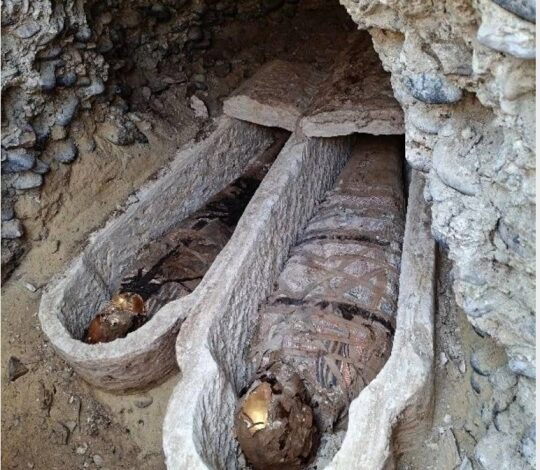
The excavations, led by Maite Mascort and Esther Pons Mellado, unearthed several Roman mummies—some wrapped in linen decorated with geometric patterns—alongside wooden coffins. The mission also found three golden tongues, one copper tongue, and evidence of gold foil used on some of the mummies.
A significant addition to Egypt’s heritage
Minister of Tourism and Antiquities, Sherif Fathy, expressed his pride in the discovery, noting that it adds to a series of important archaeological finds in Minya and reflects the immense diversity of Egyptian civilization throughout the ages.
Hesham el-Leithy, Secretary-General of the Supreme Council of Antiquities, explained that the find offers new insights into funerary practices in Al-Bahnasa during the Greco-Roman periods. He highlighted a particularly rare discovery: a papyrus found inside one of the mummies containing a text from the second book of Homer’s Iliad. Known as the “Catalogue of Ships,” the text describes the Greek participants in the campaign against Troy, adding a significant literary and historical dimension to the site.
Details of the excavation site
Mohamed Abdel-Badea, Head of the Egyptian Antiquities Sector at the Supreme Council of Antiquities, stated that excavations east of Ptolemaic Tomb No. 67 revealed a trench containing three limestone chambers.
-
Chamber one: Contained a stone slab and a large jar with the cremated remains of an adult, alongside the bones of an infant and the head of a feline, all wrapped in textile.
-
Chamber two: Contained a similar jar with the cremated remains of two individuals and feline bones.
-
Southern site: Yielded small terracotta and bronze statues, including depictions of the deity Harpocrates as a rider and a small statue of Cupid.
Hassan Amer, Professor at Cairo University and the mission’s excavation director, added that work in Tomb No. 65 revealed further gold and copper tongues, as well as Roman mummies and colored wooden coffins within an underground burial chamber (hypogeum). He noted, however, that these items were in a state of deterioration due to ancient looting.