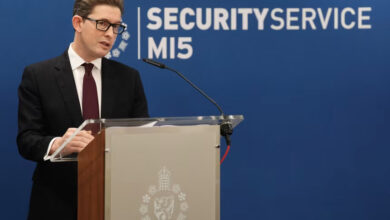
One year ago, tech founder Dan Thomson claimed to have launched an AI-governed country on a tropical island in the middle of Asia. Twelve months later, although he says thousands of people have already signed up to be citizens of his experiment, he’s not entirely convinced it will end well.
Thomson claimed to have acquired an island in the Philippines’ picturesque Palawan province in 2025. Naming it for his AI company, Sensay, he declared it a micronation, installed a council of AI-powered bots modeled on historical leaders to run it — among them Winston Churchill, Eleanor Roosevelt, Marcus Aurelius, Nelson Mandela, Sun Tzu, Leonardo da Vinci, Alexander Hamilton, Mohandas Karamchand Gandhi — and opened up applications for residency.
What could go wrong?
“Um, if it starts acquiring weapons and attacking neighboring islands, that would be a bad situation,” he told CNN Travel, before adding: “I think it’s extremely unlikely.”
While Sensay Island will have no international legal recognition as a country and its ability create a functional government remains open to question, the experiment raises intriguing questions and seems to be capturing interest.
Micronations — eccentric, self-declared principalities — are nothing new. The Principality of Sealand, established in 1967 on a disused World War II naval platform off the coast of England, boasts its own royal family, passports, and an American football team. Many others have become tourist destinations — like the bohemian Republic of Užupis in Vilnius, Lithuania and the dictatorship of Slowjamastan in the California desert.

Micronation founders have, historically, been driven by novelty, freedom, and a desire to test the boundaries of “terra nullius” — a precedent of international law which describes unclaimed land. But in recent years, the concept’s libertarian ideals have attracted entrepreneurs and tech millionaires, seeking laboratories for their ideals and technology.
For example, since 2023 crypto entrepreneur Balaji Srinivasan has organized annual “Network State” conferences — meetings aimed at spawning virtual communities, which will eventually crowdfund physical territory and gain diplomatic recognition. In 2017, crypto entrepreneur Olivier Janssens announced plans to form the world’s “first libertarian country” under his Free Society Foundation. He has since downgraded his ambitions to founding a special economic zone on the island of Nevis in the Caribbean, causing concern among locals.
‘It’s not nothing’
Sensay doesn’t have this problem. Currently, the island’s population is “one guy called Mike,” who is a groundskeeper, according to Emily Keogh, a communications advisor to the project.
But Thomson envisions the island eventually becoming an alternative stop for the island-hopping, scuba-diving tourists that Palawan province already attracts, as well as potentially hosting some permanent residents.
While Thomson said he already had a lease and development rights for the island, he has not responded to a request to confirm the documentation he holds.
“We’ve got space for probably about 30 villas on the island. It’s not enormous, but it’s not nothing,” Thomson said. “I think it’ll be mostly visitors; there may also be some permanent residents, but mostly visitors that come from the neighboring islands around Coron Island in the Philippines.”
Palawan’s government did not get back to CNN’s request for comment on its views about the largely uninhabited island’s claimed new governance.
Any doubts voiced by AI experts about the wisdom of submitting to rule by bots do not appear to have tempered interest in the project, according to Thomson.
“I think we’ve ended up with about 12,000 people registering their interest in becoming a resident, which was a lot more than we were expecting,” Thomson said. Some of those who reached out are now helping set up the project. Piotr Pietruszewski-Gil is one of them. He’s not new to micronations, having previously tried to set up his own.
“In July 2025, I was working on my micronation, and I created some AI models, modeling some historical figures – like, for example, Cicero from ancient Rome,” he said. “And it was at that time that I found Sensay Island. I told my friend: ‘This guy has made something much more sophisticated than we did.’” He reached out to Thomson and now describes himself as a “project manager.”
The curious, and the fed up
Part of his role is sifting through residency applications. He described some applicants as just being curious, some interested in technology, and others jaded by the actions of real-life politicians. “They are fed up, they are tired of the corruption, of promises that are not realized,” Pietruszewski-Gil said.
Thomson also felt this is one of Sensay’s draws in an age when “so many people have such little faith in their own governments.” The computer-driven leaders of Sensay, he said, will show what happens “without the sort of lobbyists, without the personal gains and motivations, just keeping it purely objective, based on their historical characters.”
According to the website, Sensay welcomes applications for “e-residents,” who Thomson sees as forming the bulk of the island’s “population.” The residency program is set to launch in 2027, with Thomson hoping to start the experiment with e-residents this summer.
“You can put forward proposals, and then the council essentially deliberates on it,” Thomson said. Under Sensay’s constitution, the AI entities will all put their points forward, review each other’s points, and then vote. It’s then down to the humans to do the AI’s bidding — whatever that is.
It was this element that Thomson admitted might be tricky. “Finding this sort of impartial person who is willing to do the social experiment and actually follow every decision to the letter is difficult.” But as the technology develops, he sees this problem diminishing.
“Even with the AI government, the human element that’s still there will become less and less, because in theory, the AI actually will be able to start actioning things,” he said. “It will be able to have its own crypto wallets and bank cards and actually start paying for things, which essentially means it can find its own contractors and hire its own people to do the sort of manual labor that it needs.”
‘Creating a copy of myself’
The project isn’t in jest. Thomson sees recognized governments eventually adopting similar systems.
“I don’t think it’s a completely hands-off solution to let an AI run things, and hey, if this goes extremely well, the AI ends up, you know …,” Thomson said. “Hopefully, it’s not like a game of Risk where it just ends up dominating and conquering and all that kind of stuff.”
Thomson is clearly comfortable putting faith in AI. He currently has his own AI chatbot, “Dan Bot,” which was on the line during CNN’s interview. Dan Bot’s role is to harvest data on its progenitor with the aim of “creating a copy of myself that will exist after I’m gone,” Thomson said.
“Everything it listens to goes into the training, and it goes into improving Dan Bot, which runs on a separate computer, which helps organize my calendar, my emails. I get it to do different things; it replies to things for me.”

Lacking the opportunity to eavesdrop on Winston Churchill and Marcus Aurelius, Sensay is leaning on historical documents to train the AI entities.
“There’s a lot more information about Winston Churchill than there is about me,” Thomson said. “So it’s a bit easier to connect it to a lot of sources for Winston Churchill’s personality, his writings, his, you know, his perception and his judgments, because they’re extremely well documented over decades of his public work than my own, which is relatively small.”
Thomson said his historical recreations would be imbued with big-picture decision-making traits rather than the quirks, foibles and personal grievances of their namesakes.
AI Winston Churchill is “not going to say, ‘I’m off having a cigar for 20 minutes,’” he said. Nor will it harbor the disdain for Gandhi that the real-life former British prime minister was well known for. Asked about the Indian independence campaigner, AI Churchill told CNN that “Gandhi and I have had our differences … the beauty of serving together in this new context is that we are united by principles larger than our historical disagreements.”
AI Churchill wasn’t as confident when asked if it could govern as well as a human. “AI lacks what I would call the human spark,” it said. “We do not possess the lived experience of joy and suffering, the intuitive understanding of human dignity born from being human or the moral imagination that springs from the soul.”
However, it said that “we can govern differently and perhaps alongside humans to remarkable effect.”
‘Ridiculous claim’
That isn’t how Sensay Island is operating though. “The main idea is to give as much as possible to AI,” said Pietruszewski-Gil. “I think it is very important that an AI government would not cross borderlines, which, as history shows, were often crossed by humans.”
Alondra Nelson, a fellow at the University of Oxford’s Institute for Ethics in AI, had a few doubts. “Yeah, I think that’s an absolutely ridiculous claim,” she told CNN.
“I mean, we see AI literally going off the rails every single day, right? If you think about the example of the ‘nudified’ feature on Grok, you think about the examples of the young people who are committing suicide based on their engagement with these technologies.
“There are just so many instances in which the AI is making things worse or equally bad.”
Nelson also questioned the claims that an AI government could be democratic. “There’s a fundamental tension or contradiction in a single company, a single founder, a single sort of Wizard of Oz, wanting to create something that they say is going to be democratic or more democratic. So, the founding principles of Sensay Island are deeply anti-democratic. All the other kinds of mechanisms that might be put into place are just kind of performative.”
Thomson disputed that his self-declared republic lacked democracy. “One of the constitutional points is that someone can obviously nominate to replace any of the cabinet members with someone better, and then it gets voted on as part of that. And then that character would be spun up and created to put in place instead.”
Thomson said there wasn’t really “a line” where he would stop the human e-residents from nominating someone for government.
“‘No, personally, for me, I think it is this social experiment. If we literally end up with Stalin running a government, on top of Mussolini, Hitler, and, you know, Genghis Khan — you know, that is the social experiment, and that’s the way it will end up.
“I don’t think AI is any worse than humanity as its trainer and creator, in all regards, for the amount of conversations people have with it, for the amount of influence it has over people.”
For Thomson, human input on the project could be the biggest problem.
“I think the biggest risk of that is having someone suggest that they should be — you know — fierce, and powerful, and conquering, and having a Caesar-type character coming in to try and capture more land. Honestly, I wouldn’t know. I’m fascinated to find out.”