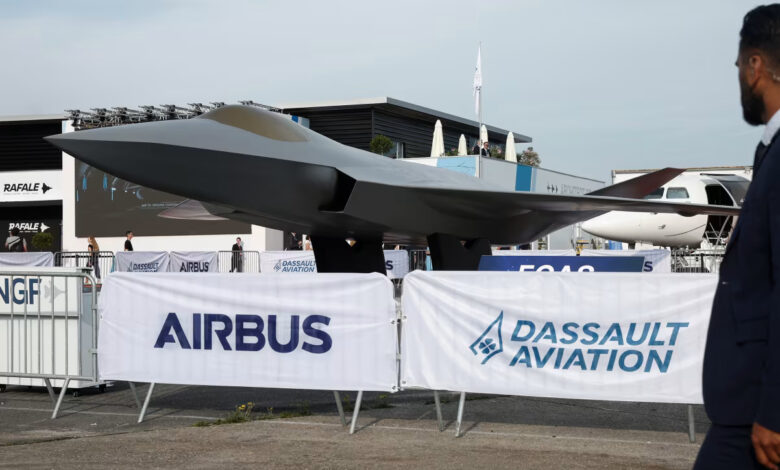
When plans to build a European fighter jet to surpass the US F-35 were officially grounded this week, it came as a surprise to almost no one.
Industrial incompatibilities ultimately sank the project at the heart of the Future Combat Air System (FCAS) scheme, the much-vaunted political lynchpin of Franco-German military cooperation. The deal, which had come with an estimated price tag of 100 billion euros ($116 billion), seemed doomed from the start: France and Germany wanted two different aircraft.
The program also promised an information-sharing “combat cloud” and high-tech drones which would fly alongside the fighter as unmanned “wingmen.” Those parts may still survive.
But the collapse of the fighter jet element has thrown into question the multinational approach to developing next-generation military tech, as Europe rethinks how it arms its troops against the backdrop of a transatlantic partnership whittled away by US President Donald Trump.
Doomed to fail?
Since its announcement in 2017, the project to build Europe’s first sixth-generation fighter has had its doubters.
“The first lesson is that the Germans and the French didn’t want the same aircraft,” retired French Gen. Michel Yakovleff, former deputy commander of NATO forces in Europe, told CNN. Across the industry, experts were surprised it took the project so long to crumble.
The aircraft was to be a love child of French manufacturer Dassault Aviation and European aerospace group Airbus, representing Germany.
In the end, the firms couldn’t see eye to eye on how to design and make the aircraft. France’s presidency foisted at least some of the blame onto Berlin, which “felt it was not possible to put any further pressure” on Airbus and Dassault, the French statement read. “Only President (Emmanuel) Macron still believed in the survival of the (FCAS),” said Senator Cédric Perrin, president of the French Senate’s foreign and armed forces committee.

The German government acknowledged the companies’ inability to cooperate on the jet but, speaking at the Berlin Air Show this week, German Chancellor Friedrich Merz struck an optimistic tone, looking ahead to what the countries could still achieve with the rest of the FCAS project. France and Germany look likely to turn to homegrown or other multinational projects respectively to fill the fighter-jet gap.
France has a long history of building its own fighter aircraft, stretching back to the earliest days of aerial combat. During the Cold War, a nuclear-armed, NATO-skeptical France developed its own philosophy for war in the air. At its center were highly capable jets, some equipped for operations from France’s aircraft carrier, and all “multi-role” by design. Dassault’s Mirage fighter – and more recently the Rafale – can creep into enemy airspace, dogfight, drop bombs and launch cruise missiles. Germany, with neither aircraft carriers nor nukes of its own, sought more of a traditional dogfighting jet, even questioning whether it needed a pilot.
“The French Air Force is very good at making pretty generic requirements and letting Dassault sort out the technological compromises,” in contrast to the overly demanding technical requirements that bogged down FCAS, Yakovleff said. Even in the 1970s, the RAND Corporation, a US thinktank, was investigating how Dassault managed to field advanced fighter jets on time and at a cost well below US manufacturers.
Since World War II, Germany has not made a jet of its own, instead favoring multinational European projects. In the 1970s, what was then West Germany co-produced the Tornado bomber with the UK and Italy; then in the 1990s Germany worked with the UK, Italy and Spain to produce the dog-fighting Eurofighter jet.
This latest attempt was a political project, signaling European unity as tensions brewed on the continent’s borders. It was also a political failure. “It is the problem of state leadership,” Emil Archambault, a fellow at the German Council on Foreign Relations, told CNN. Berlin and Paris “failed to define clearly what the requirements were and how they want(ed) it to proceed.”
Real value
While its collapse has made headlines, the loss of the joint aircraft isn’t a serious setback for European capabilities, Per Erik Solli, a senior defense analyst at the Norwegian Institute of International Affairs, told CNN.
And if the two remaining pillars of the FCAS project – a “combat cloud” to share information and so-called drone wingmen to accompany fighter jets – are preserved, real value could still be saved.

For modern jets, “it’s not how fast they can fly and how tight they can turn,” Solli said. With the advent of drone wingmen, they are “more command ships rather than independent fighting aircraft.”
When the FCAS was first promised in 2017, the world was a very different place. With NATO anticipating conflict with Russia by 2030, the 2040 promised delivery date for FCAS no longer seems prudent.
Back then, the defense industry focus “was less about capabilities and being ready to fight, than technological advancement and sort of keeping pace with peers and adversaries,” Ed Arnold, senior associate fellow at UK defense think tank the Royal United Services Institute (RUSI), told CNN. Today, production at scale is king.
Spending close to home
Making a fighter jet is difficult – and expensive.
New polling from the European Council on Foreign Relations suggests that Europeans – bar in Italy – support increased spending on defense and purchasing European-made weapons, as trust in American partners hits a generational low.
Europe is now the world’s largest arms importer, with its purchases trebling for 2021-25 compared to the five-year period prior, according to data from the Stockholm International Peace Research Institute (SIPRI). The US has been a major beneficiary of that, more than doubling its sales to the continent over the same period.
In March 2025, Macron – a fierce advocate for European autonomy on defense – announced he would convince allies to buy European over US arms. “That’s the way to increase the rate of production,” the French leader said.
Recent months have seen a flurry of announcements from European and Western nations doing just that. Germany, long a patron of US manufacturers, has made the clearest step back. In Berlin’s 80-billion-euro ($93 billion) military procurement plan for 2025-26, some 90% of arms were to be sourced from Europe.
Denmark, bruised by Trump’s designs on its autonomous territory Greenland, did not allow US companies to bid on a multi-billion-dollar missile contract last year. And it’s not just hardware that’s at stake. Among European NATO allies, there are also moves to rally around a European-made battlefield AI, rather than the Maven AI system that the US has adopted.
Shifting balance of power

The collapse of the FCAS fighter jet project casts a long shadow over France and Germany’s other joint enterprise: building a next-generation tank.
Unlike Germany, France currently lacks the industrial base to build its own heavy armor. And with Berlin’s meteoric increase in defense spending – the 150-billion-euro military budget it plans for 2029 will dwarf even that of France, omitting Paris’ undisclosed nuclear spending – the balance of power on the continent is now shifting, as the German industrial giant wakes up.
“German politicians are more confident now regarding their role in Europe,” defense analyst Solli told CNN.
“Why have such an expensive, exquisite tank when you can just continue to develop what you already have?” Arnold said, pointing to the German-designed Leopard tanks, which outshine Russia’s armored offerings.
But the FCAS fighter’s demise might nevertheless have a silver lining for European defense, if the billions of euros earmarked for it are instead used to rapidly beef up capabilities and stockpiles. “If something isn’t working,” Arnold said, “you kill it, you divert resources from it, and you get better value for money.”
Additional reporting by Elina Baudier Kim