Egyptian artifacts at international auctions attract considerable attention from collectors and researchers of ancient Egyptian civilization.
These international auction houses witness the sale of dozens of artifacts with vastly varying values.
In 2022, a number of Egyptian artifacts were offered at international auctions, particularly at Christie’s and Sotheby’s. Sales prices varied, with some pieces fetching high figures while others sold for less than their initial estimates.
This report reviews the most expensive and least expensive Egyptian antiquities sold then, their prices, key characteristics, and the historical period to which they belong.
The most expensive
Among the most expensive pieces was a large bronze statue of the goddess Isis holding Horus, dating back to the 25th and 26th Dynasties (750–525 BC).
Its pre-auction value was estimated at between £100,000 and £150,000, but it sold for £126,000.
The statue depicts the goddess Isis embracing her son Horus and is similar in design to one displayed in the Metropolitan Museum of Art.
It is considered a prime example of ancient Egyptian art.
Isis and Horus
The take of Isis and Osiris is one of the most famous myths in ancient Egyptian civilization.
It tells the story of Osiris’s murder at the hands of his brother Set, who usurped the throne. Isis then searches for her husband’s body and gathers the pieces after Set dismembers it, before giving birth to their son Horus, who became a symbol of legitimacy and victory.
Osiris then became the lord of the underworld according to ancient Egyptian beliefs.
Cheapest Artifacts
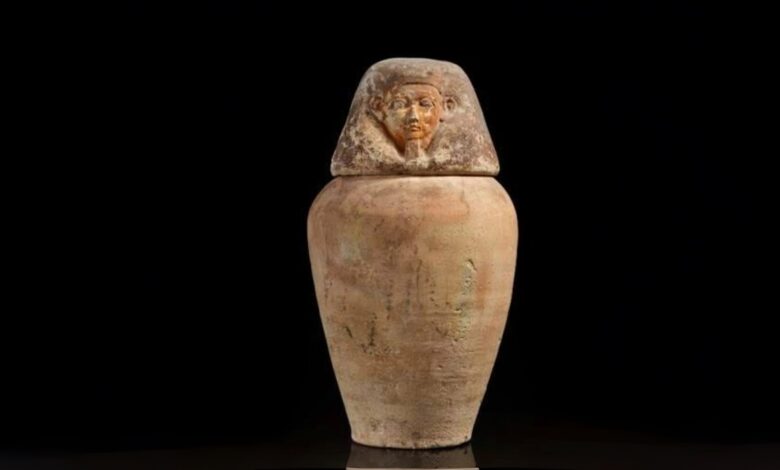
Among the pieces that sold for less than their estimated value was a canopic jar dating from between 1550 and 1425 BC.
Its pre-auction value was estimated at between $20,000 and $30,000, but it sold for $17,640.
Canopic Jars
Canopic jars were among the most prominent tools used in the mummification rituals of the ancient Egyptians. They were typically made of limestone or pottery and were used to preserve the internal organs of the deceased in preparation for the afterlife.
The set consisted of four jars, each dedicated to a specific organ: the liver, lungs, stomach, and intestines.
The heart was left inside the body, as the ancient Egyptians believed it to be the seat of the soul and mind.
Edited translation from Al-Masry Al-Youm