The rapid advances of Chinese artificial intelligence over the past year seem to have alerted Washington to the real possibility that the world’s second-largest economy could pull ahead of the United States in an increasingly tight technology race.
“We’re leading China in AI…and frankly, I want to keep it that way, because whoever wins AI wins,” US President Donald Trump said earlier this month.
Trump’s comments underscore the stakes of a US-China tech competition that is increasingly being framed in existential terms. The US has an obvious edge, with pioneering AI labs, the most advanced chips and deep-pocketed investors. Leveraging that dominance, Washington is also forcing countries around the world to pick a side.
But China has a vision that, for many, may be more compelling. Even as it trails the US in frontier AI models, it’s rapidly narrowing the technology gap while championing a more open ecosystem centered on accessibility and lower cost.
In July, Chinese leader Xi Jinping launched the World Artificial Intelligence Cooperation Organization – a rival grouping to the Pax Silica alliance that Trump formed last year to reduce reliance on China for AI supply chains.
While over two dozen countries and the European Union signed up to Trump’s Pax Silica, Xi has recruited 29 countries, including Russia, Indonesia and Pakistan, to his alternative vision of open models, which allow users to freely download, customize and run without paying hefty fees to American firms like Anthropic and OpenAI.
For developers in the Global South, an inexpensive Chinese model from DeepSeek or Moonshot may be more useful than a slightly more capable system requiring an expensive subscription and access to a foreign cloud provider, said Eric Olander, editor in chief of The China-Global South Project, a research agency.
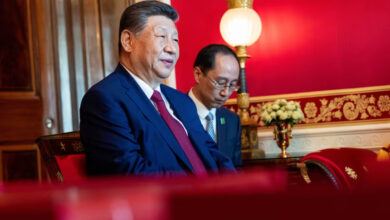
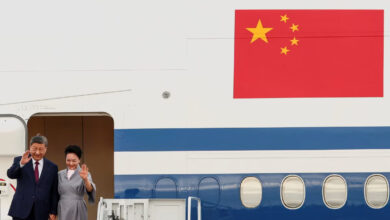
Amid concerns about AI’s potential threat to humanity and growing calls for a global oversight body, the technology became a key focus of the Trump-Xi summit this week.
The right thing to do on AI, Xi said during talks with Trump, is to “draw on each other’s strengths, not guard against each other” – a reference to Beijing’s concern about US containment, from existing tech export controls to potential AI restrictions.
“The two sides can continue their dialogue on AI, exchange views on its risks and benefits, and jointly prevent the misuse and abuse of AI,” he added.
But the summit has yielded little progress on AI beyond a formal dialogue and a bilateral communication channel, proposals discussed before the two leaders’ summit – underscoring the entrenched mutual mistrust amid contrasting visions on AI.
Embrace of open systems
China’s embrace of open systems has not always been a top-down strategy by Beijing.
Restrictions on access to the most advanced chips because of US export controls, coupled with smaller capital markets, have pushed Chinese developers toward open models as a way to compete with leading US proprietary systems.
That shift has proved effective.
In a year, Chinese models’ global usage skyrocketed from less than 15% to over 54% last week, led by DeepSeek, according to AI leaderboard data by OpenRouter, a marketplace for models.

Even American firms, from Airbnb and DoorDash to Shopify, have embraced Chinese models, tapping into the advantages of open systems, including lower costs and greater flexibility for customization.
Rather than picking a side, companies – American or not – generally prefer to diversify their technology suppliers, Olander said. Chinese AI could spread through existing telecom, cloud and hardware networks, particularly in emerging markets where Chinese companies already have substantial distribution networks.
“It may not be that DeepSeek or Moonshot will make much money, but the companies surrounding them – Huawei, ZTE, the others providing support, providing technology, providing all the services around AI, may do very well,” Olander said.
The meaning of winning the AI race is also poorly defined. Different metrics, from profitability to market share, could yield a different result to the question.
“Is Apple winning the mobile phone race? Fewer people use Apple products, but Apple eats up 90% of the profits,” Olander said, adding that the likely outcome of the AI race may mirror Apple’s case, where the US holds the profits while China accumulates the users.
As AI capabilities continue to advance, the differences between the most advanced models and slightly less capable systems may become less noticeable to most people and businesses, experts said. Some companies may need frontier US models, while others may find Chinese models efficient enough for their needs.

“For most people around the world, the question will ultimately be about what kind of trade-off they want to make,” said Chucheng Feng, founding partner of advisory firm Hutong Research.
“Do I want a model that costs 10 times as much but is six months ahead, or one that costs one-tenth as much but is only six months behind?”
Limits to openness
Still, the appeal of Chinese models may hinge on the extent to which they remain accessible without restrictions, experts said.
At China’s signature AI conference in July, Xi called for greater openness and collaboration in AI, while stressing the need for regulation to keep it under human control.
The more capable Chinese models become, the less likely it is Beijing may leave them unrestricted, said Alex Colville, an analyst focusing on tech and security at the government-backed Australian Strategic Policy Institute.
“Beijing wants to export the country’s technology to bolster its international influence, but national security always comes first,” he said, explaining that restrictions could be placed around AI with Anthropic’s Mythos-like cyber capability, for example, that could pose a threat to China if misused.
“But it won’t be anything as black-and-white as total closure or total openness. What I think we will see going forward is a mixture of both open- and closed-source AI from China, as both serve the country’s national interests,” Colville said.

Instead of a blanket ban, Beijing could use licensing rules to restrict where certain models could be used, he added.
Global developers and some governments have rushed to take advantage of Chinese open models to push for sovereign AI development and avoid picking a side. But they now have to worry about how long those models may stay open, as China may be compelled to limit the deployment of its most powerful open models to “avoid cyber anarchy,” said Reva Goujon, a director focusing on China at research and advisory firm Rhodium Group.
“China’s strategy is only more compelling to the world so long as the models remain available and open so that they can be adopted and fine-tuned for domestic and enterprise needs,” she said.
Deepening mistrust
As Chinese firms unveil increasingly capable models that near the performance of Anthropic and OpenAI’s most advanced systems, Washington has dialed up accusations that China is engaging in what it calls the “industrial-scale theft” of American trade secrets.
Both Anthropic and OpenAI have released reports claiming that leading Chinese AI labs trained their models on outputs from American systems, a process known as distillation. In a lengthy report earlier this month, Anthropic detailed how DeepSeek and Moonshot forwarded some customer requests to Claude to train and improve their own models, and in some of the processes, exposed sensitive information.

Beijing has repeatedly rejected the distillation accusations. DeepSeek and Moonshot did not respond to CNN’s request for comment.
“Since the US has a very leaky export control regime, including a still gaping hole that allows Chinese access to US AI compute via overseas data centers, it’s very difficult to pinpoint just how much Chinese AI developers are relying on distillation to put out these incredibly advanced models,” Goujon said. “The question is what does this US administration actually do about it?”
Washington has floated possible sanctions and other restrictions on open Chinese models. But Nvidia, Meta, Microsoft and dozens of other companies warned against “sweeping restrictions” on open models in an open letter in July – revealing a rift between US tech companies and Washington.
Despite growing calls to prevent AI development from spiraling out of control, the Trump-Xi summit has produced little substance, as many experts expected.
Because of low levels of trust, cooperation between the two superpowers remains limited, said George Chen, chair of digital practice at The Asia Group consultancy.
“Beijing continues to believe Washington seeks to contain China’s rise in AI and other emerging technologies, a perception that will shape the pace and scope of future engagement for the two countries on AI,” he said.