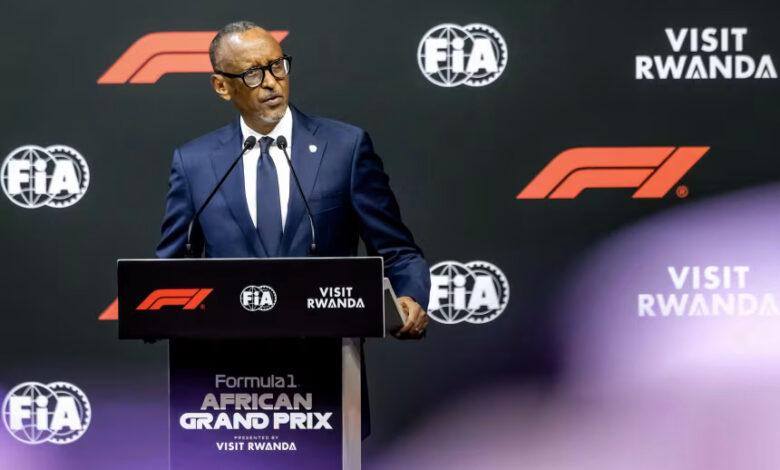
Formula One is to return to Africa for the first time in more than three decades, with Rwanda granted a 10-year contract to host a Grand Prix from the early 2030s – a deal described by F1 chief Stefano Domenicali as a “landmark” moment.
For Rwandan President Paul Kagame, the race offers a chance to attract more visitors and investment to the East African nation and raise its global profile. Kagame has led the country for decades, and his government has long been accused of abuses over its treatment of political opponents, journalists and other critics.
The race will be branded the Formula 1 African Grand Prix, presented by Visit Rwanda, the country’s tourism-promotion brand. But while Domenicali says F1 is “showing the world what it means to be a country that has a vision,” Rwanda’s use of sports to promote itself internationally has drawn criticism from human rights groups. Meanwhile, allegations of its support for M23 rebels in neighboring Democratic Republic of Congo (DRC) have also raised questions about the image it hopes to project.
From soccer sponsorships to Formula One
Rwanda has spent years building its international profile through sports. Its Visit Rwanda campaign has partnered with prominent European soccer clubs, including Arsenal, Paris Saint-Germain, Atlético Madrid and Bayern Munich, though the arrangements have varied. Arsenal’s eight-season partnership ended in June 2026, while PSG’s agreement runs through 2028. Bayern shifted its deal toward youth development in Kigali, the Rwandan capital, after facing criticism over the partnership.
In July, English Premier League side Aston Villa signed a multi-year Visit Rwanda sponsorship agreement reportedly worth around £20 million (roughly $26.8 million) a year. Human rights campaigners, including Amnesty International UK, have spoken out against the deal, arguing that it could improve Rwanda’s international image despite concerns about repression at home and its alleged role in the conflict in eastern DRC.
Critics have described such partnerships as “sportswashing.”
Hosting a Grand Prix, one of the world’s most prominent sporting events, would take that strategy beyond soccer sponsorships. The race would bring teams, corporate partners, international media and spectators to Rwanda, creating opportunities to promote tourism and attract business. The government hopes it will create jobs, develop local skills and deliver lasting economic benefits.
Itamar Dubinsky, a senior lecturer in African studies and politics at Ben-Gurion University of the Negev in Israel who researches sports and politics in Africa, told CNN that hosting a race differs from paying for visibility through soccer club sponsorships. It would bring the sport’s international network directly into the country.

The race is planned for a new circuit in Bugesera, about 40 kilometers (25 miles) south of Kigali, as part of a wider development project led by the Rwanda Development Board. The circuit must be completed before the race can take place, and F1 has not announced an inaugural date. Its public announcement does not specify how the project will be financed or what returns it is expected to generate.
Questions remain about the cost, potential public investment and how the venue will be used outside race weekends.
The image Rwanda wants the world to see
Rwanda wants to be seen as a country that attracts tourists and investors and can host major international events. But that image contrasts with criticism of the government’s human rights record. Human Rights Watch (HRW) has documented restrictions on political opposition, independent media and dissent under Kagame. In a report this month, the organization warned that the Grand Prix could put journalists and vulnerable communities at risk.
Lewis Mudge, HRW’s Central Africa director, said F1 had yet to explain how it would assess the agreement’s human rights implications.
“The F1 talks only about the social and economic impact of this deal but, to date, we’ve seen no language with regard to what effect this could have on the human rights outlook in Rwanda,” he told CNN.
Mudge said Rwanda had barred three HRW staff members from entering the country because of their work. He also cited the organization’s documentation of authorities detaining homeless people and street vendors ahead of major events. Before an international conference in Kigali in 2021, some of the city’s poorest residents were detained in a warehouse described as a transit center until foreign visitors had left, according to HRW.
The organization has urged Formula One to assess human rights risks, consult civil society and establish measurable protections for journalists covering the event. F1 has not publicly confirmed that it will adopt those recommendations.
F1 defended its decision to hold the race in Rwanda, telling CNN it had a “long track record of delivering significant economic, social and cultural value to our host nations.” A spokesperson said the race could inspire the sport’s more than 100 million fans across Africa and that F1 believed sport could be “a positive force for good.”

F1 also referred CNN to comments by Domenicali, its president and CEO, who highlighted the potential for tourism, investment, skills development and business growth. The organization said it had spent years searching for the right partner for its return to Africa and that several parties had expressed interest.
However, F1’s announcement does not explain how potential hosts were assessed or how human rights concerns factored into Rwanda’s selection. CNN asked follow-up questions about its human rights safeguards and due diligence but has not received a response.
Kate Hixon, Africa advocacy director for Amnesty International USA, said Formula One should investigate whether money it receives from Rwanda could be linked to minerals procured from abusive operations in eastern DRC.
Amnesty has reported abuses against miners in areas taken over by M23 and alleged that gold and coltan are smuggled into Rwanda. Hixon urged F1 to publish its due diligence findings.
“Racing fans deserve assurances that money generated from the M23’s abuses is not funding the Grand Prix,” she told CNN.
CNN contacted the Rwanda Development Board and the Rwandan government spokesperson for comment but has not received a response.
The war next door
United Nations experts have documented Rwandan military support for M23 rebels, which have seized territory in eastern DRC. Rwanda disputes allegations about its involvement. The conflict has displaced communities and caused widespread civilian suffering.
A human rights observer in the DRC, known as Healing and Rebuilding our Communities (HROC RDC), described Rwanda’s international image as mixed, with recognition for development and infrastructure alongside allegations of involvement in the conflict. It told CNN that the contrast with civilian suffering in eastern DRC had fueled frustration and called for civilian protection, transparency and accountability.

That frustration was also reflected in criticism from DRC Foreign Minister Thérèse Kayikwamba Wagner, who called F1’s decision to hold a Grand Prix in Rwanda “morally indefensible” and said it “would help polish the image of an authoritarian leader.”
Jacques Issongo, from the Congolese civil society movement LUCHA, said Rwanda’s sporting partnerships were intended to divert attention from the conflict.
“By multiplying major partnerships with global sporting giants such as F1, Arsenal and Paris Saint-Germain, Rwanda is creating a media and diplomatic diversion,” he told CNN.
Beyond the spectacle
Africa’s last Formula One World Championship race was held in South Africa in 1993. South Africa hosted 23 championship races, while Morocco held one in 1958. The 1985 South African Grand Prix took place during apartheid, and French teams Renault and Ligier did not attend amid opposition to the country’s racial policies.
Formula One did not return to South Africa in 1986, as international protest over apartheid hardened. It returned in 1992 and 1993 as the apartheid regime was dismantled, but financial problems then ended the South African Grand Prix again. Since then, the high cost of hosting a Grand Prix, infrastructure requirements, and competition for a place on the calendar have blocked an African return.

Rwanda now hopes to overcome those barriers, but hosting the race is only part of the challenge.
Formula One may bring visibility, tourism and international prestige, but Dubinsky, the African Studies researcher, says the question is what remains after the cameras leave. If Rwanda builds an expensive circuit that sees limited use, he warned, it could become a “white elephant.”
The race’s success, he said, will depend on whether it delivers lasting economic and social benefits and whether those benefits outweigh the negative attention that the deal may bring.
For Mudge, the bigger concern is whether Rwanda’s pursuit of international recognition will overshadow the country’s human rights record and undermine efforts to improve it.
“Rwanda is run by a government that is very protective of its global image no matter the cost,” he said.