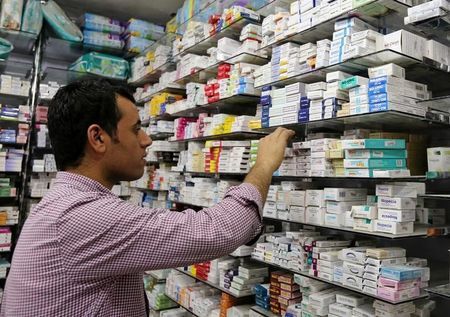
The Assistant Chairman of the Egyptian Drug Authority (EDA), Yassen Ragai, denied circulating reports about repricing and price increases for 40 pharmaceutical items effective next January, emphasizing that there is no prior approval to raise medicine prices during January.
Will 40 pharmaceutical items be repriced?
Social media users circulated statements attributed to the Head of the Pharmaceuticals Division at the General Federation of Egyptian Chambers of Commerce, Ali Ouf, regarding the EDA’s approval to reprice nearly 40 pharmaceutical products and increase their prices starting next January.
In statements to Al-Masry Al-Youm, Ragai stated: “There is no such thing as approving an increase in medicine prices in January from now; this is completely incorrect.”
The Assistant Chairman of the Egyptian Drug Authority explained that pharmaceutical companies submit requests to the authority to reprice certain items; however, these requests undergo inspection and review to assess the impact on production costs and determine whether a price adjustment is warranted.
Have companies submitted requests to raise medicine prices?
The Head of the Pharmaceuticals Division at the Federation of Chambers of Commerce, Ali Ouf, revealed that the Egyptian Drug Authority rejected approximately 90 percent of the price adjustment requests submitted to it.
He explained that companies had submitted around 400 requests, and the authority agreed to study only 10 percent of them starting in January 2027.
Ouf told Al-Masry Al-Youm that the EDA reviews price movement requests submitted by companies and examines the production costs of the items presented to determine the feasibility of price adjustments.
He noted that the rejection of the vast majority of requests means the authority sees no need to adjust the prices of these items at the present time.
How does the authority handle requests to increase medicine prices?
He added that the authority does not handle price adjustment requests with automatic approval.
Instead, applications are subject to examination and review to verify the extent to which production costs have been affected and whether they warrant a price adjustment.
He pointed out that studying the requests—which represent about 10 percent of the total applications submitted—is tied to cost reviews to identify items that may require price adjustments, confirming that final decisions on these requests remain subject to study and evaluation.
Ouf further noted that there will be no movement in medicine prices through the end of 2026, with cost and request reviews set to begin starting in January to determine whether specific items require price adjustments.
He stressed that any potential price adjustments are linked strictly to the results of the cost review rather than a general decision covering all medicines, adding that items whose costs do not warrant a price adjustment will remain unchanged.
Edited translation from Al-Masry Al-Youm