Abdesslam Laraki made a name for himself as the man behind Africa’s first supercar, the Laraki Fulgura, and followed it with the Sahara hypercar. Now, the Moroccan is working on something even more eye-catching — a lightweight electric sports car based on a famous Grand Prix winner from the 1920s.
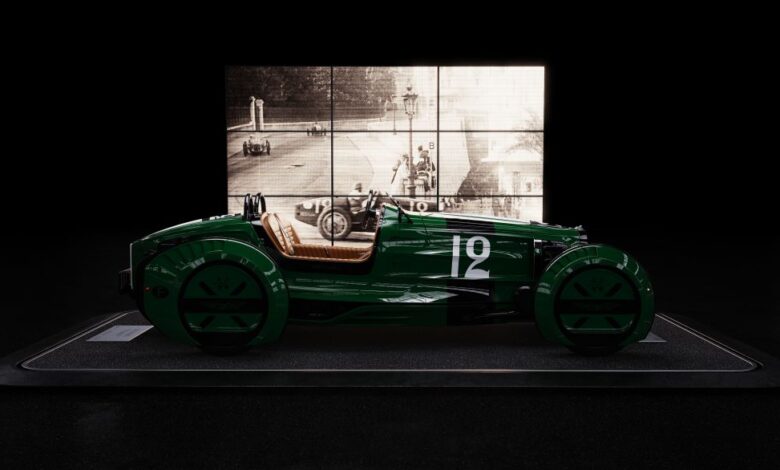
Laraki’s Grace (named after Princess Grace of Monaco) has an origin story as unique as its retro lines. Laraki said he was asked by Prince Albert II of Monaco to produce a one-off car for the 2020 Ocean Gala charity auction in the principality. Inspired by the Bugatti Type 35B, which won the first Monaco Grand Prix in 1929, he produced a back-to-the-future EV homage for the event.
The Grace was an instant hit, said Laraki. Enquiries from potential buyers followed and he raised funding to transform it from eye-popping prototype to a commercial product.

Only 250 cars are scheduled to roll out of the factory in Casablanca, Morocco, starting in early 2026. Yours for $250,000, or more if you require a more bespoke version.

Although the Grace will have a top speed of just 120 kilometers (75 miles) per hour, Laraki is also working on the electric AEON-1, capable of 354 kilometers (220 miles) per hour.
In an age of heavyweight EVs, it is intended to be as lightweight as possible. Think carbon fiber monocoque (where the body and chassis are joined as a single shell), aluminum frame and driver-focused interior. And there’s an additional Laraki flourish; this EV comes with a seven-speed sequential gearbox. “I want to create a modern EV that rewards the owner with a classic driving experience,” he said. The intention is to produce 500 AEON-1’s, at $200,000 each.

A childhood passion
For Laraki, the new EVs are the latest chapter in a career of milestones for African car making.
Growing up in Casablanca in the 1980s, when other 11-year-olds were playing football or video games, Laraki was designing and building his first sports car. Well, first sports go-kart. The young auto aficionado had stumbled across an article on the now iconic Lamborghini Countach and spent the next year working with a family friend to design and build a go-cart interpretation of the Countach out of spare parts from car showrooms.
“When I see a design that inspires me, I’m immediately thinking ‘how can I improve the design, how can I make it better?’” Laraki said on a video call from his office in California.
This youthful zeal for perfection in industrial design led Laraki to study first in Switzerland, at the “Écoles Espace Sbarro,” followed by the Art Center College of Design, and then in France at the “Strate École de Design.”
His initial career saw him win awards for yacht design (for celebrated Italian yacht designer Mangusta), but by 2001 Laraki was determined to return to his childhood passion, as well as his childhood home, to design and build limited-edition sports cars. Laraki Automobiles was born.
Initial designs were intended to spark press interest and commercial orders. Laraki was also keenly aware of the need to challenge possible global stereotypes about a small-batch supercar designed and built in Africa.
“Some people will always be more concerned with the provenance of a supercar. It must be a Ferrari or a Lamborghini, but I wanted to put Morocco on the map for car design,” he said.
Laraki Automobiles made a streamlined debut in 2002, at the Geneva Motor Show, with the Fulgura, Africa’s first supercar (modelled on the chassis and engine of a Lamborghini Diablo). Orders came in from buyers who didn’t care where the car came from, they just loved the look of the vehicle. But that wasn’t enough for Laraki, who wrought an original lightweight aluminum chassis and suspension system for the production version of the Fulgura — and a bespoke Mercedes-AMG V12 620 hp engine for good measure. Twelve Fulguras were built and sold.

A new Laraki model, the Borac, was revealed at the Geneva Motor Show in 2005, but the 2008 financial crisis ended any further development of that prototype.
It wasn’t until 2013, this time at the Pebble Beach Concours d’Elegance, that Laraki Automobiles came back with a bang — a 1,750-horsepower bang at that. The Epitome was Laraki’s, and Africa’s, first hypercar. A liquid blend of muscular retro-future elegance, the Epitome concept car turned heads around the world. By 2019, the Epitome evolved into the Sahara, and legend has it the King of Morocco, Mohammed VI, supposedly bought the only two Sahara’s in existence for a kingly sum of $2 million each.
“I need to set the record straight on that,” said Laraki. “I don’t know where that story came from, but the press got hold of it and now it’s all over the internet. I did receive an Order of Muhammad (Morocco’s highest state decoration) from his majesty, but it’s not the case that the king bought the Saharas.”
Glad we could clear that up. And in case someone reading this wants to witness a Sahara firsthand, one of the only three production models in existence is currently in the Petersen Automotive Museum collection in Los Angeles.
The boy with big dreams has come a long way. “My ultimate goal is to take Laraki to the next level. To make it Africa’s first high-end automobile OEM (Original Equipment Manufacturer).”