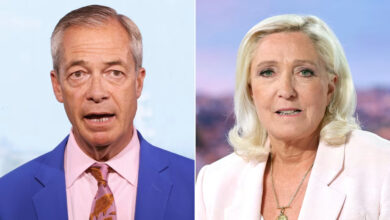
France’s far-right National Rally party, led by presidential candidate Marine Le Pen, has renewed calls to ban the hijab in public spaces—an unprecedented stance globally that has drawn fierce backlash across the French political spectrum, including right-wing and center-right factions alongside the left.
Enforcing such a measure remains highly impractical even if the National Rally secures power.
Beyond its feasibility, critics argue the proposal reflects a fundamental misunderstanding of French secularism (Laïcité), conflating state neutrality in public institutions with an infringement on personal liberty and the basic right to choose one’s attire.
In recent years, French authorities have adopted increasingly hardline stances on practices widely accepted across other European nations.
Pausing football matches for a single minute to allow fasting players to break their Ramadan fast was framed as an infraction against secularism, despite being a standardized, routine accommodation across major European leagues.
In another instance, state pressure forced a fast-food chain to abandon a halal menu advertisement targeted at areas with large Arab-French populations.
Similarly, the government banned the hijab in sports competitions citing threats to state secularism.
The move was accompanied by a controversial public statement from the Interior Minister, who declared: “Long live sports, down with the veil.”
Building on this momentum, the far-right has pushed for a total public ban on the headscarf, underscoring a growing mainstream consensus around these proposals—and explaining why prominent political figures continue to champion them.
The fundamental question is how a global powerhouse like France—whose international stature and prestige draw heavily from the brilliance of its cultural identity, the vitality of its political framework, and a history of integrating diverse ethnicities and producing creative pioneers across every field—could reach this critical crossroad.
Despite hosting vibrant democratic debates across diverse ideological spectrums, the country now finds itself in a paradoxical position.
Leading presidential contenders in opinion polls—notwithstanding the rise of left-wing figures like Jean-Luc Mélenchon—are openly calling for a ban on the Islamic headscarf in public spaces.
Such proposed restrictions stand in sharp contrast to the reality of a nation that welcomes 70 million international tourists annually, all displaying a diverse mosaic of cultural attire and head coverings on French streets.
While acknowledging the unique structure of the French secular model—rooted in the historic 1905 law separating church and state—critics caution that expanding restrictions into the public sphere represents a dangerous escalation.
Unlike its European neighbors, France enforces a strict secularism that bars visible religious symbols from public institutions, including the removal of crucifixes from classrooms and the two-decade-old prohibition of the Islamic headscarf in public schools.
However, extending these prohibitions to public streets marks a severe departure from established precedent.
Expanding restrictions beyond state institutions constitutes a direct violation of explicit constitutional guarantees protecting freedom of belief and fundamental personal liberties.
Author’s biography
Amr al-Shobaki is an Egyptian writer, political analyst and managing-editor of Ahwal Masria magazine.
He holds a Bachelor’s degree in Political Science from Cairo University (1983), a Master’s degree in Political Science from the Institute of Political Studies in France (1993), and a PhD in Political Science from the Sorbonne University in France (2002).