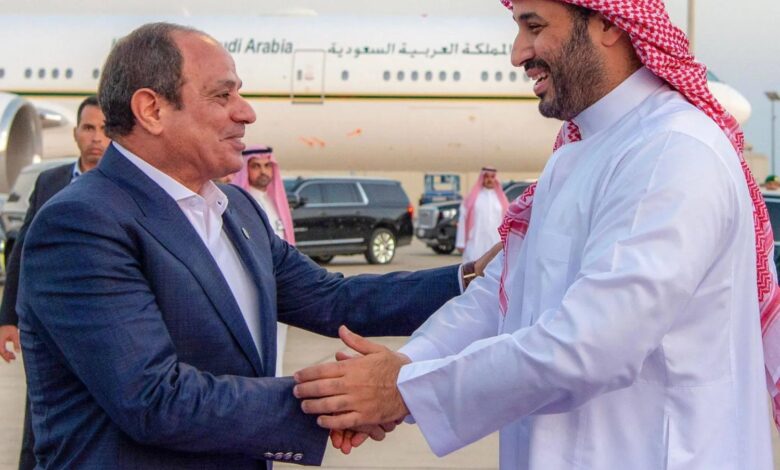
Egypt’s former ambassador to Yemen, Ashraf Aql, emphasized that the visit to Cairo on Tuesday by Saudi Crown Prince and Prime Minister Mohammed bin Salman comes at a highly sensitive regional juncture.
This visit reaffirms the status of Egyptian-Saudi relations as a pillar of Arab stability, he said, noting that their importance extends well beyond the bilateral framework between the two nations.
Aql added that the visit—during which Bin Salman is meeting with the Egyptian President Abdel Fattah al-Sisi—holds particular significance given the escalation of various regional crises.
He referred to developments in the Gaza Strip, Red Sea security and international navigation, the crisis in Sudan, and other rapidly unfolding events across the region.
Aql explained that the visit was preceded by high-level contacts between Cairo and Riyadh, addressing the strengthening of bilateral cooperation, regional developments, and efforts aimed at de-escalation.
Egypt’s emphasis on the fact that Saudi Arabia’s security is integral to Egypt’s national security reflects the level of strategic coordination between the two nations, he added.
Sensitive regional issues
Aql indicated that the Palestinian issue would be at the forefront of the agenda—particularly regarding a ceasefire in Gaza, ensuring the delivery of aid, and initiating reconstruction efforts—alongside the rejection of any attempts to force displacement or alter the demographic composition of the Gaza Strip.
Sudan represents a shared priority, given the ongoing war and its repercussions for regional security, he said, emphasizing the importance of Egyptian-Saudi coordination to support efforts aimed at achieving a ceasefire and preserving the unity of the Sudanese state and its institutions.
Ambassador Aql further noted that the security of the Red Sea and maritime shipping lanes constitutes a strategic issue for both Egypt and Saudi Arabia, in light of the impact of regional instability on global trade and the Suez Canal, as well as Huthi attacks and developments concerning the security of the Bab al-Mandab Strait.
Coordination between Cairo and Riyadh on this matter is becoming increasingly important, he stressed, particularly given the widening scope of regional tensions and the need to safeguard maritime security and the free flow of international trade.
Economy talks
Aql also emphasized that the Crown Prince’s visit holds significant importance for deepening the investment partnership between the two nations.
This comes amidst growing Saudi investments in Egypt and expanding cooperation across sectors such as energy, tourism, transport, logistics, and industry.
He noted that the agreement on the promotion and protection of mutual investments between Egypt and Saudi Arabia serves as a vital framework for boosting reciprocal investment and fostering a more stable environment for investors, alongside opportunities for cooperation in sectors such as renewable energy, tourism, and logistics.
According to Aql, the electrical interconnection project between the two nations represents a key area of strategic cooperation, supporting economic integration and advancing the shared interests of Cairo and Riyadh.
The significance of the visit extends beyond the outcomes of bilateral talks, he stressed.
It enables Cairo and Riyadh to coordinate their stances on Arab and regional issues and sends a clear message that cooperation between the two countries is a pivotal factor in upholding stability, safeguarding Arab interests, and addressing the repercussions of crises unfolding in the region.
Edited translation from Al-Masry Al-Youm