Minister of Petroleum and Mineral Resources Karim Badawi said Egypt is expanding the use of hydraulic fracturing and horizontal drilling as key technologies in the petroleum sector’s five-year plan.
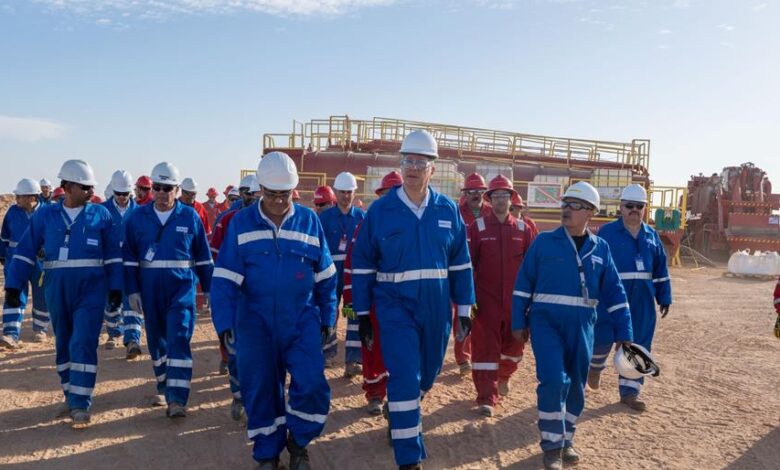
During an inspection of hydraulic fracturing operations at the H-18 well in the Western Desert’s Al Abyad field, operated by the Badr Eldin Petroleum Company (BAPETCO), Badawi said the initiative aims to increase production from existing wells, revive declining wells, and access resources that cannot be economically developed using conventional methods.
Operations at the H-18 well aim to raise its daily gas production from 3 million to approximately 12 million cubic feet using multi-stage hydraulic fracturing.
The minister noted that these technologies have delivered successful results internationally, particularly in the United States and Saudi Arabia, as well as in Egypt’s Western Desert.
He added that the ministry is working with international companies to develop investment incentives and economic models to encourage wider adoption.
A preliminary study by oilfield services company NESR suggests that expanding hydraulic fracturing in the Western Desert could add between 50,000 and 100,000 barrels per day to Egypt’s oil production. However, this potential remains subject to further technical and economic assessments.
Meanwhile, 15 horizontal wells have been drilled in the General Petroleum Company’s Sinai fields, with four more currently underway.
Petrobel has also successfully drilled the SIDRI-48 horizontal well, while plans include drilling two additional horizontal wells in the Nes field.
The Egyptian General Petroleum Corporation is coordinating the initiative, reviewing technical data from 38 production companies to identify suitable wells and reservoirs and prioritize projects based on economic feasibility.
The ministry has also commissioned SLB and Halliburton to assess three opportunities in Abu Rawash reservoirs.
Initial study results are expected gradually during the third quarter of the 2026/2027 fiscal year.