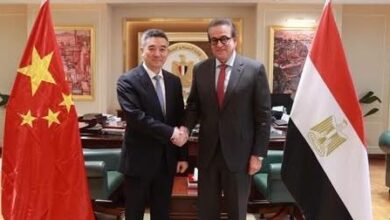
Local Development and Environment Minister Manal Awad discussed on Tuesday, November 10, 2026, with a World Bank delegation, led by Regional Director for Egypt, Yemen and Djibouti Alwaleed Al-Atbani, progress on the Greater Cairo Air Pollution and Climate Change Management Project, implemented in cooperation with the bank.
The meeting, held at the ministry’s headquarters in the New Capital, was attended by Environment Affairs Agency Chief Sherif Abdel Rahim, National Project Coordinator Mohamed Hassan, and World Bank officials and environmental experts.
Awad welcomed the addition of 20 new electric buses to the Bus Rapid Transit (BRT) system under the project’s vehicle emissions reduction component.
Supported by nearly $7 million in World Bank Group funding, the buses mark an important step toward more sustainable and efficient urban transport and wider adoption of clean transport technologies to reduce air pollution and climate-related emissions, particularly in densely populated urban areas.
The minister and the delegation reviewed preparations for operating the integrated waste management facility in 10th of Ramadan City.
Covering 1,228 feddans and costing $16 million, the facility is expected to be one of the largest of its kind in the Middle East and Egypt’s first fully integrated facility.
It is designed to process 15,000 tons of waste daily, equivalent to around 50 percent of the waste generated in Greater Cairo, and serve the region for more than 30 years under a public-private partnership.
They also reviewed implementation progress and the facility’s expected environmental and economic benefits, including a 30 percent reduction in greenhouse gas emissions, a 10 percent decrease in waste-related fires, support for local manufacturing industries and greater private-sector participation, as well as the creation of more than 3,500 direct and indirect jobs.
The meeting also addressed plans to close the Abu Zaabal dumpsite and eliminate its accumulated waste.
A simulation of the site after closure was presented, highlighting expected reductions in fires in Qalyubia Governorate and greenhouse gas emissions in Greater Cairo, as well as improvements in environmental conditions, quality of life and the economic value of nearby residential areas.
The delegation reviewed an environmental development plan for the industrial zone in Al-Akrasha, Qalyubia, which faces challenges due to the overlap of industrial and residential activities.
Proposed measures include establishing a green belt, separating residential and industrial areas, and addressing untreated domestic and industrial wastewater through a proposed drainage system.
Discussions also covered the development of the Amiriyah bus depot to accommodate 100 electric buses.
It is set to become Egypt’s first electric bus depot and one of the largest in the Middle East.
Its operation and maintenance will be managed through a public-private partnership, creating more than 1,100 jobs and supporting research, development and the adoption of best practices.
Awad also reviewed progress on Component 6 of the project, which aims to reduce unintentional releases of persistent organic pollutants by improving the management of electronic and healthcare waste.
Plans include comprehensive guidelines for healthcare waste management, Egypt’s first unified training materials in this field, and a pilot project to collect and recycle 40 tons of electronic waste.
The component also involves assessing waste management practices, providing technical support to formal recycling facilities and the informal sector, evaluating startup capabilities, and developing an integrated digital management information system (MIS) to improve monitoring and update electronic waste data.
Awad called for accelerating all projects and programs under the initiative, stressing their importance to the government and their direct impact on citizens’ lives in the targeted governorates.
For their part, the World Bank delegation reaffirmed its continued cooperation with the ministry to achieve the project’s objectives, monitor performance indicators and implementation rates, address challenges and complete the project on schedule, supporting Egypt’s goals for sustainable development, green transition and protecting citizens’ health and safety in the targeted governorates.