President Donald Trump’s summit last week with the tyrant rulers of Russia and China implied that powerful men can do exactly as they please.
On Monday, he proved it.
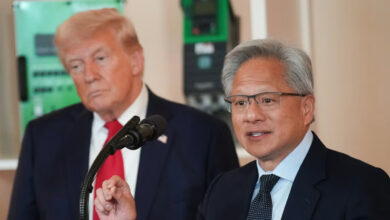
Trump described how he used his influence to restore AI king Jensen Huang to his job running Nvidia, which by most estimates is the world’s most critical company.
The president compared Huang to a baseball all-star, implying that he was just too important to the US economy and defense industry — and therefore Trump’s own political fortunes — to leave out of the game.
“The board decided to do what we wanted to do,” Trump told CNBC.
Huang’s restoration was followed by a stunning spike in share prices that eased the president’s concerns over crashing stock markets, revealed in his social media posts.
The Nvidia boss is himself a data point for the theory that great power delivers impunity, having been absolved by Trump of accusations that a woman with whom he had an affair was a Chinese asset.
Director of National Intelligence Jay Clayton, meanwhile, said on CNN’s “State of the Union” Sunday that China had illicitly obtained advanced Nvidia chips despite US export controls meant to prevent such transfers.
The coziness between the president and a top corporation that is supposedly regulated by the government is one of many perceived transgressions the new Democratic Congress will probe next year.
“We’re living in something like a monarchical corporate state where the corporations have their way with the government, and then the president of the United States decides he’s going to weigh in on the meeting of a corporate board of directors,” Rep. Jamie Raskin, incoming chair of the House Judiciary Committee, told CNN’s Kasie Hunt. “That’s just an amazing turn of events and such a descent for us.”
Trump’s flexing of power Monday was hardly limited to Nvidia
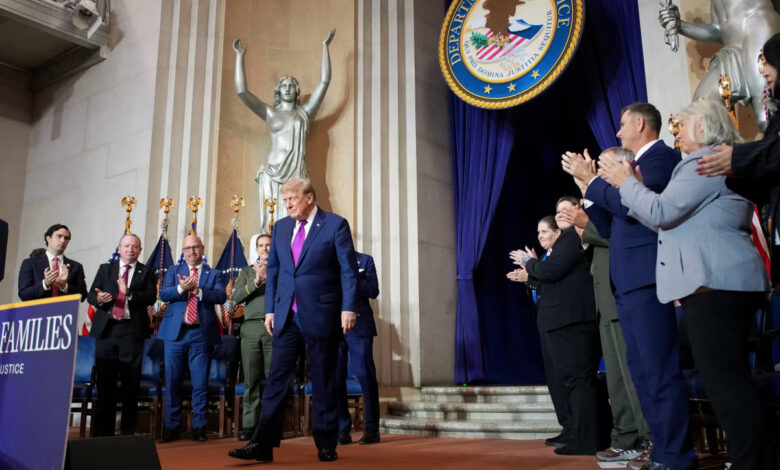
The president made the short trip from the White House to the Justice Department to condemn California’s outgoing Democratic Gov. Gavin Newsom for his commutation of hundreds of death sentences.
Trump’s anger at Newsom is not an abuse of power. There’s a legitimate debate over whether the possible 2028 presidential candidate is serving justice or whether, like Trump, he’s wielding power to boost his own political prospects. Trump also gave voice to relatives of victims of Death Row inmates who’d suffered unspeakable evil. They included Sandy Friend, the mother of 8-year-old Michael Lyons, who was raped, tortured and murdered in 1996. “You’ll never understand the unimaginable pain that you’re putting these families through,” Friend said, publicly rebuking Newsom.

But it was Trump’s choice of venue, rather than his subject matter, that was significant. His visit to the Great Hall of the DOJ seemed a deliberate reminder that he’s demolished the wall between the White House and an agency traditionally seen as dispensing justice above the political fray. And it was a clear suggestion he plans to mobilize the power of the government in efforts to destroy the prospects of Democratic 2028 hopefuls. It would hardly be the first time, that he’s weaponized the DOJ to go after perceived political foes such as former FBI Director James Comey.
And the president earned impeachment for using the inducement of military aid in 2019 to try to force Ukraine to investigate Joe Biden, and again for using the power of his office to try to overturn his 2020 election defeat.
Newsom argues that capital punishment is incompatible with Californian values and undermines the legal system. The governor said in a statement that he wouldn’t take “lectures on accountability from a President who has used the pardon power to help wealthy friends and business associates avoid accountability while victims are left fighting to recover what was stolen from them.” He added: “Justice should be about the people we serve, not the political interests of the people in power.”
Trump also flexed power Monday in a noticeably political manner in a dispute over a US Army plan to blow up nearly five tons of hazardous material in Iowa, which triggered a public outcry over fears of lead contamination. He temporarily halted the detonation — but warned that if the chemicals spontaneously combusted in the meantime, it would be the fault of incoming Democratic Gov. Rob Sand.
In another display of personal power almost designed to outrage his foes, Trump is expected to award Rudy Giuliani America’s highest civilian honor, the Presidential Medal of Freedom, on Tuesday. The former New York mayor, who announced the award on Steve Bannon’s podcast Monday, led Trump’s legal team in the bid to overturn the will of voters six years ago.
‘Sex sells, fellas’
Each of Trump’s power plays Monday would have been regarded as aberrant behavior from other modern presidents. And the Nvidia intervention might turn out to be legacy-defining.
But each reflects his vision that there’s nothing, as president, he cannot do.
Most remarkably, Trump doesn’t even try to hide his motivations. He said in a freewheeling interview with CNBC that he phoned the Nvidia board and told them that he felt very strongly about reinstating Huang — “one of our great stars.”


And he dismissed the idea that Huang’s affairs — one with alleged Chinese intelligence contact Alice Huang (no relation) and another with a subordinate — were a big deal, though at the very least they would seem to infringe the principles of good corporate conduct. “Sex sells, fellas,” he told CNBC’s anchors, explaining the reason the story took off.
The president’s cavalier attitude to the possibility that Jensen Huang might have been compromised by a foreign intelligence service was also stunning. Nvidia is, after all, critical to equipping US armed forces for a superpower standoff with Beijing. “Who isn’t in contact? I just left China,” Trump said. “I think probably China speaks to everybody. … That doesn’t make them bad.”
Democrats are questioning a DOJ determination that Huang poses no security risk. “There’s no way they could have conducted a thorough investigation already to draw the conclusion that both the attorney general and the president have made,” Virginia Democratic Rep. James Walkinshaw told CNN’s Erica Hill. Other Democrats on Monday demanded investigations into whether Trump’s decisions on Nvidia were partly motivated by his personal financial interests.
Trump has wielded aggressive power swiftly to outrun the courts and Congress repeatedly over his two terms.
But his method is especially significant now because it seems to repudiate voters, who delivered a historic midterm election win to Democrats partly because they wanted some restraints on the president.
And so many of Trump’s previous gut calls and big gambles have backfired. His use of government power for personal political gain twice got him impeached. The war in Iran looked like a spectacular short-term success when it killed Iran’s supreme leader, but inflicted high fuel prices and elevated inflation on hundreds of millions of people worldwide. And the US economy might not be quite so dependent on the AI boom were it not for Trump’s trade wars, which also hurt consumers.
Now, Trump is seeking to effectively dictate the future of AI — an industry he has refused to regulate despite fears it could threaten humanity.
What could go wrong?
This headline has been updated.