The governor of Turkey’s Hatay province, Mustafa Masatli, announced that his country has succeeded in rebuilding thousands of modern buildings after the province and its cities – including Antakya – were hit by an “earthquake of the century” on February 6, 2023.
According to the governor, Hatay was one of the areas most affected by the powerful earthquake, which was strongly felt by residents of seven districts in the province.
The earthquake impacted a total of 1.7 million people.
In special statements during a press conference to explain the extent of his country’s reconstruction efforts, the governor noted that while the disaster that struck Antakya was natural, the disaster that plagued that the Gaza Strip is man-made – with far worse repercussions.
The conference was attended by Al-Masry Al-Youm under the auspices of the International Media Coordination Office of the Turkish Presidential Communications Directorate, and in the presence of journalists and media professionals from 32 countries, including the United States of America, Canada, South Korea, Azerbaijan, Greece and Hungary.
In response to whether his country’s experiences is being shared in rebuilding Gaza, he said that Hatay is ready to lend a helping hand if requested by Turkish President Recep Tayyip Erdogan, who will not hesitate to support Gaza.
The governor also thanked the countries that provided aid to his country in the aftermath of the earthquake; foremost among them being Egypt, Saudi Arabia, Azerbaijan and China.
He also pointed out that hospitals were established during the past three years, adding that while the earthquake destroyed 210 schools, up to 225 new ones were opened and a large scientific center will be opened with an interest in education and research.
Nine new hospitals were built and work is underway to build 44 new hospitals during the coming period.
The airport was also rebuilt, in addition to the construction of mosques, and the opening of new roads to shorten the distance between Hatay, Gaziantep and Antakya.
He confirmed that all displaced people would be housed during the summer, with 110,000 temporary shelters available.
Up to tens of thousands of buildings suffered severe damage as a result of the disaster, he said. A land subsidence of 80 centimeters occurred along the coast, and Atatürk Street was flooded.
Hatay accounted for approximately half of the total number of deaths and injuries during the devastating earthquake.
Supporting those who have lost
During a video presentation about the scale of the natural disaster, the governor of Hatay stated that 60 percent of those who underwent amputations were residents of the province, and a special program was developed to support them, including children who lost their parents.
This program, which includes 8,850 children who lost their parents in the earthquake, has become the largest social project in Turkey.
He added that the reconstruction and restoration work carried out after the earthquake also had a positive impact, reducing unemployment rate by 50 percent.
The governor confirmed that the project for those left orphaned by the earthquake provides them with social, psychological, and financial support, and that these children have the right to request healthcare and education at any time, in addition to financial assistance and counseling services.
Personal devastation
With a somber tone, survivor Mohamed Ward recalls the scenes of the devastating earthquake.
Speaking to Al-Masry Al-Youm, Ward said that at first it felt like a slight tremor – he noted feeling dizzy even though he was asleep. But the force quickly intensified, forcing him to hide under his bed to save himself as the roof of his house collapsed on them.
Ward sustained a direct head injury while his wife, just one year after their marriage, passed away.
He noted that 11 members of his family were killed. His surviving relatives managed to pull him from under the building after about 12 hours.
The event felt like a “massive explosion,” he said, as if Judgment Day had occurred in his neighborhood.
Ward hailed the tireless efforts of his government in the three years since the disaster to restore to city to a state that was even better than before, with new modern buildings that can better adapt to earthquakes – thanks to concrete installations and iron panels that are easy to disassemble and assemble.
This showcases how the government and the governorate drew up a quick plan in order to construct homes and long-term commercial shops.
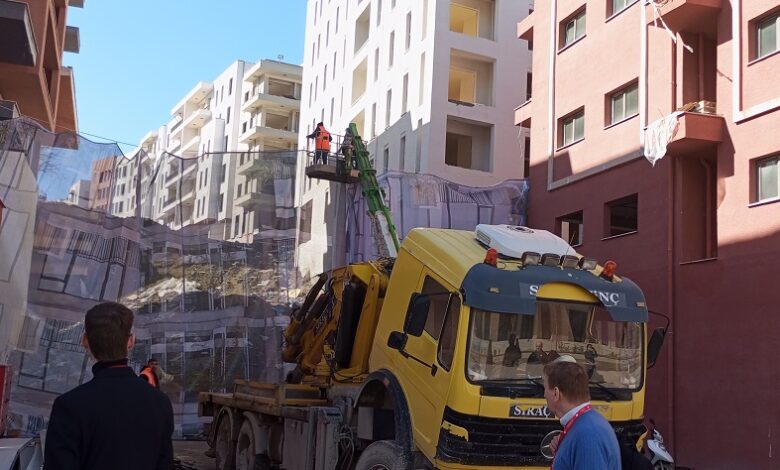
Al-Masry Al-Youm witnessed firsthand the efforts done to rebuild thousands of homes.
The city was redrawn as it was in the past, preserving its architectural form, while the streets were developed, the number of parks and children’s recreation areas was increased, and hospitals and old parliament were rebuilt.