Everyone is asking the same question: What’s going on!?
America was already rattled by an economic insecurity crisis, a foreign war that won’t end and AI’s shattering of a collective sense of control.
Now comes a cascade of tech failures striking at pillars of everyday life, including online communications, air travel and banks. Even classified computers used by National Security Agency eavesdroppers have crashed.
Seems like too much of a coincidence, right?
You don’t have to be a conspiracy theorist stewing in social media algorithms or a doomsday prepper hoarding dried food to be alarmed.
The Trump administration is hardly helping as it rushes to deflect blame and promises the apocalypse isn’t nigh.
Early Wednesday morning in Asia, where President Donald Trump is traveling, top officials scrambled to reassure Americans they were safe after misjudging the public’s mood again, two weeks after the GOP midterm election wipeout.
Secretary of State Marco Rubio admitted: “People are fearful, people are uncertain.”
Emily Harding, director of the Intelligence, National Security and Technology Program at the Center for Strategic and International Studies, told CNN’s Jake Tapper on Tuesday that there “is absolutely a tendency to see a pattern where one may not exist.”
She added: “But at the same time, I don’t really believe in coincidences. And this is a lot of things piled up at the same time.”
Lawmakers have picked up unease among their constituents.
“It’s unclear if it’s all infrastructure-related, or whether there’s some malignant activity,” Democratic House Minority leader Hakeem Jeffries said Tuesday.
New York Republican Rep. Mike Lawler said on X that “while some of this may be coincidental, it is clear we must take cybersecurity and the nefarious use of AI seriously — and act without delay.” And Missouri Sen. Josh Hawley said that if it’s “all a coincidence, it’s like the greatest coincidence in the history of the world.”
The good news is that there’s no public evidence that any of the recent incidents were due to cyberattacks by a hostile power or criminal organization.
And our brains may be playing tricks on us, since they naturally seek out patterns to rationalize chaos and detect threats.

Tech glitches reveal dangerous vulnerabilities
Fears over whether this string of meltdowns might be the work of some unknown adversary, while understandable, may be a distraction from more material questions.
The past five days have raised vulnerabilities that speak to a disorienting moment in a transition to a volatile and potentially dangerous new technological era.
- Daily life suddenly looks more fragile as the power of artificial intelligence and super-fast computing rocks a national infrastructure that everyone knew was crumbling but that now seems embroiled in a more urgent mess.
- If recent tech failures were not down to a cyberattack, how long will it be until they are? The chaos has shown adversaries like the leaders of Russia and China, with whom Trump will meet Thursday, the scale of disruption and political discord they could easily wreak in the US.
- Concerns are growing that the Trump administration lacks the expertise or even willingness to reassure Americans at a disturbing time. It also seems unlikely the US government and corporate sectors have sufficient plans for resilience — that is, to combat events like collapsing infrastructure; cyberattacks or biochemical weapons attacks; or a “polycrisis” of simultaneous emergencies.
- And some recent failures were caused not by creaking infrastructure, but by the specific act of fixing it. “While we still need to get to the bottom of these incidents, the evidence so far points toward legitimate efforts to secure our systems, not malicious activity,” Sen. Mark Warner said in a statement on X Monday. This means perilous years ahead, as the Virginia Democrat observed: “It feels like every day brings another reminder that AI is moving faster than our ability to manage its consequences.”
- There are societal implications to all this change. Humans and organizations are being dragged by unaccountable tech pioneers into a future for which they are unready; that they did not ask for, do not understand and cannot control. AI and other new technologies promise great benefits. But lately, their destructive alter ego is dominating. If leaders can’t begin to tame the worst consequences, the midterm election data center backlash will seem like a tiny kerfuffle.

Glib Trump seems in denial
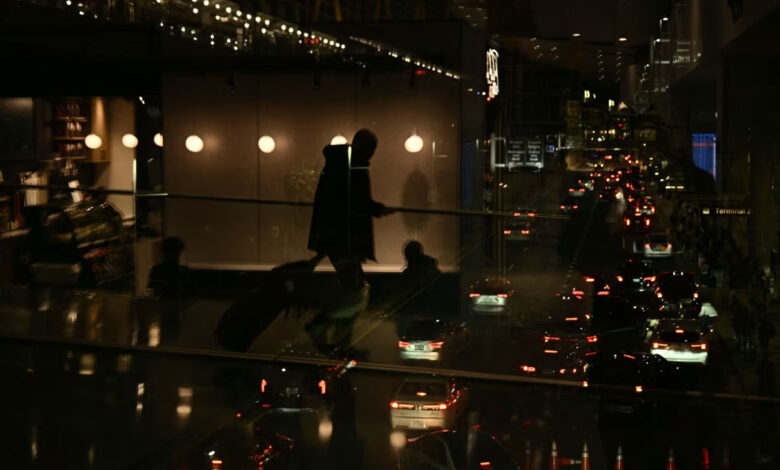
Tech’s grim run — as distinct from the familiar routine of denial of service attacks, botched website refreshes and other glitches — started Thursday when a Microsoft Outlook update crashed, leaving millions around the world without email access. On Friday, more than a million travelers were stuck at airports when the FAA grounded all planes nationwide after an attempt to update copper communications cables sent the entire network haywire. On Monday, Chase Bank fell victim to a software bug. On Tuesday, it was the NSA’s turn.
At such times, a lack of clarity can feed panic.
Homeland Security Secretary Markwayne Mullin tried to restore calm amid Friday’s ground stop. But when he said it was not another 9/11, he left any number of frightening possibilities in a preview of the clumsy messaging to come.
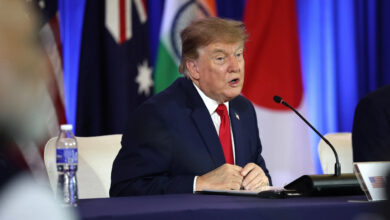
Trump was glib Tuesday when asked about the aviation, bank and email outages. “It’s life, it’s life,” he said. “When you’re big and powerful and you have all the money, things like that happen. It’s fine.”
While struggling to comprehend public anxiety, the administration returns to its favorite flex — blaming former President Joe Biden.
“I don’t take any responsibility,” Trump, who has been president for six of the last 10 years, said Monday. Transportation Secretary Sean Duffy, meanwhile, keeps saying he hates to deflect blame before doing just that. “Listen, this network dates back decades. It’s decades old, right? It’s what I inherited,” Duffy told CNN’s Manu Raju on Tuesday. He has a point. But buck-passing won’t get anything done.
Republicans as well as Democrats are getting antsy. Florida GOP Sen. Rick Scott wrote on X Tuesday that the American people “feel like they’re not getting the whole story. You can’t blame anybody for that. I’m a member of Congress, and I feel that way!”
Former White House press secretary Karoline Leavitt urged Trump to send a clear message to the American people when he returns home. “This has really been spiraling for quite some time,” she said Monday on Fox. “The White House should just address it directly with the American people.”
Yet Vice President JD Vance’s attempt to provide clarity did the opposite. He told Fox viewers Monday that they didn’t need to build bunkers or stock up food and water. “We do not see some crisis coming down,” he said, before muddying his own script: “But you have to be prepared for everything.”
The confusion will be an early test for Trump’s new chief of staff Stephen Miller, because when a political narrative takes hold that a president has lost control, it can be impossible to reverse.
That may be why the administration deployed Rubio, one of its most effective communicators. “We get it,” Rubio said.

Trump alone can’t fix it
But recent days have underscored a truth first revealed in Trump’s first term: The president is often not the man for a crisis.
“I alone can fix it,” Trump famously pledged during his 2016 Republican National Convention address. But the opposite has often been the case.
When the Covid-19 pandemic struck, Trump’s illogical briefings and state of denial during a once-in-a-century public health emergency helped doom his 2020 reelection bid.
It seemed things had changed after a hyper-organized start to his second term and competent operations like the ousting of Venezuelan President Nicolás Maduro. But this year has since brought the Iran war quagmire, an ongoing affordability crisis and a midterm wipeout for the GOP.
Trump has always been more effective as an opposition insurgent going on offense. When he’s in office, the nation’s problems often seem a distraction from what he most cares about. On Monday, for instance, he denied his priorities were off. Then boasted about how he’d cleaned dirt off the White House and fixed the windows.
And his most significant move regarding governance was the bureaucratic purge by Elon Musk and his DOGE team, which some critics blame for driving away experts who might have mitigated recent failures.
Explaining how he’d fix the air traffic control network on Monday, Trump delivered a metaphor for a political method specifically designed to create instability rather than calm. “We essentially want to blow it up and put new in, and we can do it simultaneously with — with very little trouble,” Trump said.
If that’s his plan, the transition to the world of AI — a disruptive technology he refuses to regulate — will be rocky.
This is a moment when anxious citizens need transparency, honesty and consistency from their government.
So far that’s lacking, which is another kind of system failure.