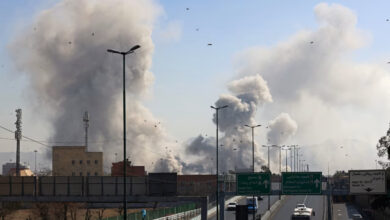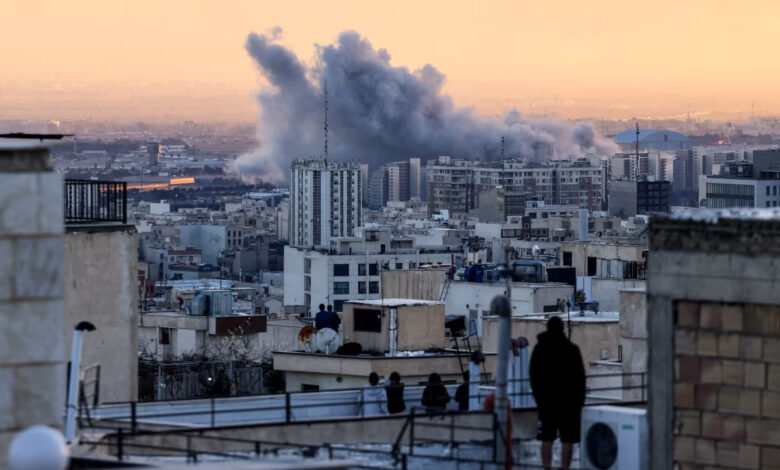
It is obviously “war” when two countries attack a third, kill its leader and try to destroy its military, as the US and Israel have done in Iran.
But in the weird way modern American leaders dance around the US Constitution, names get complicated.
The Trump administration does want to call the Pentagon the Department of War, a nod to the era of world wars, when, he and Pentagon Chief Pete Hegseth say, the US military was more used to winning.
But they do not want to formally ask Congress to declare war on Iran, as the text of the Constitution requires and as Presidents Woodrow Wilson and Franklin Roosevelt did after years of internal debate and direct attacks on Americans.
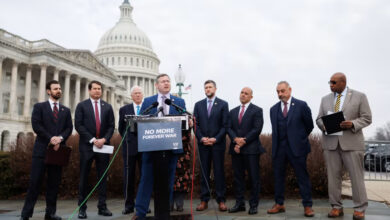
And lawmakers, rather than exert their own authority, are set to beat back efforts in the Senate Wednesday and the House on Thursday to require a debate and vote to authorize Trump’s war.
In the World Wars, the US made a declaration
Roosevelt’s “date which will live in infamy” speech, given less than 24 hours after the Japanese attack on Pearl Harbor, was him formally asking Congress to declare war.
“I ask that the Congress declare that since the unprovoked and dastardly attack by Japan on Sunday, December 7, 1941, a state of war has existed between the United States and the Japanese Empire,” Roosevelt said. Congress complied.
Woodrow Wilson asked for a declaration of war in a speech to Congress in 1917. After years of trying to maintain a sort of neutrality, Wilson said war was unavoidable after interception of the Zimmerman telegram, an intercepted encrypted communication in which Germany proposed an alliance with Mexico against the US.
Now, presidents just act
Trump apprised Congress of his war on Iran with a two-page document required by a 1973 law. It announced “military action” in the interest of “collective self-defense,” although this time it was the US launching a sneak attack.
That term, “collective self-defense,” is important because it appears in Article 51 of the UN Charter as an exception to the need for the UN Security Council to authorize war.


No detailed explanation was given
Trump had an opportunity just last week during his State of the Union address to make a more complete argument for war, but he barely mentioned Iran in the speech. He did, however, take time to acknowledge the 250th anniversary of the nation’s founding, via the 1776 Declaration of Independence, which functioned as a sort of declaration of war on Great Britain.
Wars in all but name
So the Iran conflict, which is clearly a war, will not technically be called a war by the US government. It’s not unlike the fact that the “Department of War” is the “secondary” title of what is still technically called the Department of Defense, the name Congress gave it.
There have been 11 declared wars in US history, and none since World War II, although the US has been involved in bloody wars in Korea, Vietnam, Iraq and Afghanistan, among other places in the years since.
When presidents stopped asking permission
President Harry Truman did not ask permission to engage in the large-scale Korean War, which his administration called an “international police action.” Congress did not balk, and in fact extended the military draft and appropriated money for the undeclared war.
It was after Vietnam, another undeclared war, that Congress tried to reassert itself.
President Lyndon B. Johnson asked Congress to authorize the use of force in Vietnam in 1964 after attacks on US ships in the Gulf of Tonkin. Much later, it was determined those attacks did not occur as the military claimed. Without that knowledge, only two senators opposed the Gulf of Tonkin resolution. The US became mired in Vietnam.

Congress tried to claw back some power after Vietnam
In 1971, Congress repealed, with President Richard Nixon’s signature, the Gulf of Tonkin resolution and demanded the withdrawal of US forces, although the war would continue for years.
In 1973, lawmakers passed the War Powers Resolution “to fulfill the intent of the framers of the Constitution of the United States and ensure that the collective judgment of both the Congress and the President will apply to the introduction of United States Armed Forces into hostilities.”
It requires the president remove US forces within 60 days of reporting a new military action to Congress unless Congress declares war or authorizes the use of force. The president can extend the use of the military once for 30 days under the War Powers Act.
Trump has said the Iran operation could be concluded within five weeks, which is well within that 60-day threshold. But this is by far the most extensive military operation undertaken without a use of force authorization by Congress.
The ‘war on terror’ era did not include a declaration of war
In the years since the 9/11 terror attacks, there has been less and less consultation with Congress over military actions. The authorization for the use of force (AUMF) to combat terrorism after 9/11 is written so broadly that presidents from both parties have used it for military operations around the world.
In one notable instance, Congress declined to authorize President Barack Obama’s request for the use of military force for three years. The administration was already conducting bombing operations against ISIS in Syria.
But as CNN’s Jeremy Herb has reported, Republicans balked at an AUMF, saying that they were opposed to limiting the military options of the commander in chief, for Obama or any future US president.
“There’s no reason for us to give him less authority than what he has today. Which is what he’s asking for,” then-House Speaker John Boehner said at the time.

Trump’s allies don’t think he needs to ask for anything
Now, Republican majorities in the House and Senate seem unlikely to try to assert any control over Trump. And any vote over the use of military force will be partisan, unlike those declarations of war from earlier generations.
Sen. Tommy Tuberville, the Alabama Republican, had no problem calling the conflict a war when he appeared on NewsNation and said he could understand the need to introduce ground troops.
“This is not your Democrat war,” Tuberville said. “This is President Trump’s war and he’s not going in to be politically correct. He’s going in to protect first of all Americans first and then our allies and people around the world.”
Asked later by CNN’s Manu Raju about the lack of congressional authorization, however, Tuberville phrased things very differently.
“I wouldn’t call this a war as much as I’d call it a conflict that should be very short and sweet, if you can put it that way.”
Raju asked multiple Republicans if the conflict was a war.
“We’re not at war right now,” House Speaker Mike Johnson said, describing the actions as defensive. “We’re four days into a very specific clear mission and operation.”


Senate vote to rein in Trump likely to fail
The White House will want lawmakers to oppose a Senate resolution pushed by Sens. Rand Paul, a Kentucky Republican, and Tim Kaine, a Virginia Democrat, that would bar Trump from taking further military action in Iran unless Congress gives its blessing.
Kaine told CNN’s Pamela Brown on Wednesday that the lawmakers in both parties who support Trump’s action should simply vote to authorize the use of force.
“Don’t hide under your desk and just let the president do it on his own,” he said. “Because if you do, you’re opening the door for presidents of either party into the future just to wage war willy-nilly.”
He argued that a similar vote on Venezuela got the administration to change its approach.