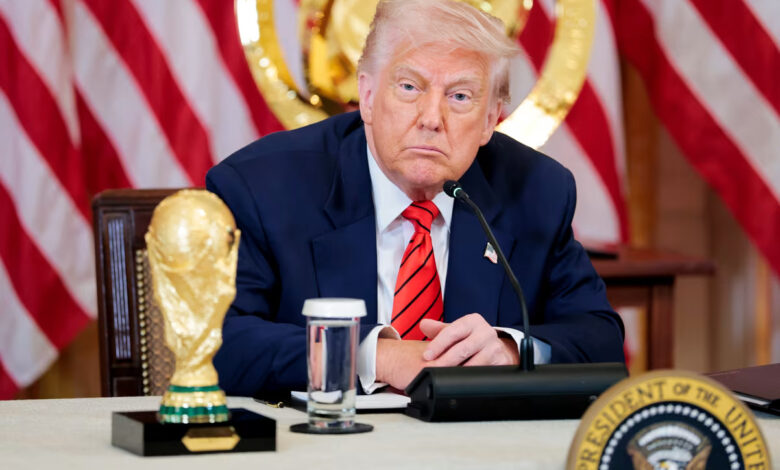
Donald Trump thought he’d miss out on the chance to stride the globe’s biggest sporting stage, lamenting in 2018, when the US won the right to co-host this year’s World Cup finals, that “I won’t be here” owing to presidential term limits.
But the historic political comeback that made him only the second president to win two nonconsecutive terms bought him political extra time and a role in the massive soccer extravaganza.
Trump has always had a flair for inserting himself into the global zeitgeist. So he seized his chance.
He proudly displayed a gleaming replica World Cup that complemented the golden decor of his Oval Office; he welcomed soccer supremo Gianni Infantino into his global MAGA orbit; and after presenting Chelsea with the trophy in a FIFA club tournament in the US last year, he celebrated with the team like he’d scored the winning goal.
But the 2026 World Cup finals that open on Thursday may serve to highlight the discord of his politics more than his enthusiasm for the beautiful game. While Trump may be looking for a new chance to promote his global ubiquity, many overseas critics are likely to be alienated by contributions that epitomize the turbulence and discord of his second term.
The finals come at a moment when Trump’s political star is waning due to growing unpopularity at home and reverses overseas.
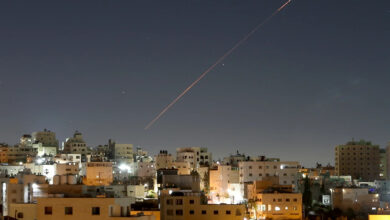
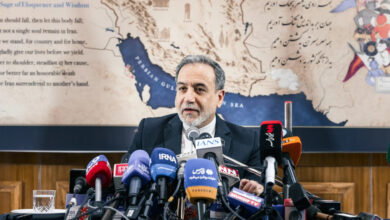
Infantino’s award of an inaugural FIFA Peace Prize to Trump — after his friend was passed over for the Nobel version — now looks awkward after the president launched military strikes against another World Cup qualifying nation, Iran.

Trump’s hardline immigration policies, which left some foreign fans feeling unwelcome in the United States, are overshadowing the countdown to opening games. A respected Somali referee was refused entry at a time when the administration is accusing Somalis in Minnesota of fraud. (The community denies the claims.) The Senegalese team reportedly endured harsh security checks when arriving for their pre-World Cup camp, though the federation said it anticipated the security procedure and deemed it normal. And Iran said Tuesday that its ticket allocation for its three group games in the US had been canceled.
This follows concerns that Immigrations and Customs Enforcement (ICE) officers could conduct sweeps for undocumented migrants at games involving South American teams with large followings in the United States, though the administration has tried to tamp down those fears.
Soaring ticket prices, meanwhile, have priced many fans out of games, leading to accusations that FIFA sees the World Cup finals more as a money grab than a celebration of football’s traditionally working-class fans. Out-of-reach ticket prices are a metaphor for affordability crises stalking western societies and economic inequalities faced by Global South countries. Even Trump balked at tickets costing $1,000 for the first Team USA game. “I would certainly like to be there, but I wouldn’t pay it either, to be honest with you,” he told the New York Post.
More broadly, Trump’s searing second term, which has seen him slap tariffs on competing economies and lambaste the societies of close allies, has created an atmosphere of global tension that sits uneasily with FIFA’s claims to promote unity and joy. For a fleeting moment, there was talk of a European boycott after Trump demanded Denmark hand over Greenland.
This is far from the first global sporting event to be hit by a political storm. The US led a boycott of the Moscow Olympics because of the Soviet invasion of Afghanistan. The last World Cup in Qatar was clouded by accusations of human rights abuses, including the deaths of migrant workers in building stadiums.
Before the competition begins, almost every huge sporting event is beset by bad headlines about politics, commercialization and access. But the hyper-politicization of the 2026 World Cup, co-hosted with Canada and Mexico at a time of Western Hemisphere antagonism, has an added ingredient almost guaranteed to cause polarization: Trump.
Infantino’s flattery of the president may backfire
The US president’s tendency to create extreme positive and negative reactions has focused attention on Infantino’s decision to align himself so closely with the US leader.
The FIFA president has been ubiquitous in Washington and Mar-a-Lago. He even showed up at Trump’s Gaza peace summit in Egypt last year. After the US president’s second-term inaugural rally, he declared on Instagram, “Together, we will make not only America great again, but also the entire world.”
This apparent endorsement seemed to conflict with FIFA’s statutes, which stress it remains “neutral in matters of politics.” Infantino, however, defended his friendship with Trump at a meeting in Northern Ireland last year. “I think it is absolutely crucial for the success of a World Cup to have a close relationship with the president,” Infantino was quoted as saying by Agence France-Presse.

Still, eve-of-tournament controversies raise the question of just how much leverage FIFA has won with Trump.
“Infantino might say, ‘(This is) what do I have to do as president of this organization, to secure political support, so that everything goes smoothly,’” said Alexander Cooley, a senior nonresident fellow at the Chicago Council on Global Affairs. But FIFA may have walked into a political trap. “I think what you’re seeing is that the Trump administration really doesn’t care about global public opinion.”
Infantino would not be the first global figure to find that buttering up a US president who demands shows of respect has little payoff. Many European leaders flattered the president during his first year back in office but couldn’t slake his fury, which drove transatlantic relations to their lowest point in decades.
Cooley, also a professor of political science at Barnard College, argued that Trump’s team may be making a classic immigration play to his base with treatment of World Cup fans, delegations and referees. “If the world is up in arms or disappointed in that, who cares?” Cooley said, paraphrasing a possible administration sentiment.
Football, not politics, is usually the winner
The World Cup finals are widely regarded as the world’s largest sporting event. According to FIFA, 1.5 billion viewers watched the final in Qatar in 2022. Trump often marvels at the scale of the event, saying last year in the Oval Office, “(It’s) like three Super Bowls every day for a month.”
The president, a sports fan of some authority, loves huge audiences and the white heat of publicity. It’s hardly surprising that he’s drawn to such a gargantuan spectacle.
Trump can be expected to weigh in throughout the tournament on social media or any on- or off-field controversies, in keeping with his habit of using sports to drive social, cultural and political messages. During his first term, for example, he often slammed former NFL quarterback Colin Kaepernick and other players who took a knee to protest police brutality.
But mixing sports and politics can backfire. He was brutally booed after showing up at an NBA Finals Game in New York on Monday night. And his craving to co-opt others’ success can overshadow the moment. The US hockey triumph over Canada in the final of the Winter Olympics this year turned a moment of national unity into one of political division after Trump and his FBI Director Kash Patel inserted themselves into the team’s victory celebrations.

World leaders often try to exploit World Cups. Some — like British Prime Minister Harold Wilson after England’s 1966 World Cup triumph — wrapped themselves in the flag. Argentina’s junta used the country’s win as hosts in 1978 as propaganda. Russian President Vladimir Putin’s hosting of the 2018 World Cup sought to restore international prestige after he was ostracized for annexing Crimea. Critics have dismissed Qatar’s World Cup and the forthcoming 2034 tournament in Saudi Arabia as reputational “sports washing” by anti-democratic regimes.
This had led critics to argue that Infantino sees himself as a geopolitical figure as much as a footballing one. His closeness to leaders like Trump and Saudi Crown Prince Mohammed bin Salman reflects an era when multibillionaire owners and Middle Eastern wealth funds own many top clubs as strongmen and oligarchs dominate political and corporate life.
Still, great sporting events usually defy attempts by politicians keen to hijack them. World Cups are defined by moments of footballing panache, like the bamboozling turn by Dutch legend Johan Cruyff at the 1974 finals or Paolo Rossi’s goal-scoring rout that led Italy to the title in 1982.
Controversies that are remembered are usually on the pitch — like Argentine Diego Maradona’s infamous “hand of God” handball goal in the 1986 quarter-final against England, or Zinedine Zidane’s stunning head butt that helped consign France to defeat to Italy in the 2006 final.

Some time over the next month, a second of brilliance or a rush of blood will underscore why World Cups, even in their corporatized and politicized modern renderings, make the world stand still.
The quintessentially political Infantino understands this better than anyone. At the World Economic Forum in Davos this year, he noted that in Qatar, the political furor faded once the football kicked off.
“When the ball started rolling, and the magic started, we had virtually no incidents,” he said.