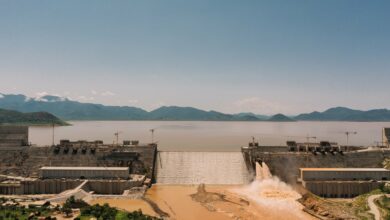
Ethiopia, Uganda, Rwanda and Tanzania signed a new framework agreement on Nile water yesterday, a step strongly opposed by both Egypt and Sudan.
Soon after, Egypt announced that it does not recognize any agreement outside the framework of the Nile Basin Initiative, and confirmed that it will do everything necessary to secure its water rights.
The new agreement is not legitimate since it does not include all of the Nile Basin countries, said Mohamed Nasr Eddin Allam, minister of Water Resources and Irrigation.
The signing of this agreement does not mean that these countries can ignore their commitments to previously signed documents on Nile water, since they were considered border agreements, said a spokesperson for the Foreign Affairs Ministry. The new agreement is not binding, he added.
Meanwhile, the Kenyan water resources minister decided not to go to the Ugandan capital of Entebbe for the signing. His assistant declined to comment on whether the minister’s absence was the result of Egyptian pressure.
The agreement evoked varied responses from politicians and experts. Diaa Eddin el-Qousi, a water expert, said that in international law, water agreements are treated as border agreements, meaning they cannot be abolished or amended.
Abdel Qader Ismail, an expert in African affairs stressed that the Nile countries must negotiate and military intervention should not be an option. The Nile source countries cannot continue to build dams because the rainfall in these countries needs to be continuously drained, he added.
Both China and Italy who have financed water projects in Ethiopia have common economic interests with Egypt and are unlikely to get involved in projects that harm Egypt’s interests, Ismail added.
Meanwhile, Waheed Abdel Meguid, vice president of the Ahram Center for Strategic Studies, said the current crisis reflects the shrinking role of Egypt in the Arab world and Africa. Egypt has become too absorbed in Middle Eastern and North African affairs, he added.
Translated from the Arabic Edition.