In recent years, the United Arab Emirates (UAE) has racked up impressive off-planet achievements, from sending an astronaut to space to reaching Mars orbit with its Hope Probe.
Now, with countries around the world focusing on building sovereign satellite networks, amid geopolitical tensions, a UAE company is working to mass manufacture commercial satellites.
Abu Dhabi-based Orbitworks is developing AI-enabled satellites that will form a 10-satellite Earth observation constellation called Altair, useful for everything from military intelligence gathering to environmental monitoring. A joint venture between Abu Dhabi’s Marlan Space and San Francisco-based Loft Orbital, Orbitworks plans to launch the first satellite in October.
Today, US-based SpaceX accounts for about 69 percent of all active satellites, according to the tracking website Orbital Radar. But Canada has plans to launch hundreds of new satellites to safeguard its national sovereignty, reducing reliance on Washington, and the European Union is developing its own network of 290 satellites.
Orbitworks describes itself as helping to “build sovereign space capability in the UAE.”
“There has been a lot more focus on nations to have their own assets in space,” Dr. Hamdullah Mohib, the CEO of Orbitworks and Marlan Space, told CNN’s Paula Hancocks.
However, “not everybody can afford to have their own assets,” Mohib said, and Altair will be offered under a “constellation-as-a-service” model, allowing businesses, governments and researchers to lease its capabilities.

Traditional satellites send large amounts of raw data to Earth for processing, which can take hours — or longer. Orbitworks’ satellites will use AI to process data in space, sending insights to users “almost instantaneously,” said Mohib.
It’ll be necessary to compete globally as other satellite companies integrate AI-functionality. “Everybody that’s anybody that does satellites is looking to put AI on board,” said Quentin A. Parker, an emeritus professor in astrophysics and space science at the University of Hong Kong.
Mohib said he hopes the involvement of the American company Loft Orbital will help attract more Western customers. “There was a lot of temptation to partner with a Chinese firm,” he said, citing competitive pricing and a willingness to share intellectual property.
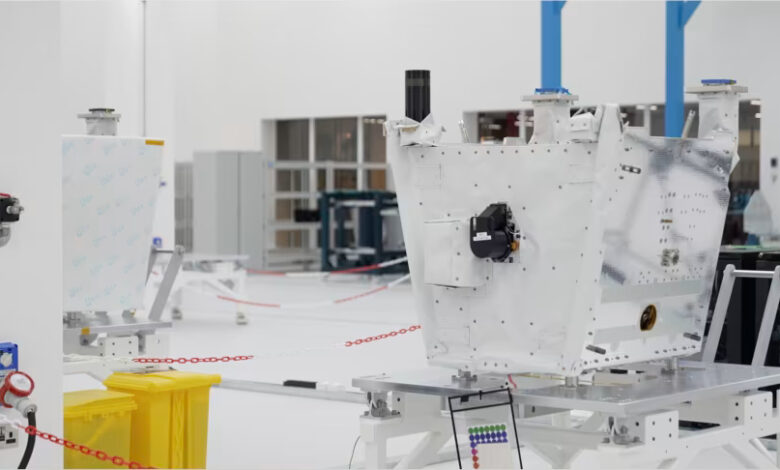
Mohib added that conversations are underway with customers who might want to tap into Orbitworks’ manufacturing capabilities. Its 50,000-square-foot factory has the capacity to make 50 satellites, weighing up to 500 kilograms (1,100 pounds), a year.
Growing space economy
The value of the global space market — where the space industry operates directly — was $224 billion in 2024, according to a 2025 report from Boston Consulting Group (BCG), mostly from satellite communication and Earth observation. The Middle East and Africa (MEA) space market was estimated to be $18 billion, with the UAE contributing around 40 to 45 percent.
The country plans to double space economy revenues and to be among the world’s top 10 space economies by 2031, as it works to diversify its economy for the post-oil future.
Globally, private sector space companies have slashed costs and sped up innovation. SpaceX, for example, drastically reduced launch costs with its pioneering reusable rocket technology.
In recent decades, the UAE has established space-focused institutions, laid out regulations to govern commercial space activities and made hefty investments. The 3 billion UAE dirham ($820 million) National Space Fund was established to support international and Emirati company cooperation to build national know-how.

That investment has helped drive the growth of a private sector in the UAE that includes a new crop of companies like Orbitworks — which describes itself as “the Middle East’s first private space infrastructure company.”
The UAE still has major mission plans, like a 5-billion-kilometer (3.1-billion-mile) journey to the asteroid belt between Mars and Jupiter, slated to launch in 2028. But in the last year or two, the country has increasingly focused on creating sovereign space security infrastructure, and technology to capture economic opportunities, Faisal Hamady, a Dubai-based managing director and partner at Boston Consulting Group (BCG), told CNN via email.
“For much of its early history, the UAE bought satellites and expertise abroad, but the national strategy now explicitly aims to build a market-driven ecosystem rather than a purely government-led one,” said Hamady.
“Falling launch costs and the rise of AI applications are also unlocking new commercial use cases, from monitoring oil and gas infrastructure to disaster response and climate tracking.”
The Abu Dhabi Maritime Academy will use intelligence from Ortbitworks’ satellites to manage ports, including for real-time vessel traffic information. The Abu Dhabi Fund for Development, which provides aid in developing countries, will use Altair to monitor its projects remotely. The French Space Agency has also signed on, according to Orbitworks.
“That’s a big endorsement for us,” said Mohib, who added that marks a shift for the UAE from a buyer of space services from France to a provider.
Orbitworks is exploring possible funding for a billion-dollar expansion plan that would help it get another 40 satellites into orbit.