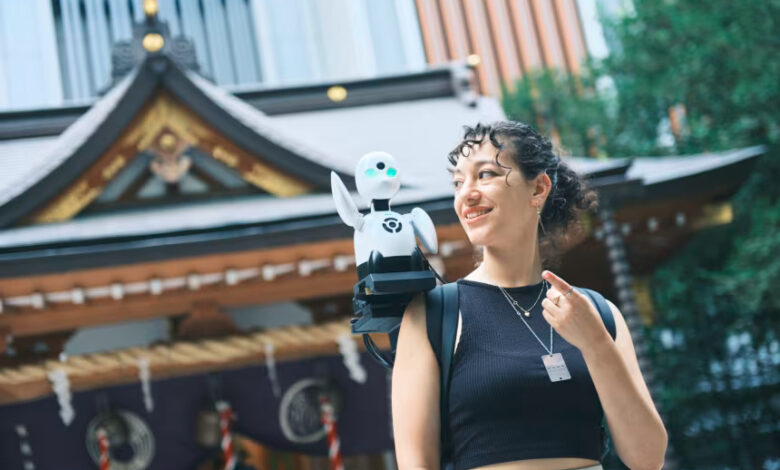
Guiding groups around Tokyo’s historic Nihonbashi district, teaching foreign tourists how to pray properly at the Fukutoku Shrine and showing locals the rich craftsmanship of the neighborhood might have once seemed impossible for 39-year-old Aya Kaji. Now she can do it without leaving her home.
“As a wheelchair user, traveling around in Japan is a hurdle,” Kaji told CNN. In 2011, she was diagnosed with multiple sclerosis (MS). Kaji has lived with the chronic, neurodegenerative autoimmune disease for years, but her motor issues worsened severely in 2022, when she completely lost the ability to walk.
Then, her world began to shrink. Her job as an energy-sector researcher became unsustainable, ultimately leading her to quit. Without a salary, she came to rely on savings, and disability support from the Japanese government, which wasn’t enough for her to sustain herself and pay for medical expenses.
In 2024, she heard about OryLab, a Japanese robotics company that builds technology that allows people with limited mobility to take part in the world beyond their homes. For Kaji, it offered a way to earn a living, be part of society and entertain her curiosity.
“I love talking to new people; I really enjoy being social,” she said. “When I discovered the company and its cute robots, I knew it was the perfect job for me.”

From a hospital bed to a robotics company
OryLab is the brainchild of Japanese roboticist Kentaro “Ory” Yoshifuji, who was homebound for more than three years as a child. “I had a weak body growing up,” he told CNN.
Severe social anxiety produced physical symptoms that kept him in hospital for months at a time, where he felt deeply lonely and daydreamed about having “a second body to use while mine was in ‘maintenance.’” Later, in his university years, he decided that attending class through Skype wouldn’t be enough: his classmates and professors wouldn’t interact with him through a screen.

So, in 2010, Yoshifuji built a small robot version of himself — a “bunshin” or clone, as he calls it — that let him take part in society. “My friends would carry me around, put me in the first row,” he said. “I could nod and listen along in class, raise my hand, leave the class with them and hang out together. My professors were first hostile about it, but they eventually gave me my attendance points,” he explained, because they recognized him as a real participant in the class.
The concept of being “recognized in the physical world” through a bunshin is the core philosophy behind OryLab, founded in 2012 by Yoshifuji, Aki Yuki, and Yoshifumi Shiiba. The company’s first robot, OriHime, was an advanced version of the robot Yoshifuji built for himself in university.
It’s a cute 9-inch, 1.4-pound upper-body robot equipped with an HD camera, speaker, microphone, movable arms and a head, allowing users to project their presence wherever the robot is carried. Then, the company developed the OriHime-D, a 47-inch-tall robot with wheels to allow people to remotely perform tasks that involve physical labor, like customer service, guiding visitors and waiting tables.
Both robots can be piloted through a simple interface, accessible from tablets, computers and smartphones. But those devices require a hand that can tap and swipe. To aid those who can’t use them, the company developed OriHime eye, a communication device for people with limited movement, who rely on their eyes and fingertips. It lets them communicate, draw, and pilot other OriHime robots.


At first, the robots were sold to families and schools, allowing home- or hospital-bound children to attend classes and have a social life. The company says it has sold a couple hundred units, with the smaller ones priced at around $4,500 and the larger ones at around €20,000 (about $26,770) before tax. But Yoshifuji decided that the best way to demonstrate what the robots could do was to build environments where they could be used.
Human connection, through robots
The first step was OryLab opening Avatar Robot Café DAWN ver.β. as a permanent experiment or demonstration space. Serving sandwiches, curries, coffees, and teas, it began as a pop-up in 2018 and opened a 70-seat restaurant in 2021 in Chuo after raising more than $400,000 through a crowdfunding campaign.
Today, it employs around 80 people as OriHime pilots who operate the robots remotely, with pay starting at Tokyo’s minimum wage and rising with the workers’ skills and duties. “We don’t like to brag, but it became the best-rated café in the neighborhood on Tripadvisor,” Yoshifuji said.


Kaji joined in 2024 after five months of training for roles ranging from waiter to hostess. The café is now self-running and profitable, and they’re planning to open a second one. Today, the space also doubles as a research and testing space, Yoshifuji said.
The company’s latest venture is tourism, using OriHime robots that attach to a backpack-style stand that weighs under 9 pounds. Tourists carry the OriHime on a small platform that rests on the shoulder. From that vantage point, the pilots can look around while giving commentary about the places they go to. When the company expanded into tours, Kaji was one of the first to sign up. She is now one of 10 pilots qualified to guide.
“I love taking this walk with people, even virtually, and interacting with everyone in real life, both in Japanese and English,” she said, adding that some foreign tourists mentioned it was the longest time they interacted with a local Japanese person on their trip. “But it’s also a way for me to prove to others that I can work and grow within a company and still gain new skills.”

In an era of AI and convenience, Yoshifuji said he wants to put human connection and hospitality at the center of technology — and he hopes society will follow his lead. The Japanese government estimates that about 9.2% of Japan’s population had a disability as of 2023. The figure is expected to rise by the end of the decade.
But Yoshifuji’s robots mean people like Kaji are becoming financially empowered.
“In total, I work around 20 hours per week,” she said. “I’m not economically independent yet; I still need my disability support. But this allows me to earn extra money, buy gifts for my friends and family, and selfishly, go enjoy a sumo show. I love watching sumo fights.”