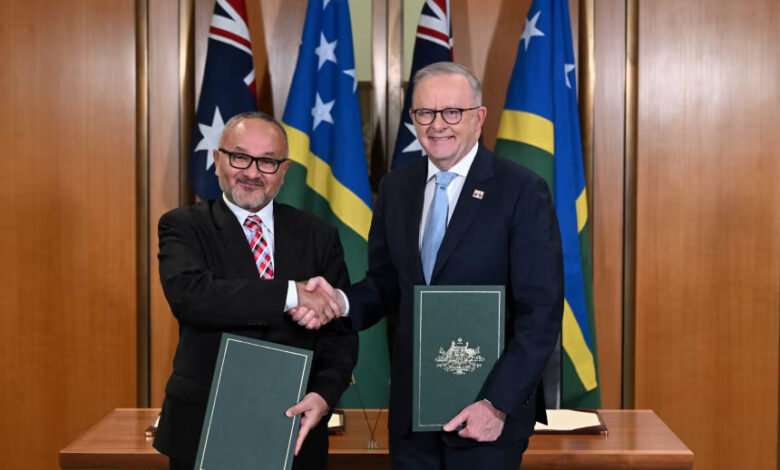
Under the deal, Australia will support the expansion and development of Solomon Islands’ police and border force, while Honiara will deny any request from a foreign power to establish military or security bases on its territory, the leaders of the countries said in a joint statement.
“Australia is proud to be the Solomon Islands’ main security partner, and that’s a responsibility that we take seriously,” Australian Prime Minister Anthony Albanese told a press conference in Canberra with his Solomon Islands counterpart Matthew Wale.
The pact is a victory for Canberra, which is battling China for influence in the region and recently signed similar agreements with Papua New Guinea, Vanuatu and Fiji.
The wide-ranging treaty includes Australian funding for investment in infrastructure and education, improved visa arrangements for Solomon Islanders, and requires Honiara to consult Australia on the development of critical infrastructure.
It signals a significant shift by Wale, a long-time China critic who had appeared to soften his stance in recent years.
“Solomon Islands has been for a number of years a source of uncertainty and doubt in the region. Those days are done,” Wale said at the press conference.
Wale was highly critical of the 2022 security deal with China, echoing the United States and other Pacific nations, saying it would upset regional security and could jeopardise relationships with existing partners.
But in 2025 he led a delegation to Beijing, where he praised China’s economic development and said his party supported the one-China principle.
Australian media reported on Wednesday that Solomon Islands’ pact with China had been scrapped, though Wale declined to comment on the status of the deal, citing a non-disclosure agreement.
A spokesperson for China’s foreign ministry did not immediately respond to a request for comment.
“I think this deal, coupled with indications that Solomon Islands will let the China deal lapse, goes beyond the success of the previous deals” which Australia has struck in the region, said Connor Graham, a research fellow in the Pacific Islands program at Sydney-based think tank the Lowy Institute.
“It is a blow to Chinese security ambitions in the Pacific certainly.”